AI-generated content is everywhere and a lot of it is forgettable. You and I scroll past it. We all know it when we see it.
I collaborate with AI every day. We think through ideas together, challenge each other’s assumptions, and the work is better because of it. I draw the line when we outsource the thinking, when we take the first response without questioning it, when we skip the part where we consider who we’re writing for, what they actually need, and whether we’re saying something worth saying.
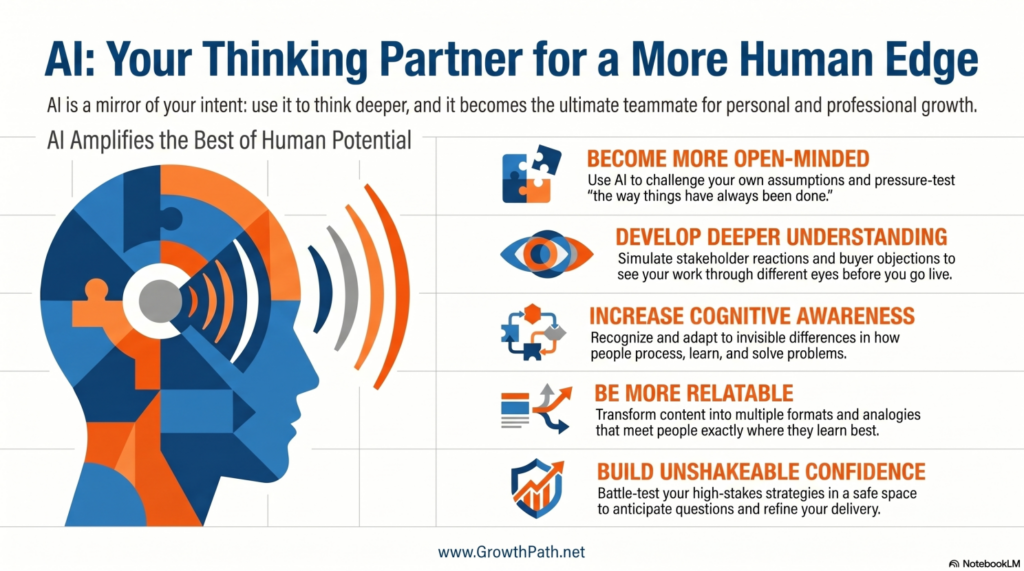
After 3+ years of this, I didn’t expect that AI has made me more open-minded, more understanding of people, more aware of how differently people think, more relatable in how I communicate, and more confident in the work I do.
I honestly believe I’m a better human today than I was three years ago, and AI is part of why. That’s my experience. I also know it can easily go the other direction. AI is a mirror of our intent. Use it to think deeper and it will. Use it to cut corners and it will do that just as well. A hammer builds a house or breaks a window.
Quick Take
I’ve spent the last few years writing about digital twins, critical thinking, people simulators, thinking systems, and NotebookLM workflows. Looking back, they all point to the same thing: AI, used as a thinking partner, develops five human qualities we’ve always had but rarely have time to fully use.
Key takeaways:
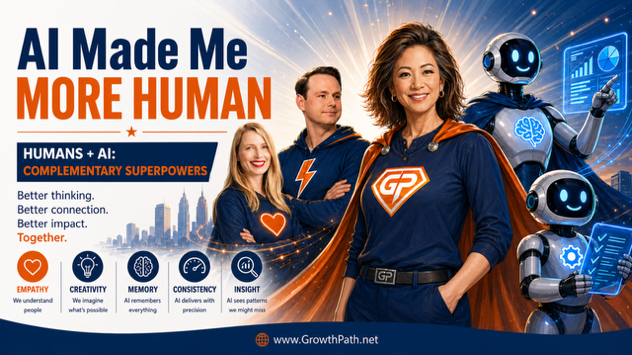
- Humans and AI are like the Avengers. Each has superpowers the other doesn’t. Together we overcome each other’s limitations. This reframe changes how teams see AI.
- Five human qualities AI helps you develop: more open-minded (challenge your own assumptions), more understanding (see how others will react before they do), more aware (recognize cognitive differences in how people think and learn), more relatable (meet people where they learn), and more confident (you tested everything in a safe space first).
- Change happens when you stop accepting AI’s first answer and start asking it to evaluate, challenge, and pressure-test your thinking. AI becomes a thought partner, not an answer machine. It helps you make better decisions. The final call is yours.
- These qualities are the antidote to AI slop. Slop happens when the human skips the thinking and accepts generic AI content created using its general training data. Five quality moves put the human back in.
- AI is an amplifier of what’s already there, good or bad. Be an amazing human and brand first.
AI Video Explainer and AI Podcast Versions of This Newsletter
To support different learning styles, this newsletter is available as a 7-min video explainer and a 21-min AI podcast with two AI hosts. I used Google’s NotebookLM to create these and personally reviewed them for accuracy and responsible AI use. Also check out the 30-sec animated overview below, created using Claude Design.
Complementary Superpowers
I use an analogy with every team I work with, and it changes how people see AI.
Humans and AI are like the Avengers. Each of us has superpowers the other doesn’t. I bring the moral compass, the empathy, the lived experience, the gut feeling that only comes from years of real work with real people. AI brings the memory, the consistency, the stamina, and the ability to have multiple perspectives at the same time. Each of us covers the other’s weaknesses.

I shared a story a couple of months ago about a morning when I was running on maybe 40% after being up most of the night worrying about my 90-year-old mom in Manila who I miss dearly. I couldn’t be my best self that day.
My digital twin (a Claude project trained on my frameworks, case studies, and communication style) stepped in. It caught inconsistencies I missed, remembered details from my frameworks that I had forgotten, and pressure- tested my ideas while I was barely holding it together. I still delivered strong work that day because I had an AI teammate that did what I couldn’t, and I did what it couldn’t. (Here’s the full post.)
When teams hear it this way, their guards come down. AI stops feeling like a threat and starts feeling like a teammate that helps them show up as better versions of themselves.
1. More Open-Minded
I was in Egypt last year with 27 friends, walking through temples and crossing the Sahara. I had ChatGPT in voice and video mode the whole trip, uploading images, asking about signs, food, history, even random rocks. I found myself more curious, not less. I asked about things I would have walked right past. I shared more in this post.
AI suggests something that doesn’t match how things have always been done, and the instinct is to override it, correct it, move on. Sometimes that’s right. But sometimes we’re closing doors before we even look through them. Creativity might just be hallucination that turned out to be useful. We only know the difference looking back.
Three Levels of Critical Thinking
Staying open requires practice. I use a three-level approach to critical thinking that I’ve been sharing with teams for a couple of years, and my own thinking has gotten richer because of it. I was no longer bellybutton gazing. It opened up my aperture, considering different POVs and possibilities. More importantly, I freed myself from my perceived truths.
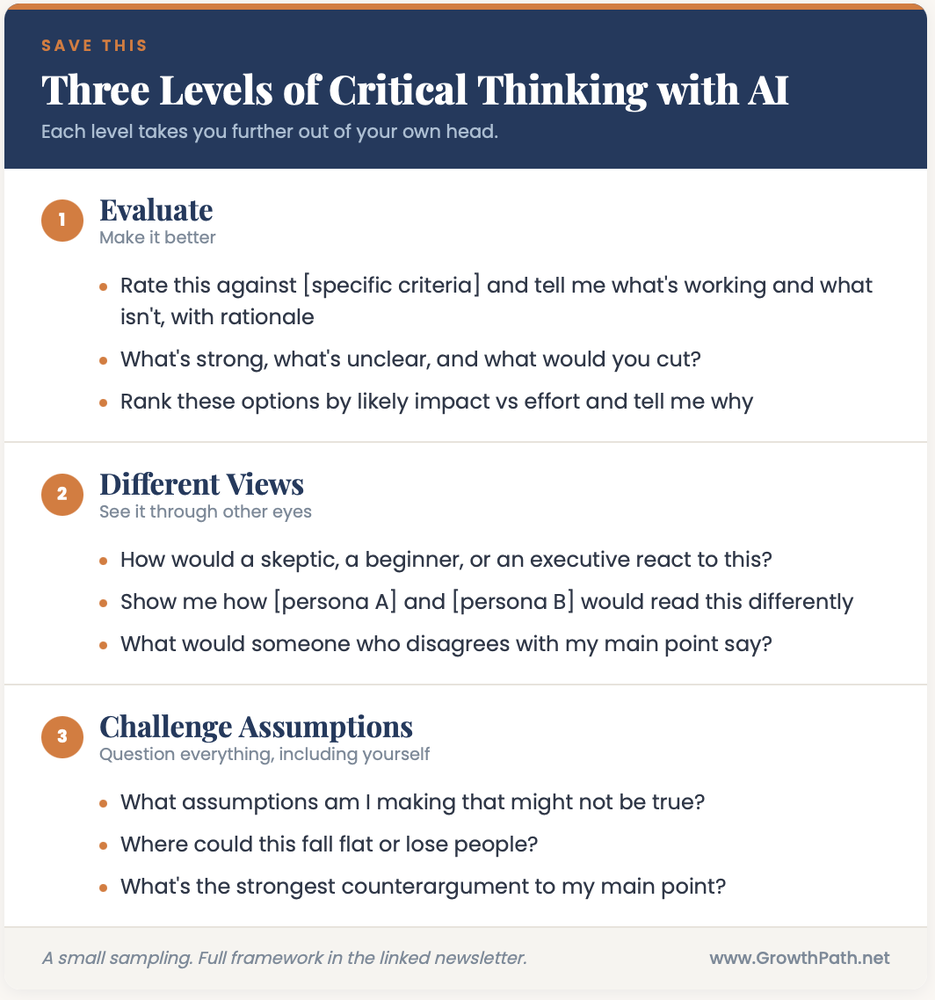
I use AI to help me judge and make better decisions. AI doesn’t make the final call, I do.
The questions I ask now are richer. I look for alternatives, ask for confidence levels, and pressure-test assumptions in ways I didn’t before. That habit carries over into every conversation, not just the ones with AI. (Full newsletter with detailed examples: How to Think Critically with AI, No Matter What You’re Working On.)
The Digital Twin
Digital Liza, my digital twin, is designed specifically for this. I built it to challenge my work, find blind spots, and push me when my thinking gets lazy. I even gave it a personality: bold, salty, and spicy, like a bowl of Chex Mix. (More on how I built it in my digital twins newsletter.)
I also use a set of criteria to push AI past its default when generating ideas. Inspired by Andy Crestodina, I developed these and then used AI to suggest additional ones. These criteria go beyond aligning to buyer personas and stages. Without this kind of push, AI gives you the average of everything it was trained on. With it, you get something that could only have come from a human who asked a better question.
We’ve long focused on the right answers. AI pushes us to ask the right questions.
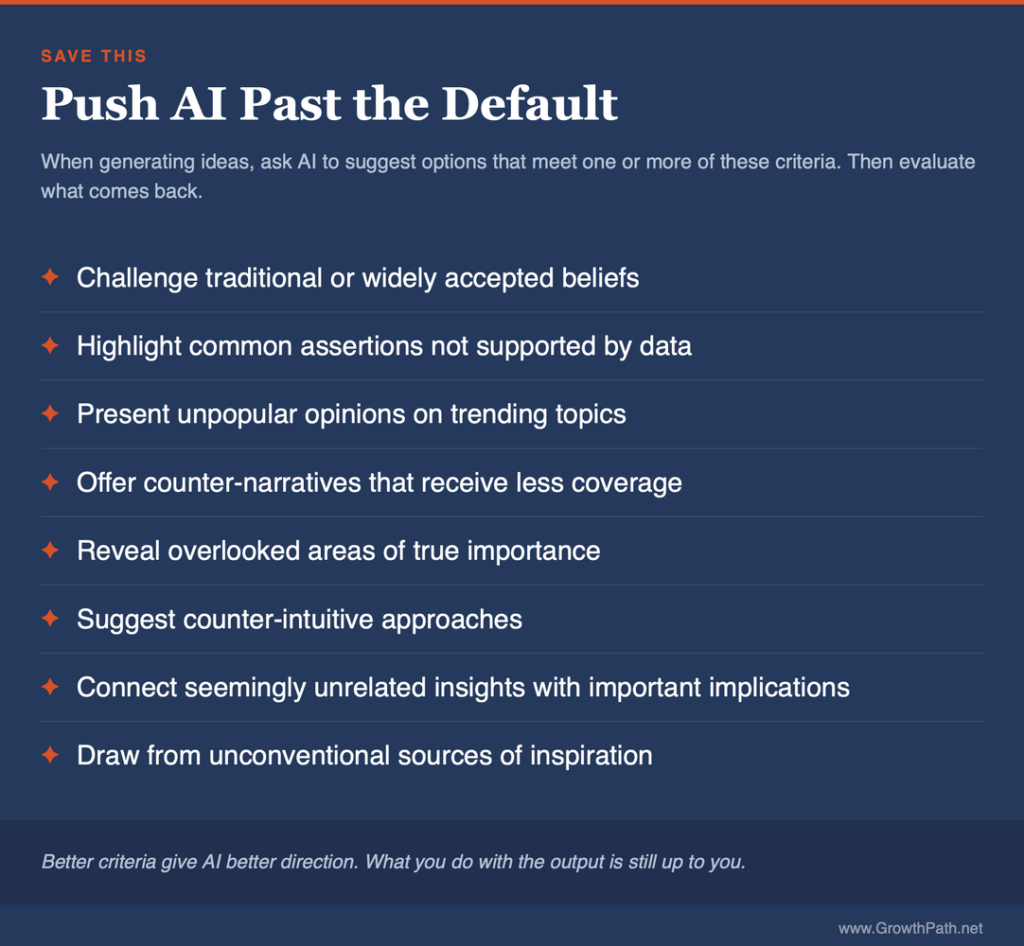
I’ve taken this further. At Content Jam in Chicago, I demoed a Product Launch Content Engine built in Claude Cowork that evaluates content against buyer personas and applies these criteria automatically. The human still makes the final decision, but the quality bar is built into the workflow. (Post with details here.)
2. More Understanding
NotebookLM is a Google tool that lets you upload documents and generate AI audio conversations, critiques, video explainers, and other formats based on your content. Try it, it’s free.
Debate Mode
I put my newsletter called Your Buyer Changed: Four AI-Driven Shifts Breaking the GTM Playbook into NotebookLM’s debate mode and two AIs roasted my ideas harder than my CMO friends after a couple of margaritas.
One AI was a rebel: “kill all gates,” “burn attribution to the ground,” “free the content.” The other panicked about CFO accountability and quarterly forecasts. At one point, one called the state of GTM a “boardroom fire drill just waiting to happen.” The other said “the house is already on fire.”
I was cracking up thinking what the heck I wrote that caused these AI podcasters to go ballistic. I said “a trend worth paying attention to.” They turned my newsletter into a soap opera. Check out the short snippet below.
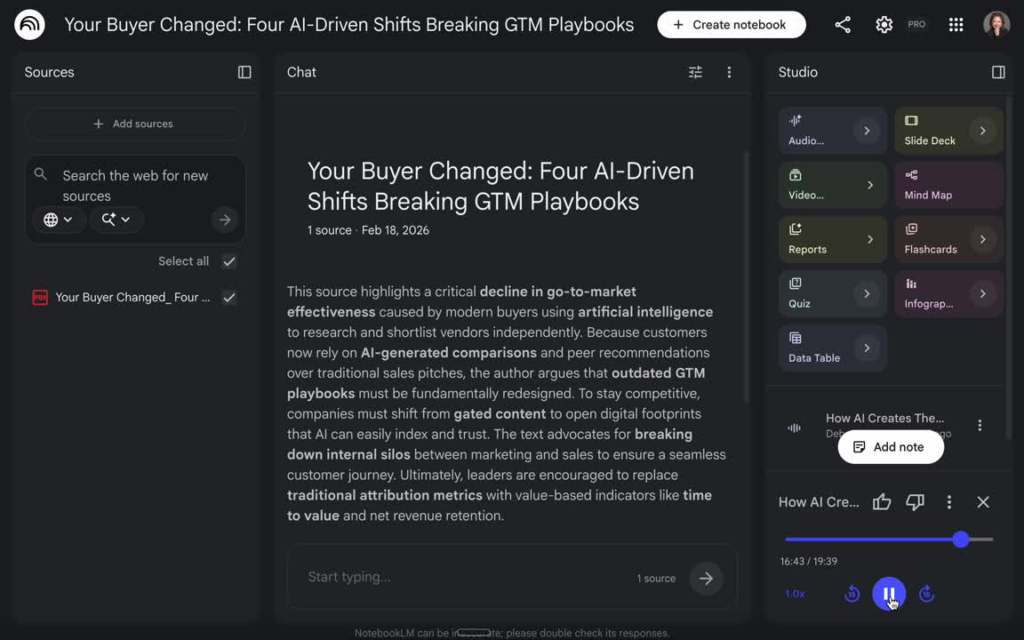
One AI argued a position opposite to mine and built a credible case using my own words. If an AI could read my writing and infer “she wants to ungate everything,” a human reader could too.
I went back and found the problem. Three statements about gated content that were individually true but together sounded like a mandate. I fixed two sentences. I never would have found the gaps without two AIs yelling at each other about my newsletter.
Critique Mode
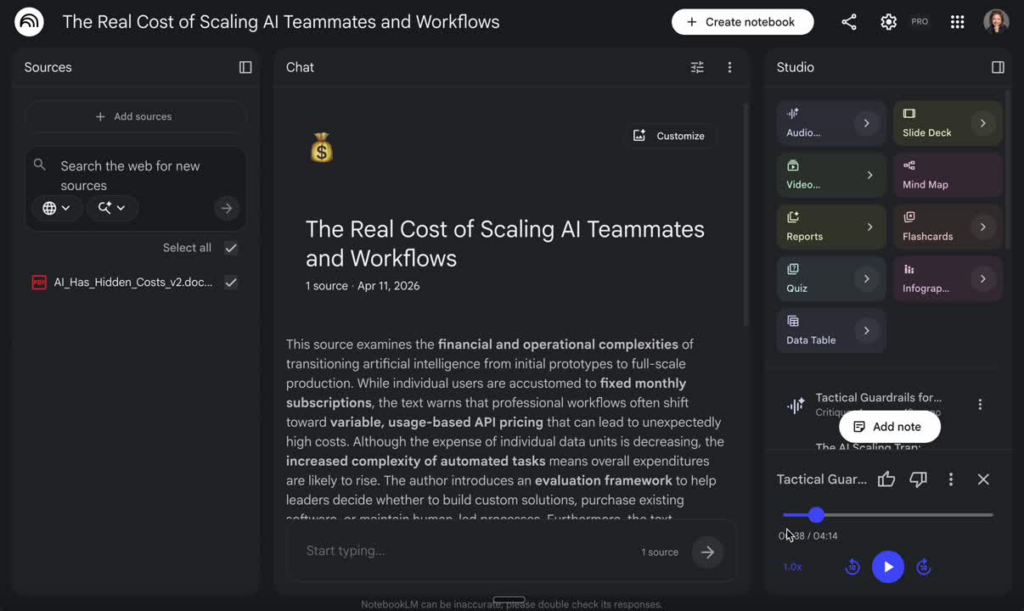
NotebookLM’s critique mode works differently. Instead of a debate, you get an expert review with specific feedback on structure, argument, and clarity. I use it to catch the things I can’t see because I’m too close to my own work.
Below is a short NotebookLM critique of one of my newsletter drafts (You’re Building AI Teammates and Workflows. Do You Know What They Cost?).
Simulations
There’s a big difference in the quality of our work when we go from asking “what would I do?” to “how would they respond?” You can build AI personas of your buyers, your executive team, your competitors, and use them to pressure-test messaging, anticipate objections, and refine strategies in a safe space.
When teams experience this for the first time, you can see it click. They go from “that’s interesting” to “I need this for my next launch” in about ten minutes. (Full newsletter: Great Strategies Die in the Reactions You Didn’t Simulate.)
Also try the interactive Sales Debate Simulator below that helps coach sales reps through customer conversations.
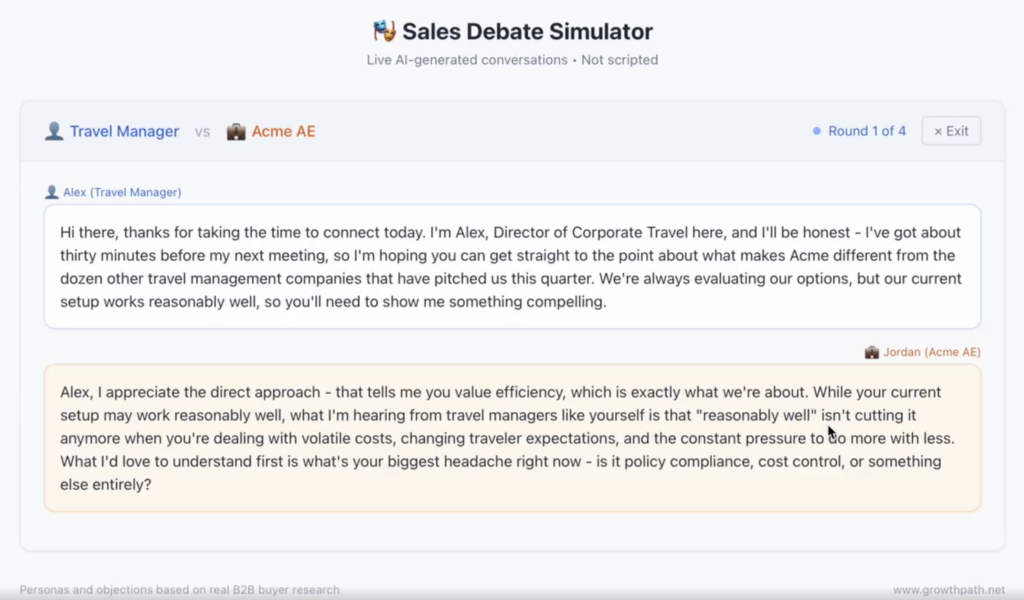
Click here to learn how create a Sales Debate Simulator.
3. More Aware
AI made me more aware of cognitive differences.
I’m 4’10” on a good day. I once stood next to Zaza Pachulia, the former Golden State Warriors center, who is 6’11”. Nobody looks at that photo and thinks I should try harder to be taller. And nobody on a plane has ever asked me to help with the overhead bin. When the difference is visible, we just help.
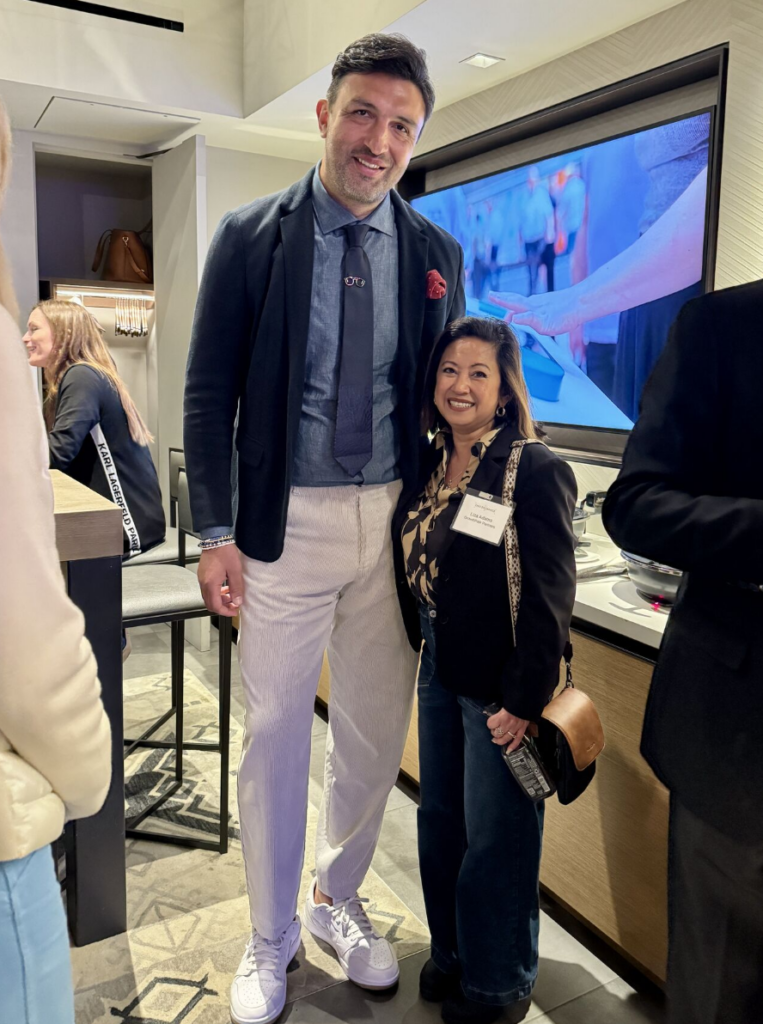
Very few people have that instinct with AI. AI right now rewards a specific way of thinking. If you naturally break problems into steps and structure prompts in sequence, it feels like a superpower. If your brain doesn’t work that way, the same tools feel confusing and frustrating, and it’s easy to assume you’re the problem. You’re not. But the gap is real. That awareness has changed how I design workshops, write newsletters, and build content for teams with different kinds of thinkers.
With visible differences like physical limitations, we give grace. When they’re invisible, like cognitive differences, we’re quick to judge. My work with AI has made me more aware of how differently people process, learn, and solve problems, and more empathetic because of it.
One example: I built an AI Teammate Instruction Builder prompt template that takes a conversational description of what you want an AI teammate to do and turns it into structured instructions to build custom GPTs, Claude Projects, Gemini Gems, or Copilot Agents. If prompting in steps feels unnatural to how your brain works, you don’t have to. You describe the outcome, and the builder handles the structure. (Try it here.)
4. More Relatable
The Format Transforms the Content
NotebookLM is part of my workflow in a way I didn’t anticipate.
I create a deep dive podcast, a video explainer, and an infographic for each newsletter so readers can choose the format that works for their brain. But the deep dive podcast does something more. Two voices having a conversation about your piece naturally use analogies, tell mini-stories, and riff on each other’s reactions. The content becomes more relatable because conversation is how humans naturally make sense of things. The format itself transforms the content. I’ve borrowed more than a few analogies from the AI podcast and used them in the next draft.
I’ve also created versions in different languages so my ideas can reach people who would never have engaged with the English version. But I’m transparent about my ability to check the work. I can check Filipino translation but not other languages.
Meeting People Where They Are
On a connecting flight through Frankfurt last year, I was on an airport bus with a woman from Cameroon. She was tired and visibly worried she’d gotten on the wrong bus. Her boarding pass didn’t show a gate, and the bus had no flight information. I pulled up Perplexity and asked about her Turkish Airlines flight to Istanbul using her flight number. She relaxed and we smiled.
Sharing and Extending Expertise
Sharing your digital twin with your team extends your expertise beyond yourself. I’ve seen this with clients who build twins trained on their strategy docs, messaging frameworks, and decision criteria. A new team member can pressure-test a campaign concept against the same thinking that a ten-year veteran would apply. Your best thinking is available at 11 pm on a Sunday when nobody’s around to ask. When your expertise lives inside a twin that others can access, it scales in ways that weren’t possible before.
5. More Confident
Recently, I was preparing a presentation for a room of 15 CMOs from companies you’d recognize. The session was about how marketing can become the most strategic seat in the C-suite by building human + AI organizations. These CMOs were at different phases of their AI journey, from teams still experimenting to organizations already scaling. I needed one cohesive session that met all of them where they were and brought them along.
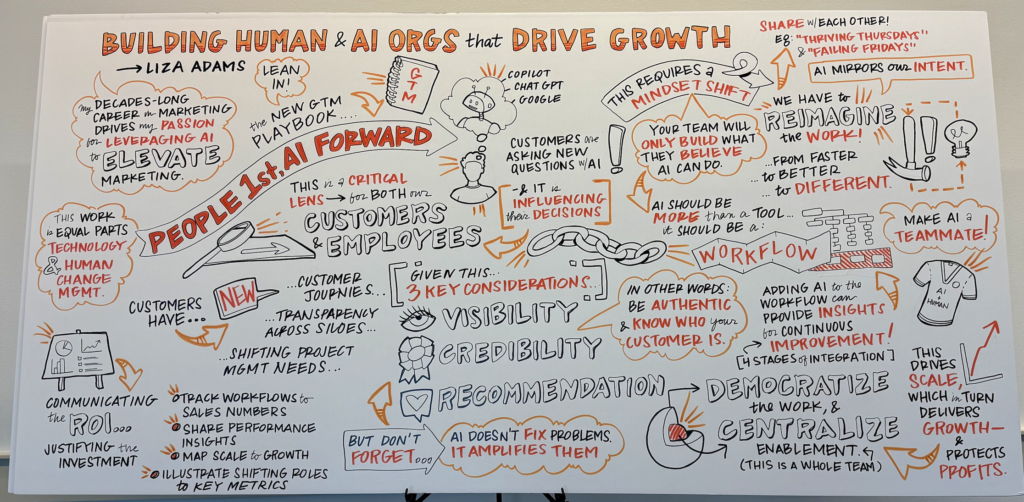
I approached it the way I approach every high-stakes session: think big, start small, move fast. I built the arc around the evolution from where teams are today to where they could be tomorrow, and grounded the impact in patterns I’ve seen across clients. Then I brought my frameworks, case studies, and learnings into AI and asked it to help me anticipate what would be top of mind for CMOs at each phase of the journey.
AI didn’t craft the answers. It brought up the situations I needed to elevate based on the pattern recognition I’d already built through my work. I adjusted the arc so that a CMO just starting out would feel seen in the same room as a CMO already scaling.
By the time I walked into that room, I knew which concerns would come up and I’d already thought through how to meet each one. The CMOs didn’t know that. They experienced a session that felt like it was built for them.
Every move I described above happened in private. There was no audience judging, no comments section, and no bruised egos.
You can test your ideas, anticipate the questions your audience will ask, and refine how you meet them where they are. The AI doesn’t make the final call. You do. But you make it informed, having already thought through the room before you walk into it.
That’s where the confidence comes from. You show up the way you would if you had more time, more distance, and an honest colleague helping you see what you might miss. AI gives you all three.
The Map
These are examples to spark ideas, not a checklist. Your best workflows will come from your own work, your own data, and the questions you actually wrestle with. Before you paste anything into an AI tool, check your company’s responsible AI policies. Redact or anonymize proprietary, confidential, or customer information.
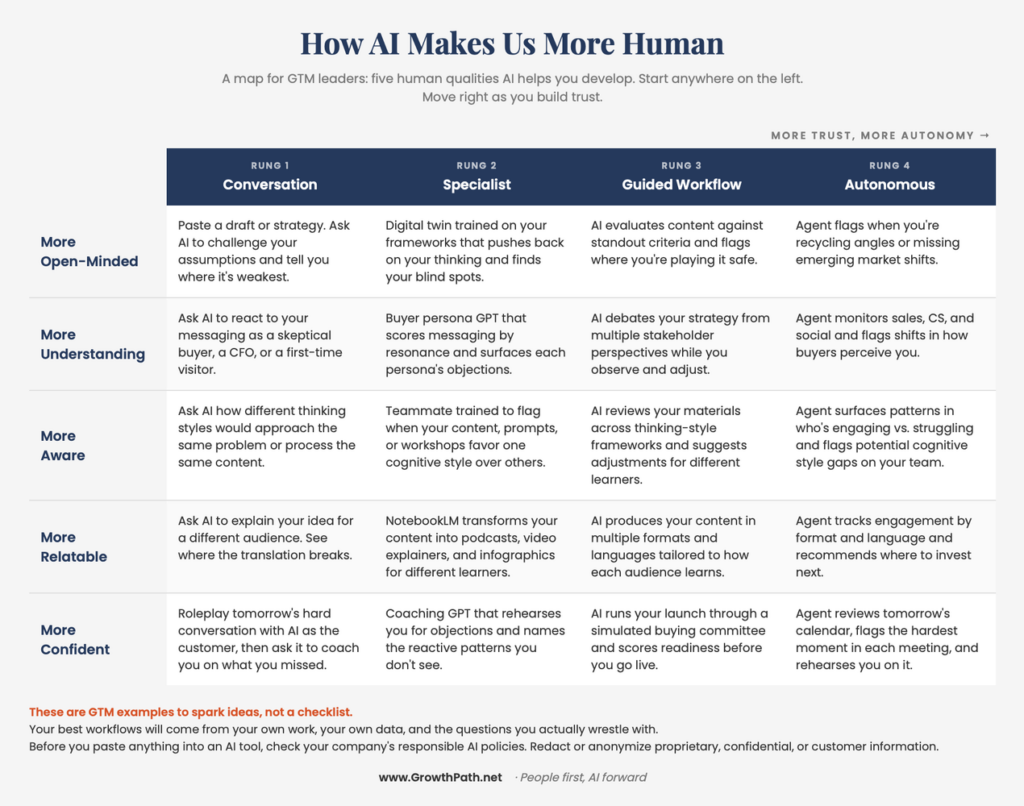
AI is an amplifier of what’s already there, good or bad. If your intent is to genuinely understand your customers, AI will help you do that at a depth you couldn’t reach alone. If your intent is to game the algorithm, AI will help you do that too, and your audience will feel it.
The five qualities in this newsletter only work because the intent behind them is real. Without that, the same tools produce faster content that nobody remembers reading. AI gives you the time, the tools, and the safe space to be more human. But you have to want to be.
I built an interactive pressure-test tool that runs your draft through the same three questions I use on every piece of my own work. Paste anything you’re about to share and see what comes back. The final call is still yours. Try the pressure-test tool. (You need a Claude account to use the tool. Free version is fine.)
There’s something truly special about being more compassionate because while we can’t walk in everyone’s shoes, we can empathize and begin to live in this world in a more nuanced and richer way.
This newsletter went through the same process I described. Digital Liza challenged the structure. NotebookLM Debate suggested an angle I missed. The critique caught two sections that were saying the same thing. I practice what I write about.
The Practical AI in Go-to-Market newsletter shares learnings and insights in using AI responsibly. Subscribe today and let’s learn together on this AI journey.
For applied learning: Explore our applied AI workshops, offering both strategic sessions (use cases and roadmaps) or hands-on building (create AI teammates during the workshop). You’ll leave with either a clear plan or working solutions. Office hours provide follow-on support to keep momentum going.
For ongoing advisory: I work with leaders as a strategic advisor through their AI transformation, providing guidance, frameworks, and a sounding board as they build. If that’s what you need, let’s talk.
For team transformation: I partner with GTM leaders to move from scattered AI adoption to an operating model where human and AI teammates work together across workflows. See real examples: a lean GTM team’s step-by-step playbook and a global cybersecurity leader scaling to 150+ marketers with 57 AI teammates integrated into daily workflows.
For speaking: Here are virtual and in-person events where I’ve covered a variety of AI topics. I’ve also keynoted at many organization and corporate-wide events.
If any of this resonated, I’d love to hear from you. Reply to this email, find me on LinkedIn, or come say hi at an event.