Sometimes you hear one line, and you can’t unhear it. Your work didn’t change, but how you see it did.
That’s a reframe, and it’s one of the most underrated tools in AI transformation. What you can build is limited by what you believe AI is capable of, and belief changes when the frame changes.
Quick Take
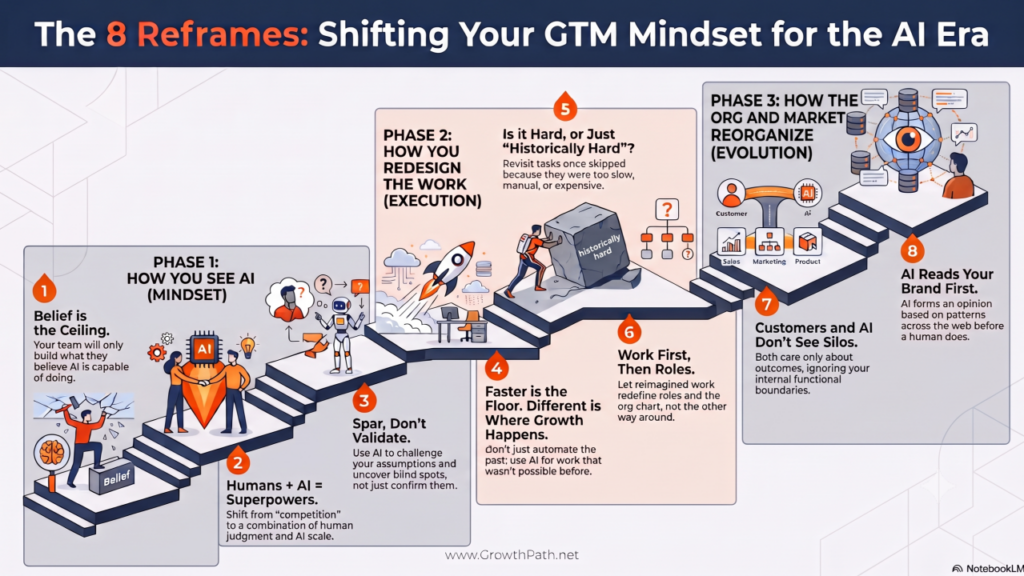
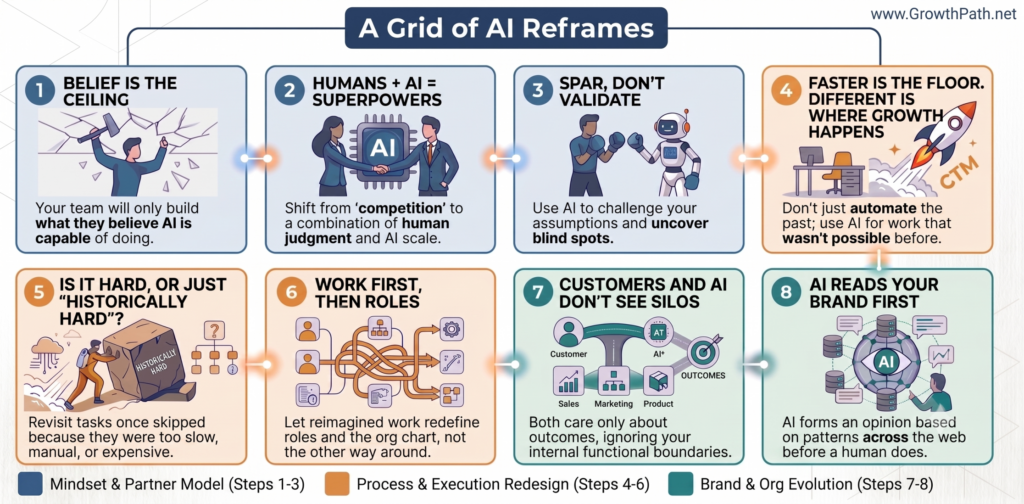
These eight aren’t separate lightbulb moments. One holds up the rest. Your team only builds what they believe AI can do, so belief comes first. The others tend to build on each other, but you don’t have to take them in order. Start where your problem is.
- How you see AI – Your team builds only what they believe AI can do. That belief is the foundation for everything else.
- How you redesign the work – Once you see things differently, you point AI at growth, find work that was historically hard for humans to do, and rethink the roles.
- How the org and market reorganize – When the workflows change, the functional org silos stop making sense, and the way AI sees your brand influences how the market finds you.
If you reorganize the org chart before your team believes AI can do more or do work differently, then you’re just relabeling boxes. These are the eight reframes that keep coming up in my work with GTM teams. Read them in any order. If two or three land, you have something to bring into your next planning meeting. The body does what the mind believes.
Watch Or Listen Instead
To cater to different learning styles and time constraints, this newsletter is also available as a 5-min cinematic AI video explainer and a 20-min AI podcast with two AI hosts. Both were made with Gemini Notebook (aka NotebookLM) and personally reviewed for accuracy and responsible AI use.
The eight reframes come from the last year of this newsletter and the work behind it, from workshops to office hours to full transformations. There are more, but these are the ones that changed how teams saw the work, and then what they built.
Start Here: How You See AI
Start here. This first group is about how you see AI, and it’s the floor the rest stand on.
1. Your team will only build what they believe AI can do.
Old thinking: Our people have the tools. Why aren’t they building orchestrated workflows?
New thinking: What you can build is limited by what you believe AI is capable of.
If your team’s experience with AI is mostly faster drafts and summarized reports, that’s the ceiling they’ll build to. They can’t picture a workflow that reads every Gong call, customer review, win/loss note, and analyst report from the quarter and tells them the top buyer objections that are beginning to impact pipeline. They’ve never seen one.
A team that sees AI as a search engine uses it for search. But every reframe after it depends on believing AI can do more than answer questions.
Go Deeper: Four Mindset Shifts to Move Them Forward
2. It’s not humans vs AI. It’s humans + AI, each with superpowers the other doesn’t.
Old thinking: AI is going to replace humans. It’s a competition.
New thinking: Some work gets automated. The lasting advantage is humans and AI together, with each one overcoming the other’s limitations.
The versus framing sets up the wrong fight, but it’s not wrong because jobs are safe. AI will do some work on its own, and pretending otherwise helps no one. The point is that the highest-value work comes from the combination of humans and AI working together.
AI does things at scale no person can match. Unlike us, it doesn’t have off days. It works the same way on the day you’re running on 40% after a rough night on product launch week. On the other hand, you bring judgment, gut feel, and lived experience. Put them together and you get work neither can do alone.
So the real question is whether you use the time AI frees to do work that grows the business, because that determines if your team shrinks or grows.
Go Deeper: AI Made Me More Human (This is one of my favorite newsletters I’ve written. And truly, AI has made me more human and I explained why and how.)
3. Use AI to confirm what you think and you do worse. Use it to challenge you and you perform at the highest level.
Old thinking: Using AI to check my thinking makes me better.
New thinking: AI is an amplifier of what’s already there. Ask it to validate your beliefs and you risk confirmation bias. Use it to challenge your assumptions and you uncover blind spots and make ideas better.
This one has data behind it. Vivienne Ming, an American neuroscientist, ran an experiment with real-world prediction teams and found the 5 to 10 percent who outperformed everyone, including professional prediction-market experts, were the ones who pushed back, demanded evidence, and challenged their own assumptions. The two traits that set them apart were perspective-taking and intellectual humility. She recently wrote about her experiment and results in the Wall Street Journal.
Change happens when you stop accepting AI’s first answer and start asking it to evaluate, challenge, and pressure-test your thinking. You make the final call and you’re ultimately accountable.
Jeff Phillips, Head of Marketing at Authentic8, runs marketing at a company built on investigations, where challenging your own conclusions is the whole discipline.

“In investigations, the fastest way to get burned is looking for evidence that confirms what you already believe. We train analysts to do the opposite: try to disprove your own theory. My team uses AI the same way. We don’t ask it to agree with us. We ask it to poke holes, argue the other side, show us what we missed. The teams using AI as a yes-machine are the ones getting fooled.”
Go Deeper: Cox Automotive Case Study – 60 Marketers, 60 AI Sparring Partners, and the Work They Reimagined
Next: How You Redesign the Work
4. Faster is the floor. Different is where growth happens.
Old thinking: AI helps us do our work faster.
New thinking: Faster speeds up the work you’re already doing. Different is work that wasn’t possible before.
If we simply train AI to do old work faster, we unintentionally build the case for automating humans out. When we use AI to do work that wasn’t possible before, work that drives growth, humans become more essential.
Most of us tend to think in incremental improvements based on what we know today. Given unreliable taxis, the natural conclusion was more taxis. Uber and Lyft reframed the problem as trust plus access to vehicles and built something different. We can’t reimagine the future by automating the past.
Sara Ramlo Larsen, VP of Marketing and Communications at Wolters Kluwer Health, saw this in her own team’s adoption.

“The hardest part of AI wasn’t the technology. It was getting people to believe it could do more than speed up their existing tasks. Once a few people on the team saw it could change how they worked, not just how fast, the rest started building things I hadn’t imagined. We now have over 100 AI use cases in action!”
Go Deeper: Stop Telling People to Reimagine Work With AI. Show Them.
5. Is the work still hard, or just historically hard?
Old thinking: This has always been too slow, manual, or expensive to do by hand, so we skipped it.
New thinking: For a lot of this work, the reason you don’t do it is gone.
There’s a whole category of work your team isn’t doing. Reading every sales call. Refreshing battlecards every week. Tailoring the message to each deal. You skipped it because an all-human team could only do so much. That made sense before AI. The question worth asking about any task you skipped: is it still hard, or just historically hard? Once you believe AI can do more, this question uncovers work you can finally take on.
Go Deeper: 5 Reimagined Workflows: Work We Skipped That AI Now Does
6. Reimagine the work first. Roles follow, then the org.
Old thinking: We need to restructure for AI. Let’s redraw the org chart.
New thinking: Reimagined work leads to reimagined roles, and reimagined roles change the org chart.
The instinct is to start with the org chart, because that’s the lever leaders are used to pulling. It’s backwards. When the work changes, the time AI frees up moves to work the team couldn’t take on before, and the roles change around it. The org follows the roles. Start with the work, not the chart.
Go Deeper: The New GTM Roles and Org Chart
Then: How the Org and Market Reorganize
7. AI doesn’t care about your siloed org chart, and neither do your customers.
Old thinking: We’re organized by function, each team with its own goals and numbers.
New thinking: Customers see one company, not separate departments. AI doesn’t care about the silos either. Both customers and AI only care about outcomes.
Your customers want to experience one company. They don’t care about your org chart, and certainly don’t want to feel like they’re dealing with different companies as they move across departments.
AI is good at exactly the work that falls between functions, because it ignores functional boundaries. When AI can see the whole customer journey, the cost of slow handoffs shows up in dollars. Now you can put a number on what the gaps between teams cost.
Drew Neisser, CEO of CMO Huddles, watches this shift unfold across hundreds of CMOs.
“Across our Leader Huddles and our task force on the future of marketing org design, I keep hearing the same thing from CMOs. AI isn’t changing marketing, it’s changing how marketing gets done. The ones winning with it won’t have better prompts. They’ll have better organizational design, redesigning the work around the outcomes they’re chasing instead of the functional boxes. Faster handoffs are still handoffs.”
Go Deeper: No Daylight: How AI Is Reorganizing GTM Teams Around Customers
8. AI forms an opinion about your brand before humans do.
Old thinking: Our brand is based on how customers perceive us.
New thinking: AI looks for consistent patterns across many sources, and it draws its own conclusions when there aren’t clear signals.
AI systems are already analyzing your brand, deciding who you serve best, and recommending you or not, whether you guide them or not. And here’s what makes this harder than SEO: it’s not just what you say about yourself. AI looks everywhere, at what customers, analysts, and communities say about you across the web, and the consistent pattern becomes the signal. If what you say and what others say don’t match, AI notices the gap. So it’s less what we say and more what we do, because that’s what others end up talking about.
Perception has always been reality. Moving forward, the AI response becomes reality, because people won’t check the 43 sources it pulled from. As Wil Reynolds (CEO of Seer Interactive) puts it, you need to be seen, believed, and chosen in AI search.
Go Deeper: When AI Judges Your Brand Before Humans Do
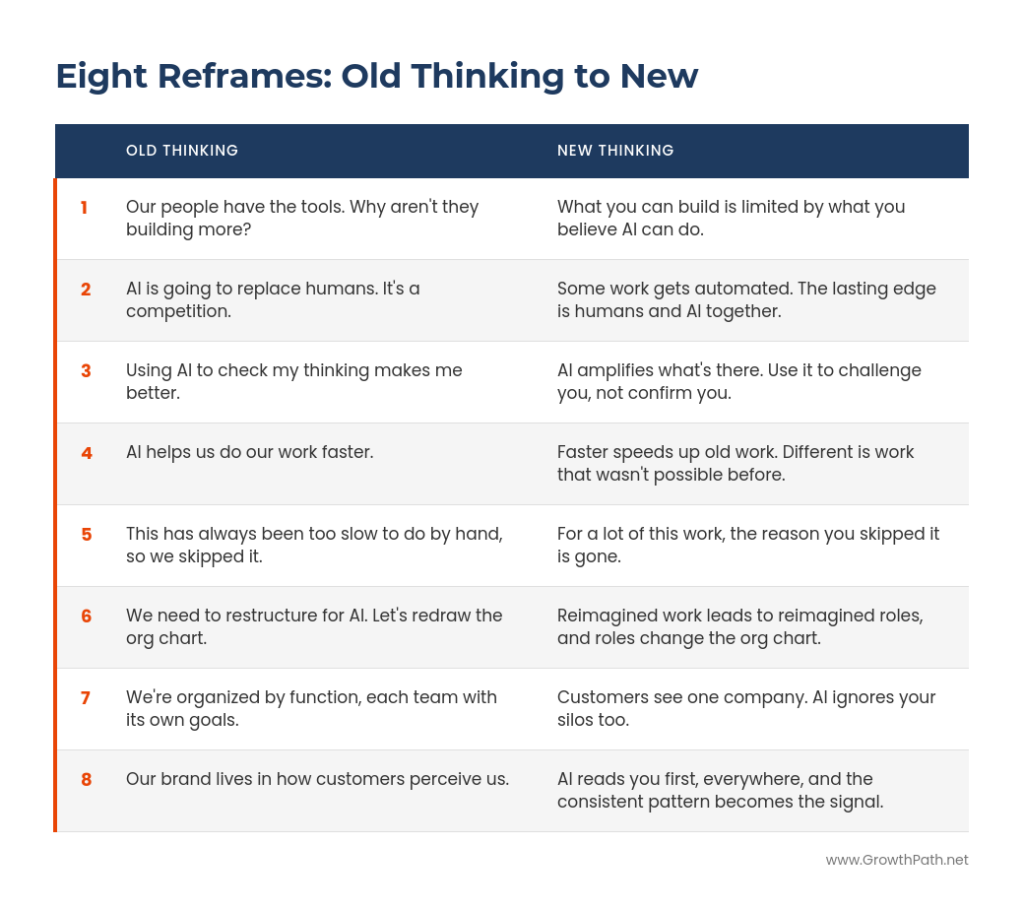
AI handles collection, synthesis, analysis, and execution at scale. You keep judgment, taste, and the final call. The reframes don’t hand the work to AI. They change what you see clearly enough to decide what’s worth building. The body does what the mind believes.
Pick one this week. Bring it to your next planning meeting and see how the conversation changes when you say it.
The Practical AI in Go-to-Market newsletter shares learnings and insights in using AI responsibly. Subscribe today and let’s learn together on this AI journey.
For applied learning: Explore our applied AI workshops, offering both strategic sessions to shift mindsets through practical AI uses and hands-on sessions to build human+AI workflows. You’ll leave with either a clear plan or working solutions. Office hours provide follow-on support to keep momentum going.
For ongoing advisory: I work with leaders as a strategic advisor through their AI transformation, providing guidance, frameworks, and a sounding board as they build. If that’s what you need, let’s talk.
For team transformation: I partner with GTM leaders to move from scattered AI adoption to an operating model where human and AI teammates work together across workflows. See real examples: a lean GTM team’s step-by-step playbook and a global cybersecurity leader scaling to 150+ marketers with 57 AI teammates integrated into daily workflows.
For speaking: Here are virtual and in-person events where I’ve covered a variety of AI topics. I’ve also keynoted at many conferences and corporate events.
If any of this resonated, I’d love to hear from you. Reply to this email, find me on LinkedIn, or come say hi at an event.