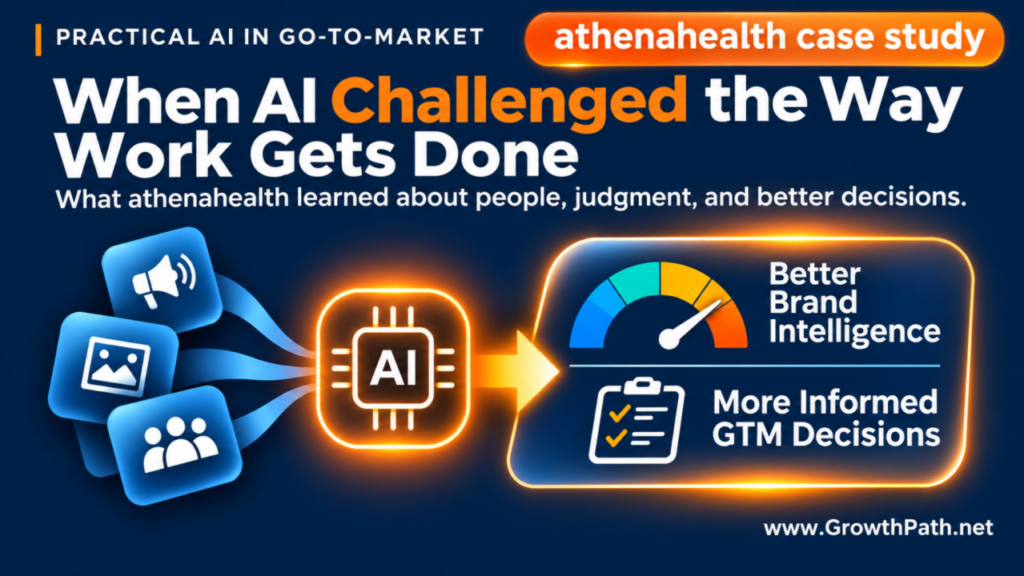
athenahealth built an AI Brand Review Agent to address roughly 30 hours of creative asset reviews its small brand team handled each week. During testing, the agent flagged creative that brand experts considered acceptable. The team discovered that some guidelines, which made sense to experienced employees, weren’t clear enough for AI to interpret consistently.
A second initiative, the Brand Health Dashboard, aimed to complement twice-yearly brand surveys with more frequent customer, market, and commercial intelligence. Deciding which measures and signals to use, how to interpret them, and which GTM decisions they could inform took months.
Both initiatives support athenahealth’s broader commitment to understanding its market and customers more deeply, serving them well, and continuing to earn their trust. AI creates new opportunities to pursue that goal, with people providing expertise and judgment to guide the work.
Both initiatives started in brand, but the lessons extend across Marketing, Sales, Customer Success, and other GTM functions. They show how building AI capabilities can expose gaps in existing processes, challenge assumptions about how work gets done, and create opportunities for people to apply their expertise and make better decisions. I appreciate athenahealth sharing the difficult parts, including what it’s still figuring out.
Quick Take
Here are five practical lessons from athenahealth’s experience building and testing two AI initiatives.
- AI struggled to apply some brand guidelines consistently. The team clarified how to interpret them and added examples of good and bad creative.
- Human judgment remained essential. Instead of automating every exception, the team added quality checks, retained human review for complex cases, and incorporated feedback.
- Look beyond time savings. The team is improving brand standards and exploring how specialists can spend more time helping others create better work.
- Choose the data that supports decisions. The team spent months examining measures and market signals, then narrowed them to those most useful for GTM decisions.
- People need time and support to build. Protected learning time, technical expertise, and governance helped employees develop AI capabilities while continuing their regular work.
Watch or Listen Instead
To support different ways of processing information and different time constraints, this newsletter is also available as a 6-min cinematic AI video (see below) and 18-min podcast with two AI hosts. Both were created with Gemini Notebook and reviewed by me for accuracy and responsible AI use.
Two Workflows, Bigger Opportunities
athenahealth supports healthcare practices with technology for clinical, financial, and patient engagement operations. Peer recommendations influence healthcare buying decisions, making brand trust and customer experience especially important.
The Brand Review Agent: When AI Struggled to Apply Brand Guidelines
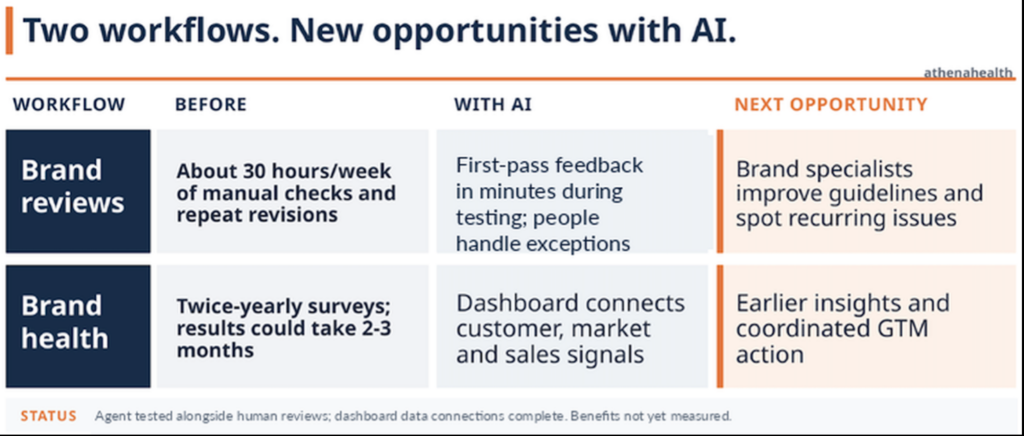
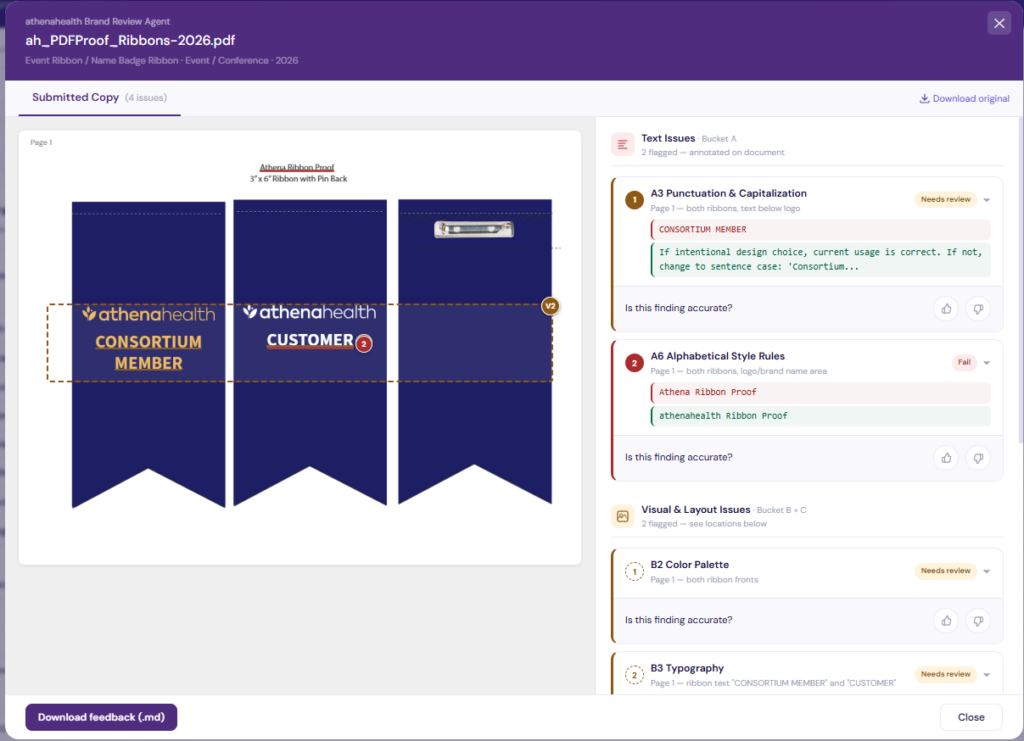
Creative reviews involved repeated back-and-forth between creators and athenahealth’s brand team. The team built an AI Brand Review Agent so employees could submit assets, receive first-pass feedback in minutes, and make corrections themselves, with brand specialists handling exceptions. For now, the agent runs alongside human reviews. Automating the first-pass review is still in development.
In one example, the agent performed 19 checks on an event ribbon: 15 passed, one failed, and three required human review. Employees can inspect the findings and provide feedback on the agent’s accuracy.
Making Brand Expertise Clear Enough for AI
The agent’s false flags prompted the team to revisit how its guidelines were written for AI. Some depended on context and judgment that experienced employees understood but AI couldn’t apply consistently.
For example, athenahealth described its brand voice as “visionary.” Experienced employees understood what that meant, but the agent needed more explicit instructions. The team added examples of good and bad creative, clarified messaging rules, and simplified parts of its guidelines.
Nicole Walsh (Carbone), director of brand at athenahealth, explained what the team learned:

I’ve seen this in GTM work, too. Teaching AI a task often reveals the unwritten knowledge people rely on.
The lesson: When AI repeatedly gets something wrong, examine the instructions. We may not have explained the work clearly enough.
Knowing When People Should Decide
The team also learned that refining an agent indefinitely has diminishing returns. Some rules, like approved colors and logos, are straightforward. Creative judgment is more subjective, and trying to automate every exception can take more effort than having a person make the call.
Rather than pushing for perfect automation, the team added an AI quality check, kept human review for complex cases, and incorporated employee feedback to improve the agent.
The bigger opportunity is changing how brand expertise is used across the company. As employees become able to review and improve their own creative with AI, brand specialists can spend less time checking individual assets and more time identifying recurring issues, improving guidelines, and helping colleagues produce better work. The team also sees potential to extend self-service reviews to external partners.
For me, this illustrates three ways AI can improve work:
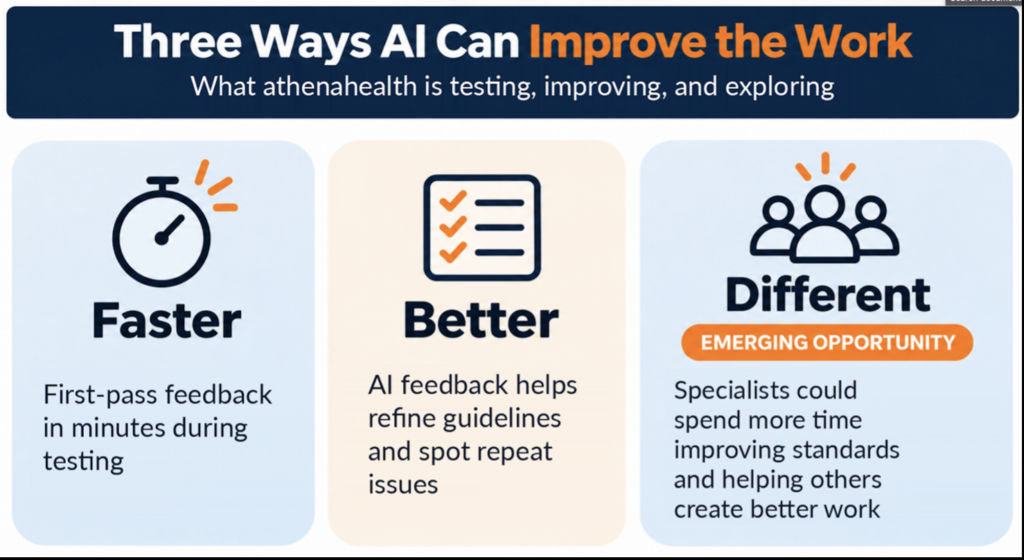
The team is testing first-pass reviews and improving its guidelines. Giving specialists more time to improve standards and help colleagues create better work remains an opportunity.
The Brand Health Dashboard: From Data to Decisions
athenahealth has long measured brand health through twice-yearly surveys. They provide valuable insights into awareness, favorability, consideration, and competitive perceptions. But by the time results reach stakeholders, the information can be two to three months old.
The team built an AI-powered dashboard to complement those surveys with more frequent intelligence. It brings together customer, market, and commercial measures and signals, including social listening, win/loss research, press coverage, and how AI tools describe athenahealth. AI synthesizes the information into executive trend insights using interpretation guidance developed by the team. The data connections are complete, and the team is preparing for monthly reporting.
The Hardest Part Was Scoping
When I asked what had been hardest, the team pointed to scoping.
The team spent months deciding which existing measures and market signals could reliably represent brand awareness, favorability, and consideration. That required collaboration across Marketing, Sales, and Customer Success, along with work to connect and clean data from different systems.
They’re also weighing whether one overall brand health score would help executives or whether individual measures would be better for identifying problems and guiding decisions.
Another assumption changed along the way. The dashboard was initially envisioned as a potential replacement for traditional surveys. The team eventually recognized the value of both: surveys to understand decision makers’ brand perceptions over time, and the dashboard for more frequent market signals. They’re now rethinking how the two can work together.
The lesson: Before building an AI dashboard, get clear on the decisions it needs to support. Connecting more data won’t help if we can’t interpret it or decide what to do next.
I explored a related challenge in Your Data Problem Is Smaller Than You Think. Your AI Payoff Is Bigger, where we worked backward from the decisions a team wanted AI to support.
Connecting Intelligence to GTM Action
Consider an example athenahealth discussed: the dashboard flagged a decline in branded search for athenahealth. AI suggested several possible explanations to investigate, including seasonal demand, campaign activity, and competitor activity. It also cautioned against increasing broad brand spending before identifying the cause.
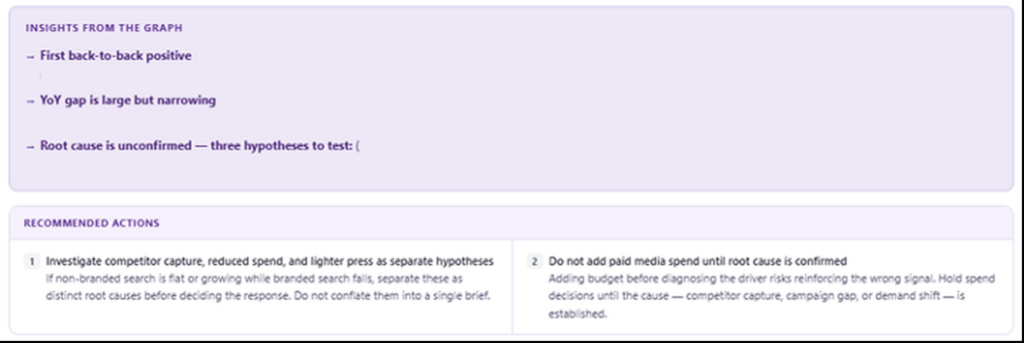
This gives the team a starting point for deciding what to investigate and which colleagues to involve. The cause hasn’t been confirmed, and the team is still developing how to turn dashboard insights into coordinated GTM actions.
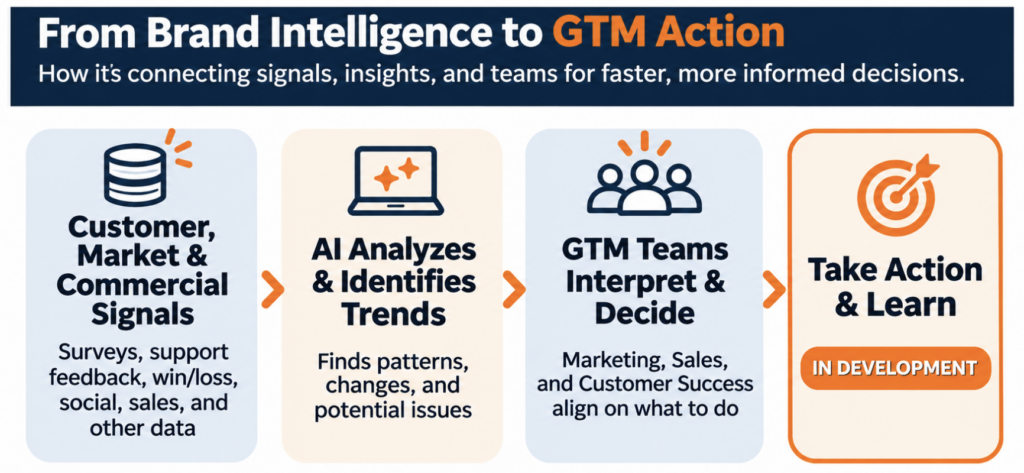
For me, the bigger opportunity is a different way of managing brand health. Instead of relying primarily on periodic moment-in-time surveys to understand buyer perceptions, Marketing, Sales, and Customer Success could use more frequent customer and market signals across the brand health funnel to identify emerging issues, coordinate responses, and learn from the results. That would make brand intelligence part of ongoing GTM decision-making, rather than something reviewed a few times a year.
Human Review Is a Start. Outcomes Help Us Learn.
athenahealth’s Brand Review Agent lets employees give thumbs-up or thumbs-down feedback on its findings. That helps the team identify mistakes and improve the agent’s instructions. But human review tells us whether an AI recommendation seems right, not whether the resulting decision actually worked.
I’ve been exploring how we can connect three things: what AI recommended, what a person decided, and what happened afterward.
For example, did changes to brand guidelines reduce recurring creative issues? Did an insight from the Brand Health Dashboard lead to action across GTM, and what happened as a result?
Over time, tracking those decisions and outcomes could help teams understand which recommendations worked, when human overrides improved results, and where both people and AI need to improve. AI could identify recurring issues and propose changes to instructions, evaluation criteria, or workflows for people to test and approve. We’d also learn when our own judgment needs adjusting.
athenahealth sees outcomes tracking as its next step and is working toward introducing it in Q1 2027. I’m exploring a similar approach in my work.
Making Time to Build While Running the Business
Building AI capabilities meant learning new skills and redesigning workflows while keeping up with regular work. athenahealth provided dedicated time and support for both.
The team reserved Tuesday and Thursday mornings for AI initiatives.
Lori West, VP of Marketing at athenahealth, captured the challenge.
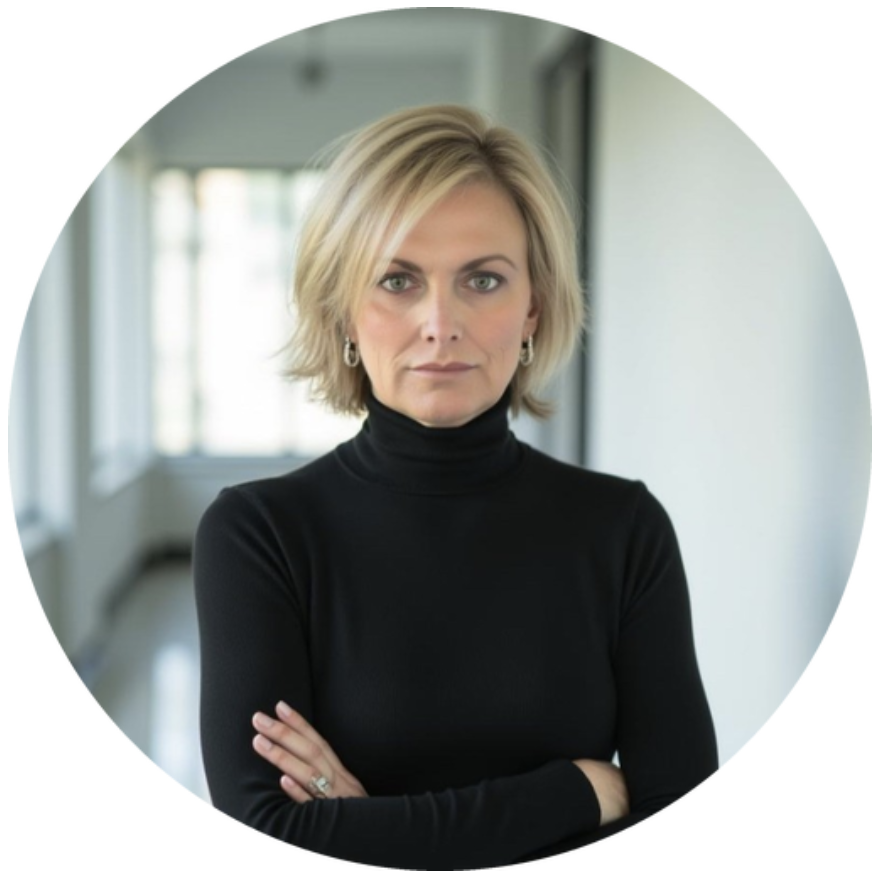
“If we don’t protect time for AI work, there’s always something more urgent that takes its place. We set aside time every week, cleared internal meetings on summer Fridays, and gave people access to help. You have to make room for learning and building while everyone is still doing their regular jobs.”
The team also balanced internal development with outside expertise. Of 12 marketing AI initiatives, nine were built internally, while three involved agency support for more complex projects and integrations.
The agency also helped interview stakeholders across functions, bringing an outside perspective to discovery and reducing the workload on the internal team. Employees remained responsible for defining requirements, contributing business expertise, and evaluating results. A cross-functional AI task force helped establish governance and guardrails.
For Stacy Simpson, CMO of athenahealth, the investment in AI was also an investment in her team’s capabilities.
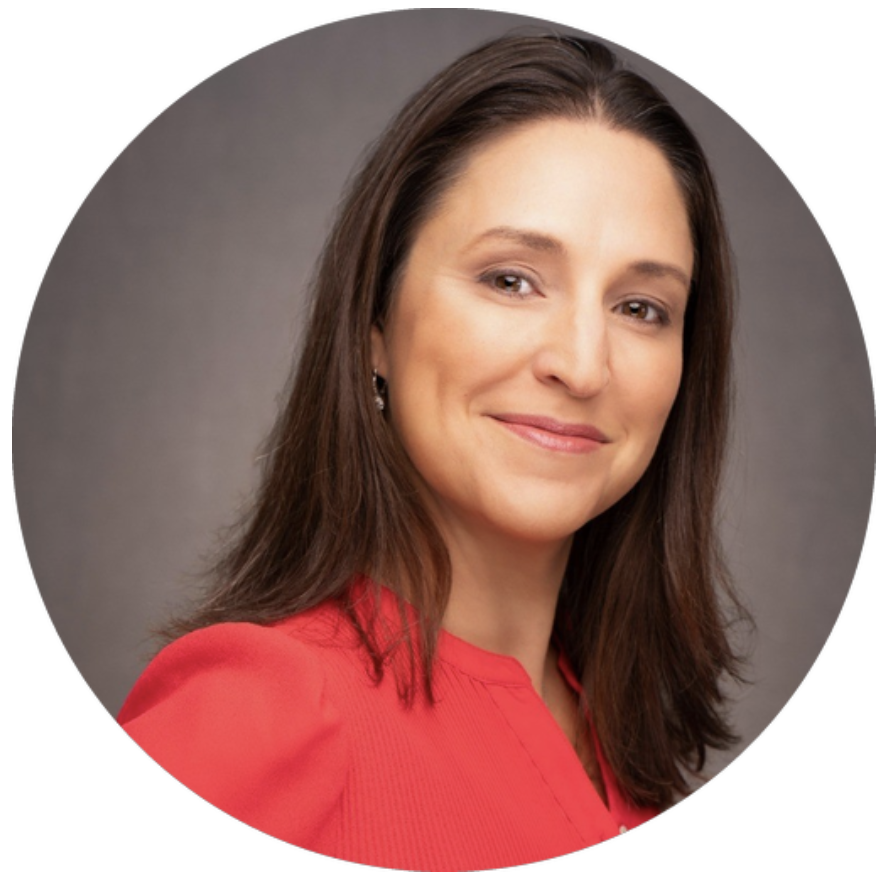
“For the more complex projects, we bring in outside technical expertise. But our marketers still define the problems, set the standards, and evaluate the results. I want our people developing those capabilities so they can rethink how they work and take on opportunities that weren’t possible before.”
Both initiatives are progressing, but important work remains. The Brand Review Agent is still being tested alongside human reviews as the team refines how it handles subjective decisions. The Brand Health Dashboard’s data connections are complete, and the team is preparing for regular monthly reporting. The impact on time savings and business outcomes has not yet been measured.
What We Can Take Into Our Own GTM Work
One exercise I’d encourage GTM teams to try is asking employees to teach AI a workflow they know well. Pay attention to where the instructions break down, where people need to exercise judgment, and where AI could help them do better or different work.
Use what you’ve learned to improve the workflow with the people who do the work today. Then track what happens: whether the changes improve quality, reduce repeated problems, give people more time to improve standards, support colleagues, and act on customer and market insights.
The opportunity goes beyond doing existing work faster. It’s about helping people make better decisions, respond to changing customer needs, and continue earning their trust.
The Practical AI in Go-to-Market newsletter shares learnings and insights in using AI responsibly. Subscribe today and let’s learn together on this AI journey.
For applied learning: Explore our applied AI workshops, offering both strategic sessions to shift mindsets through practical AI uses and hands-on sessions to build human+AI workflows. You’ll leave with either a clear plan or working solutions. Office hours provide follow-on support to keep momentum going.
For ongoing advisory: I work with leaders as a strategic advisor through their AI transformation, providing guidance, frameworks, and a sounding board as they build. If that’s what you need, let’s talk.
For team transformation: I partner with GTM leaders to move from scattered AI adoption to an operating model where human and AI teammates work together across workflows.
For speaking: Here are virtual and in-person events where I’ve covered a variety of AI topics. I’ve also keynoted at many conferences and corporate events.
If any of this resonated, I’d love to hear from you. Reply to this email, find me on LinkedIn, or come say hi at an event.