• Skip to primary navigation
  • Skip to main content
GrowthPath Partners LLC

GrowthPath Partners LLC

Empowering Purpose-Driven Growth

  • Engagements
  • Speaking
  • Newsletters
  • About
  • Contact
  • Show Search
Hide Search

change management

AI Is Making the Human Side of Work Harder to Avoid

Liza Adams · September 17, 2026 ·

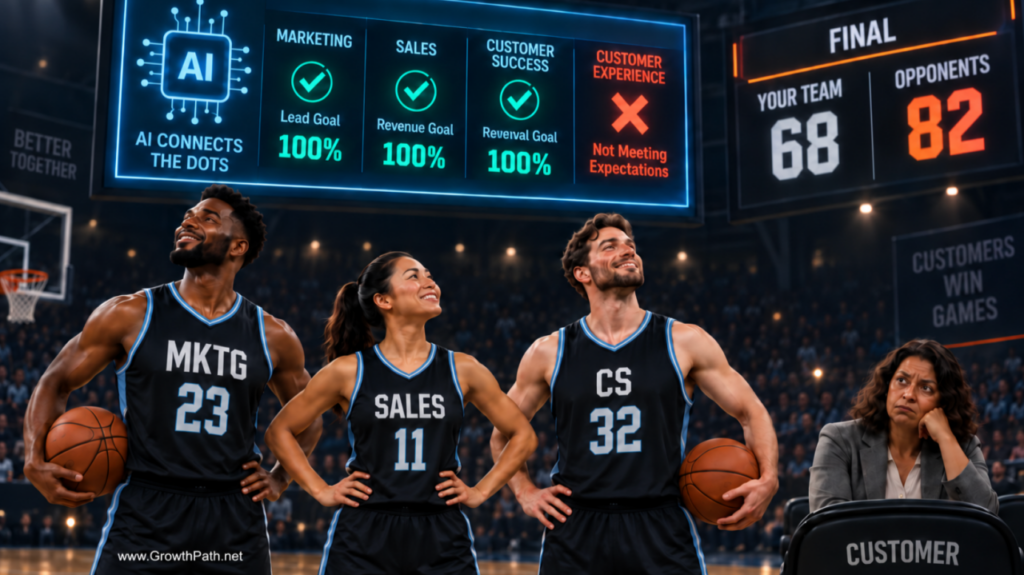
Basketball players in Marketing, Sales and CS jerseys celebrating individual goals while the team loses

Marketing hits its lead goal. Sales hits its revenue number. Customer Success hits its renewal target. And the customer can still have a lousy experience.

You wouldn’t call a basketball team successful because every player hit an individual stat while the team lost. A point guard can lead in assists, a center in rebounds, and a forward in points, and they can still lose to a less talented team that plays better together. Players still have individual roles and stats, but the team is also judged on the outcome. We understand that in sports. At work, we often reward each function for hitting its own number even when the customer experience suffers.

Nobody has to be doing a bad job. Each team can be doing exactly what it was asked to do. The customer moves across Marketing, Sales, and Customer Success, while our goals, systems, processes, and incentives often stop at the functional boundary.

For years, some of those gaps were hard to fix. Customer information sat in different systems, context got lost in handoffs, and connecting what one function knew to the next took more time and coordination than teams could sustain. AI can remove more of those constraints.

As it does, the human questions get harder to avoid. Will we trust what we learn? Will we act when the evidence challenges something we believe? Will Marketing, Sales, and Customer Success change how they work when a better customer outcome requires different choices?

Quick Take

AI can solve more of the mechanics behind disconnected GTM work. What I’m seeing is how quickly that exposes the harder human work.

  • AI can carry customer and market context across functions. People still have to decide where functional accountability ends and shared accountability begins.
  • Better information only helps when people trust it enough to act, especially when it challenges an existing belief or decision.
  • Reimagining a workflow can change roles, ownership, decision rights, and how teams work together.
  • I’ve seen AI improve a Marketing-to-Sales handoff enough to move SDR open rates from 15% to 40%. The workflow improved, but the teams still had to make the organizational decisions around it.
  • Companies start from different places. History, hierarchy, culture, regulation, resources, and what they need to protect affect how quickly the human side can change.

Watch or Listen Instead

To support different learning styles and time constraints, this newsletter is also available as a 5-min cinematic AI video explainer and a 18-min AI podcast with two AI hosts. Both were made with Gemini Notebook and personally reviewed for accuracy and responsible AI use.

AI Can Solve More of the Handoff Now

I’ve seen this with a global cybersecurity company I work with. One workflow gave SDRs consistent company, industry, role, and messaging context instead of requiring them to recreate it for every prospect.
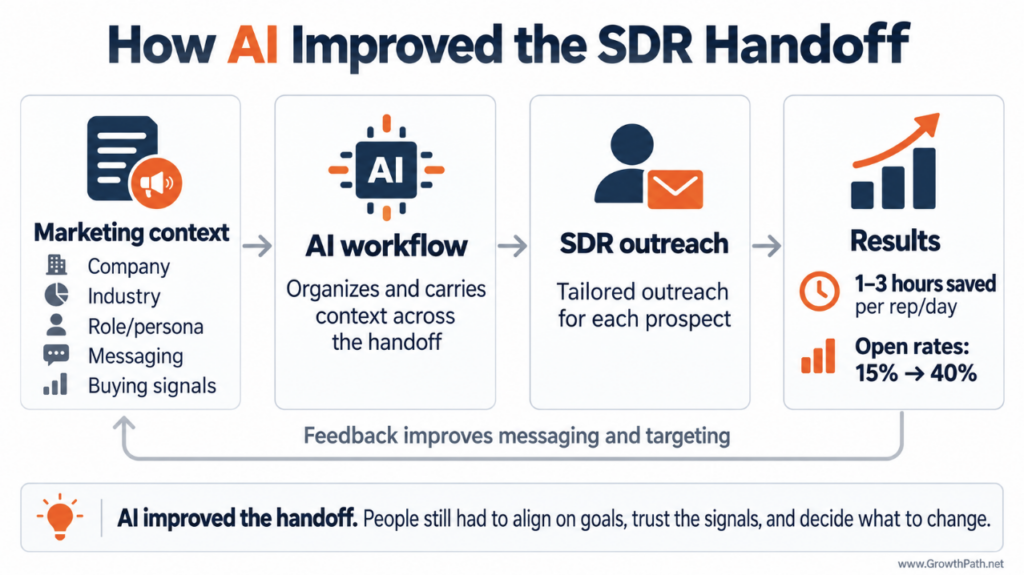
How AI improved the SDR handoff: marketing context, AI workflow, tailored outreach, open rates from 15% to 40%

Reps saved one to three hours a day, and open rates increased from 15% to 40%.

AI solved an important part of the handoff. The workflow could carry context, but Marketing and Sales still had to decide what they should optimize for together, which customer signals to trust, and what to change when new evidence challenged how they were working.

Those are the kinds of human questions I keep seeing as more of the mechanics get easier.

Where the Human Work Shows Up

In my work with GTM teams, I’ve observed three key human challenges. They aren’t new, and I don’t think they’re the only ones. But as AI makes more of the mechanics easier, they’re becoming harder to work around.
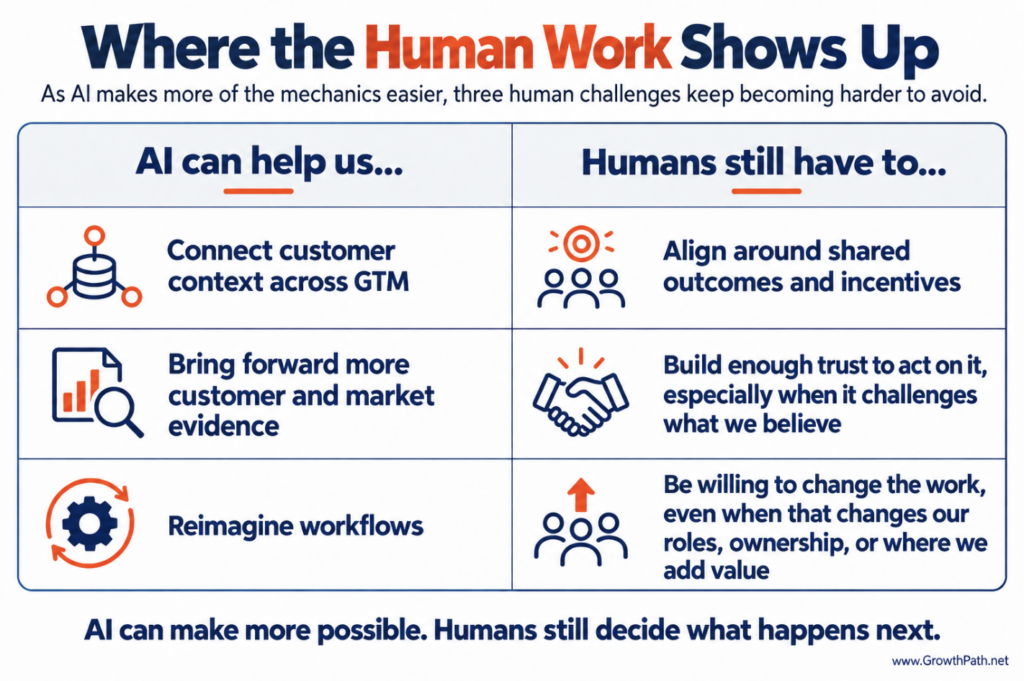
Where the human work shows up: what AI can help with and what humans still have to do

1. Better Information Doesn’t Create Shared Outcomes

AI can make customer context much easier to share. That still doesn’t align what each team is accountable for.

Marketing can see what happens after a lead becomes an opportunity. Sales can know more about what brought the buyer in. Customer Success can start with more of the history. But if Marketing is measured on leads, Sales on the close, and Customer Success on renewal, each team can make a rational decision for its own number that works against the customer outcome.

The measures don’t need to be identical, and I don’t think the answer is to abandon functional goals. Sales still needs a quota. Marketing and Customer Success need measures tied to their own responsibilities. The harder question is where to add shared accountability so each function also has a stake in the customer outcome.

That could mean a shared goal, a common scorecard, or in some cases incentives tied partly to outcomes such as getting the right customers, time to value, retention, expansion, or overall customer satisfaction.

2. More Insight Requires More Trust

AI can synthesize far more customer and market information than any one person can process. The challenge comes when the evidence contradicts something we’ve already invested in.

  • Customer conversations may challenge positioning we’ve spent a year building.
  • Win/loss analysis may suggest the problem isn’t sales execution.
  • Support tickets may show that something we considered minor is affecting customers far more than we realized.

Trust doesn’t mean accepting AI output at face value. We still need to check the evidence, add context, apply judgment, and decide whether it’s strong enough to act on.

It also requires trust between people. Someone needs to be able to bring uncomfortable evidence into a cross-functional conversation without it becoming an attack on someone’s work.

Curiosity and intellectual humility become more valuable as AI gives us more ways to test what we think we know. That only helps if we’re willing to be wrong and change our minds when the evidence supports it.

3. Reimagining Work Means Letting Go of Some Old Work

Changing a workflow gets harder when it changes who does the work, who owns the decision, or where someone’s expertise is needed.

People have spent years building expertise, careers, and influence around existing roles and processes. When AI makes a different way of working possible, we may be asking them to reconsider work they’re good at, responsibilities they own, or where they believe they add value.

That uncertainty deserves to be taken seriously. But if work that once required several people, multiple handoffs, and approval steps can now happen differently, we should be willing to rethink the process.

Stacy Simpson, CMO of athenahealth, is working through this now. Her team mapped the full campaign process and identified where individual agents could take on parts of the work. They’re now at the point where the process itself can change.

Headshot of Stacy Simpson, CMO of athenahealth
Stacy Simpson, CMO of athenahealth

“We’re in the middle of the story. We know the outcome we want, but the process isn’t predetermined. We started by identifying where individual agents could help. Now we’re asking how the process itself should change, how agents hand work to each other, and where humans need to step in.”

Changing the process also changes what we need from the people doing the work. Siddharth Taparia, Global CMO of JLL is thinking about that from the role and talent side.

Headshot of Siddharth Taparia, Global CMO of JLL
Siddharth Taparia, Global CMO of JLL

“AI fundamentally changes what we ask people to do and the skills they need. For example, a campaign manager will spend less time building campaigns and more time orchestrating and evaluating AI outputs. That means we have to rethink how we develop talent. The skills that matter most are shifting. Strategic thinking, cultural awareness, curiosity, and adaptability will become critical.”

We may not know exactly what every role becomes yet. That makes it more important to involve people in redesigning the work and help them see where their judgment, experience, and relationships can add more value.

I went deeper on five examples in 5 Reimagined Workflows: Work We Skipped That AI Now Does.

Different Starting Points

Organizations are starting from very different places. An established company may have customers, revenue, specialized roles, approval layers, regulatory requirements, and systems that already work. Changing any of those carries real risk.

A smaller company may have fewer people, less budget, and less technical support, but also less to unwind. When adding people isn’t an option, there can be more reason to rethink how the work gets done.

I think what a company has to protect may be a bigger factor than size. The more that already works, the more carefully people have to decide what should change and what should stay.

I covered this topic in more detail in The Boldest AI Moves are Coming From the Smallest Budgets.

Where Competitive Advantage May Come From

AI capabilities will keep advancing, and access to similar models and tools will get easier. The difference I’m watching is what companies do when AI gives them better information or makes a different way of working possible.
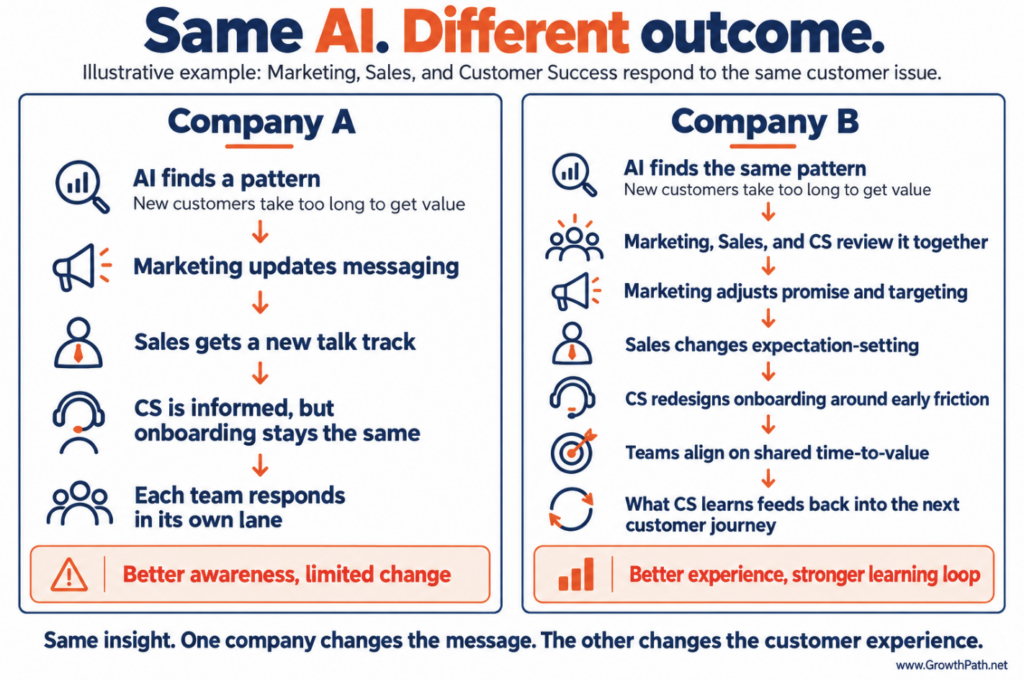
Same AI, different outcome: two companies respond differently to the same customer insight

Over time, a company willing to change how the work gets done learns more than how to use AI. Its people learn where AI works well, where human judgment is needed, and how to change when new evidence gives them a reason to.

That’s where I think some of the advantage comes from. Technology can be bought. Trust, judgment, shared accountability, and the ability to change how people work together take longer to build.

Michael DiPietro, an operating advisor at JMI Equity who works across its portfolio companies, keeps the test grounded in business results:

Headshot of Michael DiPietro, Operating Advisor at JMI Equity
Michael DiPietro, Operating Advisor at JMI Equity

“We encourage our portfolio companies to focus their AI initiatives on high-impact workflows and change. These should not only drive better business outcomes but ideally create a better customer experience. As one of our portfolio company leaders said, ‘It’s not AI transformation, it’s business transformation.’ We want them to think of AI as a means, not an end.”

I also don’t think this stays a competitive advantage forever. Over time, a more connected, context-aware experience may simply become something customers expect.

Customers don’t care how our org chart works. They expect us to know what they’ve already told us, carry that context across the journey, and respond as one company. As AI makes more of that possible, some of the gaps we’ve learned to live with become harder to justify.

I wrote more about the CMO’s role in carrying that customer context across the business in CEOs Are Looking for a Different Kind of CMO. Are You It?

Think big, start small, move fast. Try something, learn, adjust, and be willing to zig and zag.

A Few Questions I’d Ask

These are three questions I’d bring into a GTM leadership conversation:

  • Shared outcomes – Where should Marketing, Sales, and Customer Success keep distinct goals, and where should they share accountability for the customer outcome?
  • Trust – What happens when customer or market evidence challenges something an influential person or function believes?
  • Willingness to change the work – If we designed this work from scratch today, would we give the same people and functions the same responsibilities and decision rights?

What I’m Still Figuring Out

What I’m still trying to understand is what helps people move from agreeing that work should change to being willing to change their own work.

Hands-on experience seems to help. I see belief change when people use AI on their own problems, see what it can and can’t do, and have a hand in redesigning the workflow.

I’m also watching what happens when the next role isn’t clear yet. People may be more willing to let go of familiar work when they can see where their judgment, experience, and relationships will add more value. But we won’t always have that answer before the work starts changing.

We’re asking people to help redesign work that may also change their own roles. I think they need a real hand in shaping what comes next.


The Practical AI in Go-to-Market newsletter shares learnings and insights in using AI responsibly. Subscribe today and let’s learn together on this AI journey.

For applied learning: Explore our applied AI workshops, offering both strategic sessions to shift mindsets through practical AI uses and hands-on sessions to build human+AI workflows. You’ll leave with either a clear plan or working solutions. Office hours provide follow-on support to keep momentum going.

For ongoing advisory: I work with leaders as a strategic advisor through their AI transformation, providing guidance, frameworks, and a sounding board as they build. If that’s what you need, let’s talk.

For team transformation: I partner with GTM leaders to move from scattered AI adoption to an operating model where human and AI teammates work together across workflows.

For speaking: Here are virtual and in-person events where I’ve covered a variety of AI topics. I’ve also keynoted at many conferences and corporate events.

If any of this resonated, I’d love to hear from you. Reply to this email, find me on LinkedIn, or come say hi at an event.
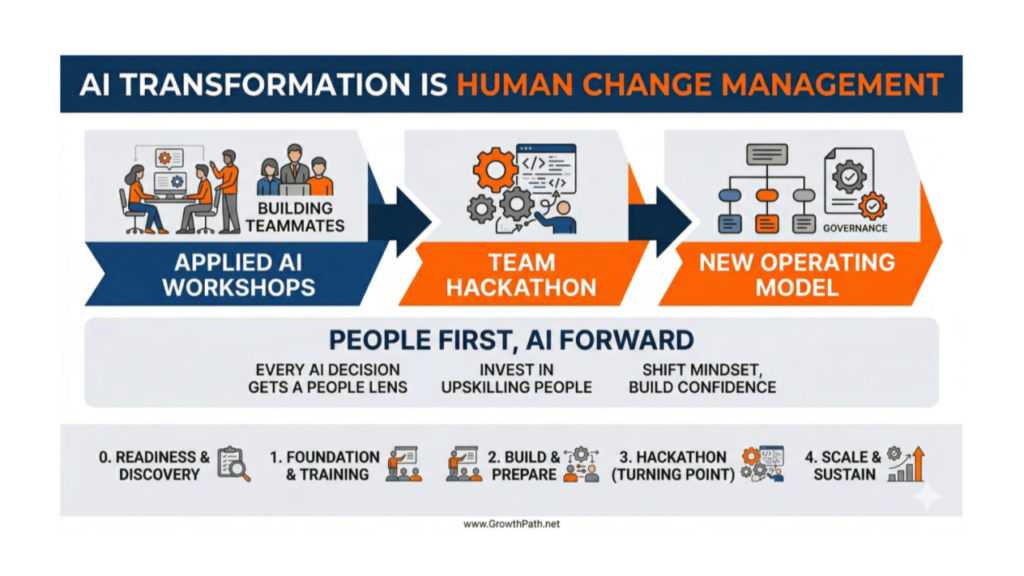
Human Change Management: From Applied AI Workshops to Hackathon to New Operating Model

Liza Adams · April 2, 2026 ·

AI transformation is human change management: workshops, hackathon, new operating model

The workshops worked. People built their first AI teammates and workflows, saw what AI could do with their actual work, and left excited to keep building.

But few teams have a plan for what comes after. The experiments stay scattered. The early excitement doesn’t connect into a sustained operating model. The hardest parts aren’t technical.

This is Part 2 of a two-part series. Part 1 covered four dimensions for seeing where your team is with AI: Q&A machine to thought partner, tool to workflow, faster to different, and org chart to work chart. You don’t need it to get value from this one, but it’s a useful companion.

Quick Take

AI transformation is human change management. Every phase exists to serve the people going through it.

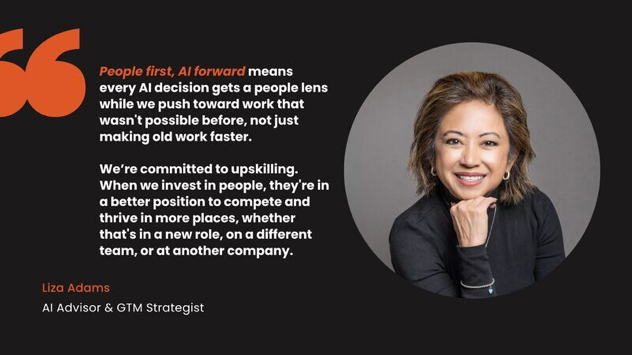
Quote: People first, AI forward. Liza Adams

What I’m sharing here comes from working with teams through the full journey. There aren’t best practices yet. We’re all figuring this out. But I’ve seen enough patterns to know what tends to work, what tends to stall, and where teams get stuck. This is a starting point, not a playbook to follow step by step. Adapt everything to your goals, culture, and pace.

Key takeaways:

  • Mindset shifts happen through demos of what’s possible with applied AI use cases and actually building for their own work
  • A hackathon gives a team the moment to stop experimenting in pockets and start building together
  • Workshops start the change. Weekly office hours, show-and-tells, and a safe space for failure are what keep it going.
  • The goal of every phase is to make the team capable of evolving on their own

AI Video Explainer and AI Podcast Versions of This Newsletter

To support different learning styles and time constraints, this newsletter is available as an 5-min AI video explainer and a 20-min AI podcast with two AI hosts. If you haven’t seen these AIs in action, they’re worth a view. I used Google’s NotebookLM to create these and personally reviewed them for accuracy and responsible AI use.

The Full Path

You can run a workshop in an afternoon. Taking a team from experimentation to a sustained operating model takes months.

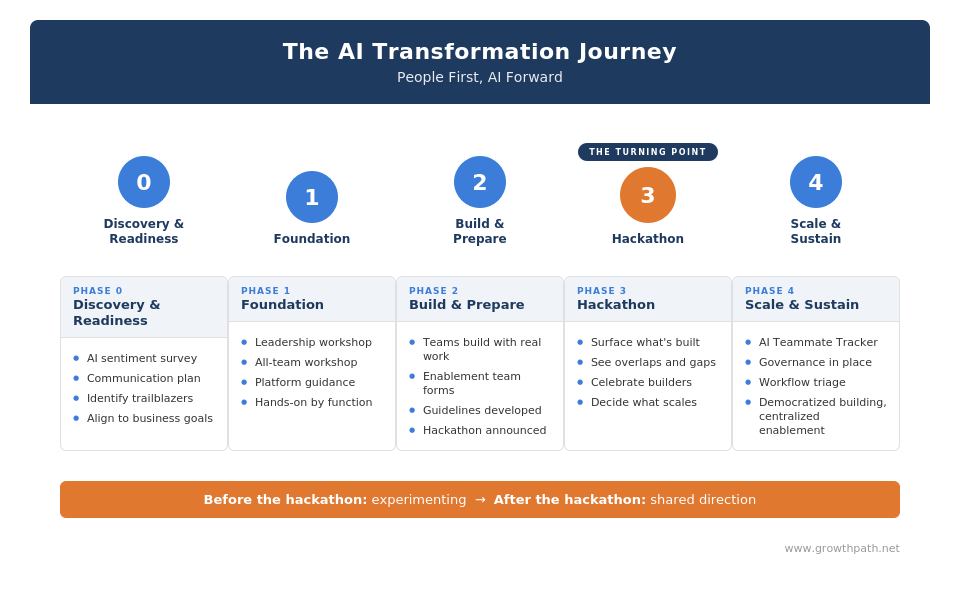
The AI transformation journey: five phases from discovery to scale and sustain

Every team adapts this differently. Some compress phases, some skip Phase 0 because they’ve already done the groundwork, some run all the workshops at once instead of sequencing them. The value of seeing the full path is knowing what’s involved so you can plan for it.

Phase 0: Discovery and Readiness

Before any workshops, understand where people are. Some teams already know this from conversations and observation. Others benefit from a structured approach, like an employee AI sentiment survey, to surface concerns that don’t come up in meetings.

A communication plan is one of the most underestimated steps. And I think the honest version works better than the safe one. People come in with different concerns: some feel overwhelmed, some are skeptical that AI applies to their work, some worry about looking like beginners. Acknowledging those concerns directly builds more trust than ignoring them.

Regardless of how anyone feels about AI, being AI literate is baseline. When people are literate, they make better decisions for themselves, their families, their teams, and their organizations.

Upskilling is a gift to your team. It helps the business, and it helps them compete in their careers beyond your company. That message, when it’s genuine, builds trust in ways that corporate talking points can’t.

Identify your trailblazers early: the people already experimenting on their own. They become peer mentors, early testers, and proof to the rest of the team that this is doable. They pull people forward in ways that leadership support alone can’t.

Teams that skip the communication work tend to spend months fighting resistance that could have been addressed early.

Phase 1: Foundation

This phase grounds everyone in why AI adoption connects to customers and business outcomes, and gives people hands-on experience building.

In larger organizations or teams where alignment isn’t strong yet, leadership often goes first so they can champion what comes next. In smaller or more aligned teams, you might bring everyone in together.

The four mindset shifts from Part 1 develop when people see what’s possible through applied use case demos and build something real with their own work and see it produce results.

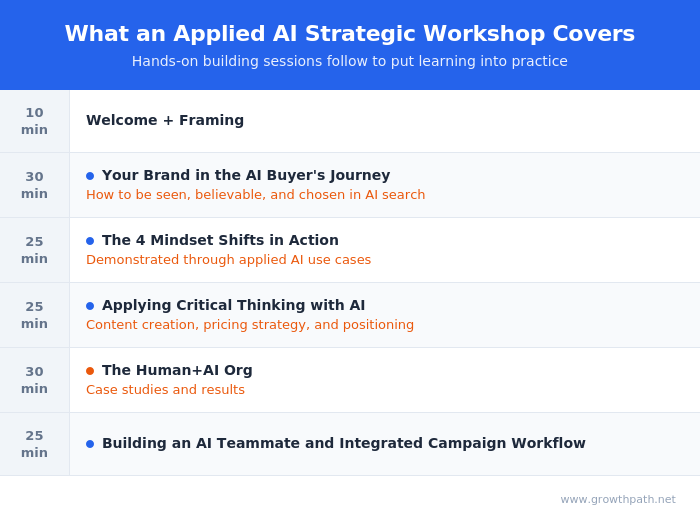
A workshop like this typically covers five areas:

What an applied AI strategic workshop covers

Hands-on building workshops follow, organized by function so people build with use cases relevant to their role before connecting to broader workflows. I’ve seen these work well virtually and in person.

I recently ran a workshop with the marketing team at Applied Systems. Their CMO, Courtney Rains, described the shift she saw:

Headshot of Courtney Rains, CMO of Applied Systems
Courtney Rains, CMO of Applied Systems

“When the demos started, you could see it click. People watched use cases they do every day, competitive intel, campaign planning, customer content, get built live in front of them. Light bulbs were going off around the room.

During the hands-on session, people progressed at different speeds, and that’s completely fine. Some were still exploring prompts. Others built full workflows. Everyone left with a clearer picture of what’s possible.”

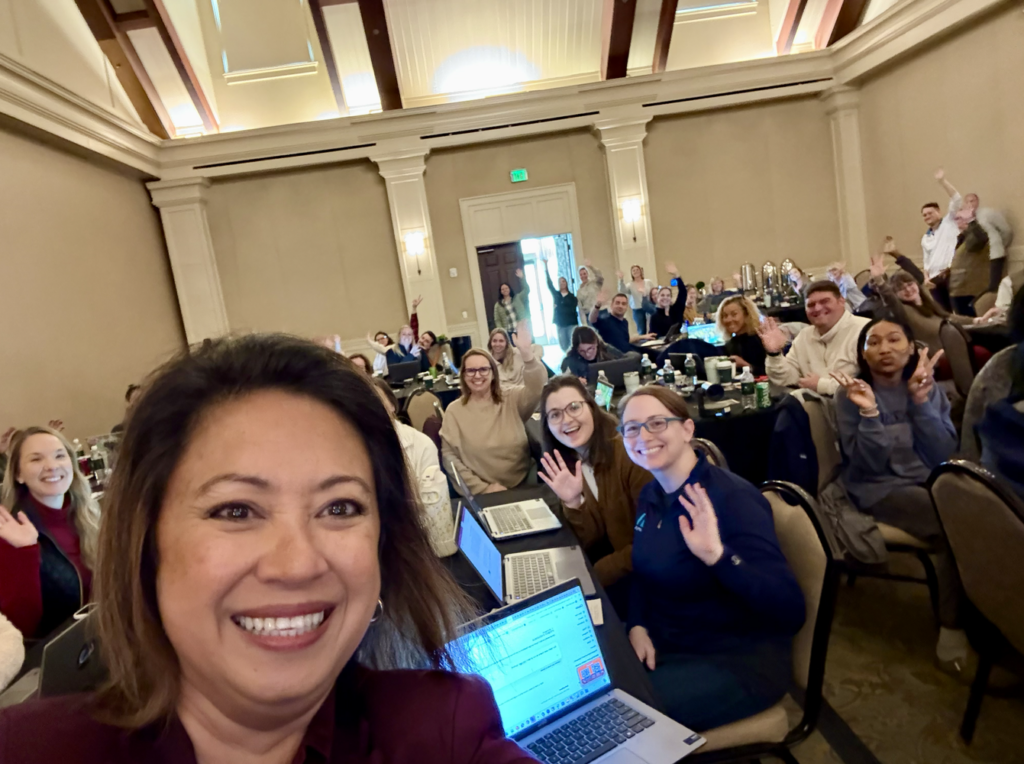
Applied Systems marketing team in a hands-on AI session
Applied Systems Marketing Team in Hands-On AI Session

Whether you run workshops yourself or bring in outside help, the structure works because it moves from why to what to how. People leave with something they built and a different sense of what AI can do for their work.

Need a starting point for what to build? This interactive tool helps teams explore AI teammate and workflow ideas.

There’s also a separate workshop for what I call enablers: the people who will eventually form the enablement team. This covers cross-system automation, agent orchestration, and workflow design into business systems, because these folks need different skills than the rest of the team. Not everyone should have read/write access into every business system. This team helps with those connections, data, security, compliance, governance, and cost management.

Phase 2: Build and Prepare

Sometimes it’s a cross-functional team and sometimes it’s a select operations group like Marketing Ops and Rev Ops that has the skillset needed and that works with Legal, IT, and Finance. Responsible AI guidelines get developed collaboratively. A tracker shows what’s being built across the org.

This phase gets messy. People build teammates that overlap with what someone else built. Some experiments don’t get used. That’s learning by doing. The tracker helps make the work visible so the mess can eventually become structure.

What keeps the momentum going between the workshop and the hackathon is the habits and routines you put in place:

  • Reprioritizing people’s work to give them the space and time to learn AI
  • Weekly office hours for support, inspiration, learning, and troubleshooting
  • Show-and-tells where teams share what’s working, what’s not, and what they’ve learned
  • Failure sharing to normalize experimentation. One CMO I work with runs “Thriving Thursdays” and “Failing Fridays,” giving equal time to both
  • A Slack or Teams channel for ongoing peer sharing and learning
  • Trailblazer spotlights at all-hands to recognize early adopters

Sarah Weddle, VP of Brand Marketing at Harbor Capital Advisors, Inc., described what weekly sessions did for her team:

Headshot of Sarah Weddle, VP of Brand Marketing at Harbor Capital
Sarah Weddle, VP of Brand Marketing at Harbor Capital

“AI can answer a lot of questions we have about how to use it, but what actually moved our team forward was the live sessions. Having a space to troubleshoot real challenges, see what others were building, and learn in real time made it practical.

At Harbor, we talk a lot about the value of access, and having direct access to that kind of expertise made all the difference. You could see the shift—team members became more creative and intentional in how they leveraged AI as a thought partner. That change in mindset alone was a game changer.”

The safe space for failure is where I see teams struggle most. Some leaders say they want experimentation but shut it down the first time something doesn’t work. When people can share what didn’t work without judgment, experimentation stays alive. When it gets shut down or ignored, people stop trying new things.

For a deeper look at how this works in practice, see How a Lean Team Transformed into a Human+AI Powerhouse.

Somewhere in this phase, you announce a hackathon. Two signals tell you the team is ready. People start building workflows that cross functions on their own, like a marketing and sales team connecting an SDR research workflow without being asked. And your AI teammate tracker starts showing overlaps, duplicates, and clear gaps, which means enough people are building that coordination is needed.

Phase 3: Hackathon

I’ve started calling this the turning point. A team goes from building in pockets to building together.

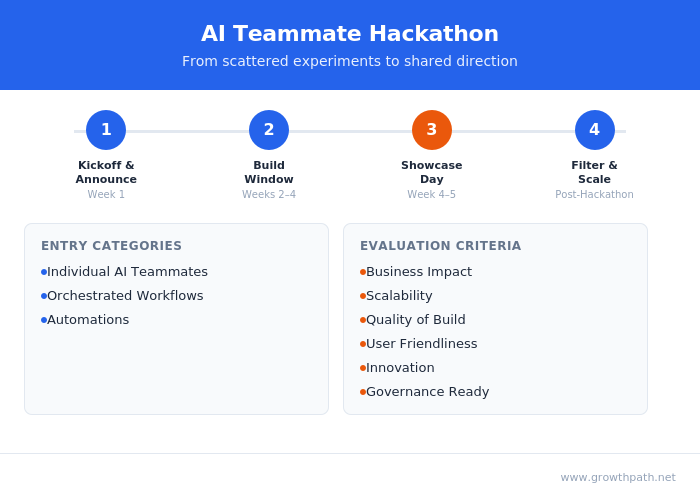
In the teams I’ve worked with, a hackathon is a multi-week build window where people refine what they’ve already started, followed by a showcase day where teams present their work. It’s not a weekend sprint or a competition for bragging rights.

AI teammate hackathon: kickoff, build window, showcase day, filter and scale

When responsible AI adoption enables strategic initiatives, the C-suite typically gets involved. They champion it and even get their hands dirty building teammates and workflows themselves. This is a cultural shift.

A judging panel reviews submissions against criteria like business impact, scalability, and readiness for responsible use. The payoff goes beyond the judging. For the first time, the full team sees everything that’s been built. The team decides together what’s worth scaling.

Rhiannon Naslund, CMO of Origami Risk, used a leadership workshop to prepare her marketing team for a companywide hackathon.

Headshot of Rhiannon Naslund, CMO of Origami Risk
Rhiannon Naslund, CMO of Origami Risk

When the company held a hackathon, our team was ready. We had seven submissions, the most of any team, and we’re one of the smallest in the org. One of our submissions was a campaign analyzer that turned a weeks-long quarterly review into a one- day process. The hackathon got people collaborating on ideas and most have continued building since.

I think it’s important to mandate experimentation, not simply roll out tools. The workshop we did before the hackathon was a really important step to help my team develop new skills and be successful.

Phase 4: Scale and Sustain

The operating model is democratized building, centralized enablement. Everyone closest to the work keeps building. The enablement team makes it safe and scalable. When a new workflow needs to connect to business systems, the enablement team triages it: who builds it, what systems it touches, what reviews it needs.

To see what this model looks like in practice, see AI Moved Fast: What Changed and What to Do Next.

You don’t need dozens of workflows to prove this works. Think big, start small, move fast. Pick a handful, make them work well, and add on. Some will crop up organically from trailblazers already building. Others come from leaders who prioritize workflows tied to strategic initiatives, address the biggest pain points, or reimagine processes that were built for a world that no longer exists.

The AI growth dashboard from Part 1 helps leaders track progression across the four dimensions and see where people need support, including where someone’s confidence has grown and where they might be stuck.

Governance is where teams often get stuck. Too little and you get risk. Too much and you slow everyone down.

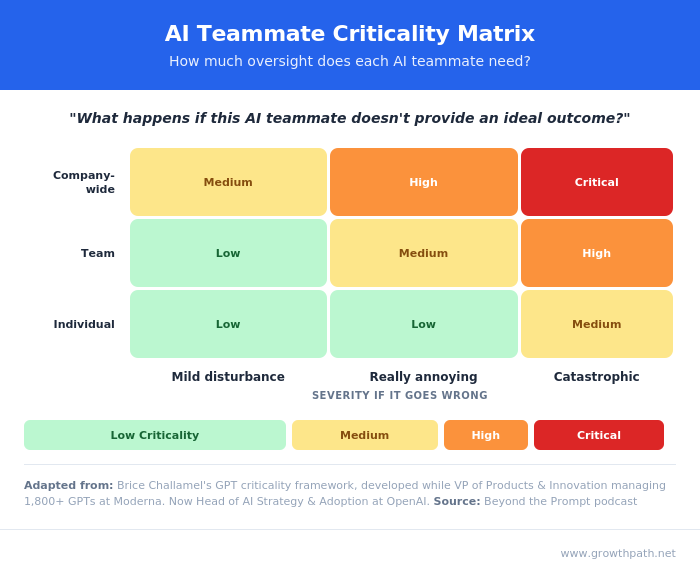
One framework worth considering: Brice Challamel, who was VP of Products & Innovation at Moderna managing 1,800+ GPTs (now Head of AI Strategy & Adoption at OpenAI), uses a two-axis matrix to rate every AI teammate by scope of impact (individual, team, company) and severity if it goes wrong (mild disturbance, really annoying, catastrophic).

The combination gives you a criticality rating that determines how much oversight each teammate needs. (He describes this framework in Beyond the Prompt podcast.)

AI teammate criticality matrix: how much oversight each AI teammate needs

To see what Phase 4 looks like at scale, see How a Leading Cybersecurity Company Redesigned Marketing Workflows to Scale Business Impact with AI.

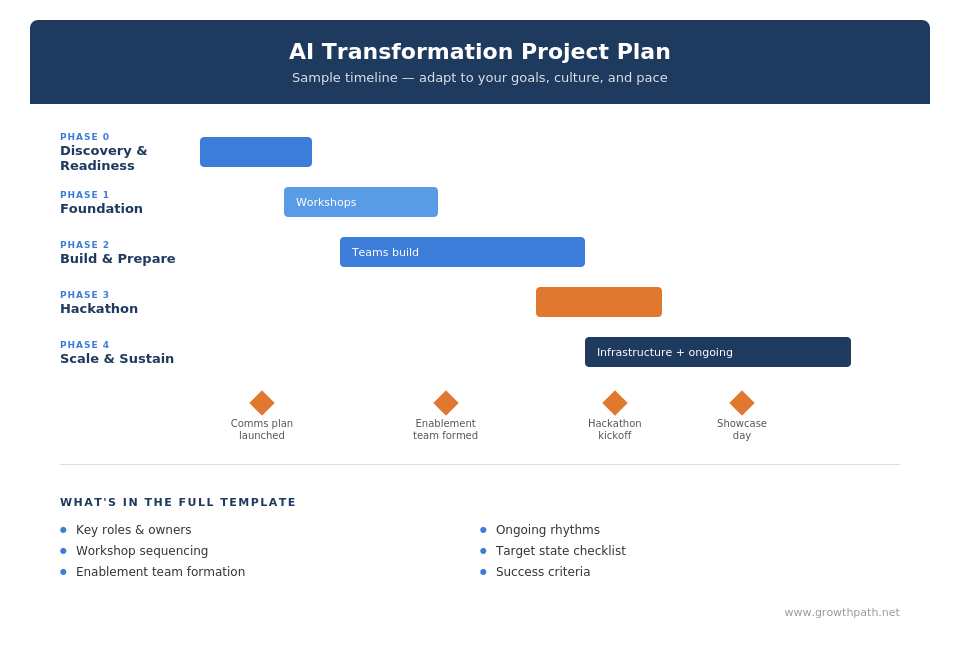
The goal of this entire phase is to make the team capable of evolving on their own. Here’s what the full arc looks like when you put it all together.

Sample AI transformation project plan timeline

Phase 0 readiness is easy to skip and expensive to skip. Ongoing habits need to continue after any formal initiative ends. Define what success looks like before you start. Teams that wait end up scrambling for metrics after the fact to prove the work was worth it.

No two teams run this the same way. But seeing what’s involved helps leaders plan.

The Bottom Line

AI transformation is human change management. We need to meet people where they are and bring them along with compassion and grace.

If you’re not sure where to start, pick one workflow that crosses two teams and look at what breaks at the handoff. That’s where an AI teammate can do real work, and it’s the fastest way to show your team what’s possible.

This is doable. Teams are doing it right now, across industries, at different sizes, at different paces. Some run the full path on their own. Others bring in someone who has been through it before to move faster. Either way, the playbook is the same: invest in your people, create space for applied learning, and build the structure so new ways of working stick.

If any of this resonated and you want to compare notes, I’d welcome the conversation.


The Practical AI in Go-to-Market newsletter shares learnings and insights in using AI responsibly. Subscribe today and let’s learn together on this AI journey.

For applied learning: Explore our applied AI workshops, offering both strategic sessions (use cases and roadmaps) or hands-on building (create AI teammates during the workshop). You’ll leave with either a clear plan or working solutions. Office hours provide follow-on support to keep momentum going.

For ongoing advisory: I work with leaders as a strategic advisor through their AI transformation, providing guidance, frameworks, and a sounding board as they build. If that’s what you need, let’s talk.

For team transformation: I partner with GTM leaders to move from scattered AI adoption to an operating model where human and AI teammates work together across workflows. See real examples: a lean GTM team’s step-by-step playbook and a global cybersecurity leader scaling to 150+ marketers with 57 AI teammates integrated into daily workflows.

For speaking: Here are virtual and in-person events where I’ve covered a variety of AI topics. I’ve also keynoted at many organization and corporate-wide events.

If any of this resonated, I’d love to hear from you. Reply to this email, find me on LinkedIn, or come say hi at an event.
Copyright © 2026 · GrowthPath Partners LLC · Log in

  • LinkedIn