
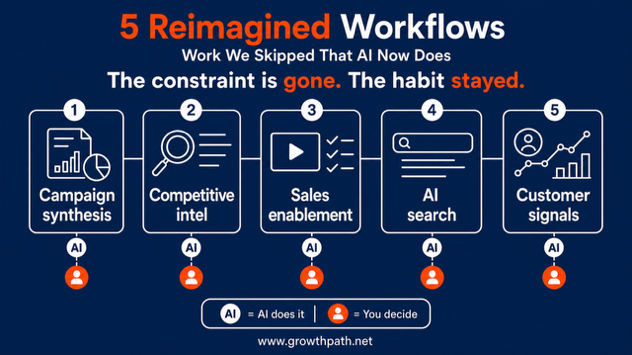
There’s a whole category of work your team’s not doing. Reading every sales call. Refreshing battlecards every week. Tailoring the message to each deal. You skipped it because it was slow, manual, or expensive to do by hand.
Some of the most important work also needed you to look outward and keep looking, at the whole market, at each account’s world, at what buyers say across hundreds of calls. Your team looks at what it can see, which is its own data. Not from a lack of effort, but because one team can only do so much. AI can look outward, and do it continuously.
That made sense before AI. For a lot of this work, the reason you skipped it is gone. The question worth asking about any task you skipped: is it still hard, or just historically hard?
Quick Take
The GTM workflows I see being reimagined aren’t revolutionary. They’re practical, teams are running them today, and they’re changing how the work gets done. They’re the work we always wanted to do, but it was more than an all-human team could handle.
What I share here comes from working with teams just a few months into agentic workflows becoming more real and accessible for GTM teams. These teams lean AI-forward, so take it as early signal, not a perspective on the whole market. And the point is never AI. It’s the work AI makes possible.
Key takeaways:
- AI now makes more work doable. But we have to fix the habit of not doing this work.
- The best inputs are already in your systems: your calls, usage data, support tickets, win/loss notes.
- Human teams look at what they can see, which is their own data. But AI can look outward too, at the market, at each customer’s world, at industries adjacent to yours, and bring back ideas with the reasoning.
- Five agentic workflow examples: build one plan from insights across all signals, watch the market and inform strategy, tailor the proof and practice to each deal, see how you show up when buyers ask AI, and understand how your customers are changing inside and out.
- AI handles what it does well: collection, synthesis, analysis, and execution at scale. Humans keep judgment and the final call.
Watch Or Listen Instead
To cater to different learning styles and time constraints, this newsletter is also available as a 6-min cinematic AI video explainer and a 15-min AI podcast with two AI hosts. Both were made with Google’s NotebookLM and personally reviewed for accuracy and responsible AI use.
5 Most Reimagined GTM Workflows
Each one runs as an agentic workflow. It moves through the steps on its own, pauses where your judgment is needed, uses other AI and tools to handle parts of the work, and delivers finished files you can use. You guide it, make the key decisions, and review the output.
1. Build one plan from every signal (campaign synthesis)
Today, with an all-human team:
- Teams coordinate in meetings and alignment calls, but something still gets missed.
- When the plan changes, it’s hard to reflect those changes wherever needed.
- The plan leans on one or two sources and misses what cuts across all of them, including what’s shifting in the market and in your buyers’ world.
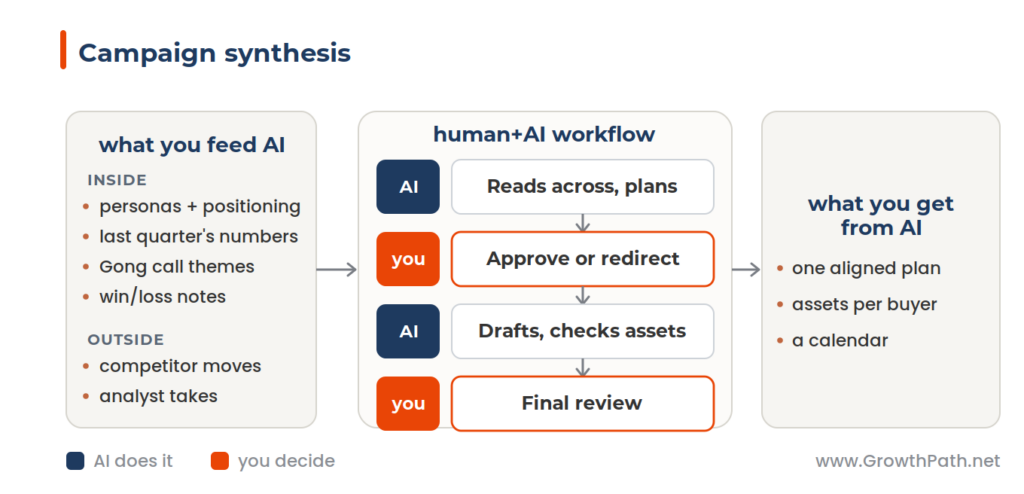
With human+AI:
- The plan is built from every source at once, internal signals and the market, and stays current when inputs change.
- Positioning applies across the buying committee because it reflects all of it
- The buyer gets one consistent story across every touchpoint, which builds trust earlier in the cycle.
The value is the synthesis, not just the drafts. A change made in the plan stage is one fix, not multiple ones, that gets applied throughout quickly.
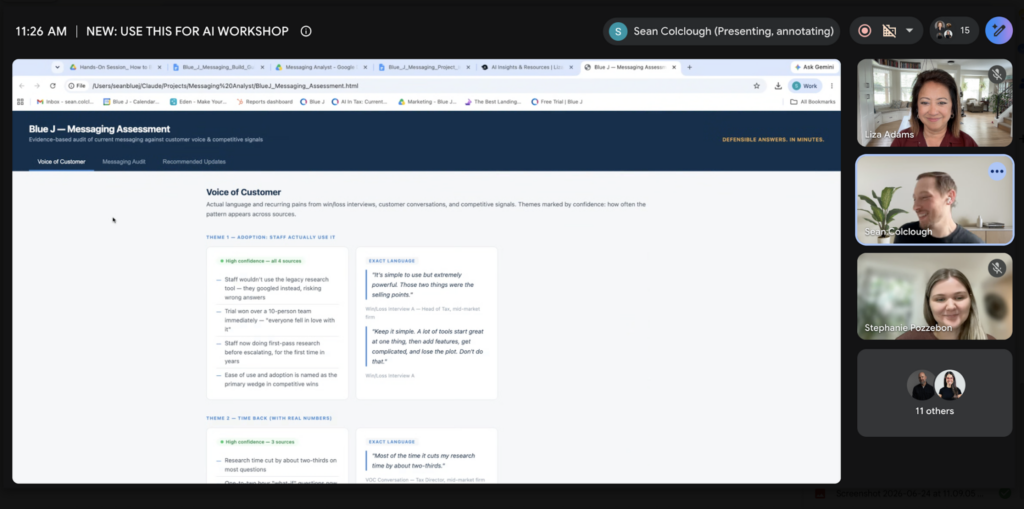
Christine Matu, VP of Product Marketing at Blue J, shared her thoughts after a team hands-on AI workshop.

“We used to pull personas, messaging, customer call transcripts and win/loss interviews from various sources and stitch them together every campaign. We want to ensure we’re always build from what customers actually say instead of the loudest opinion in the room, and that was challenging to do manually. Now it’s within reach. I’m looking forward to campaigns that resonate and reflect what our customers care about most, in real time.”
2. Watch the market and turn it into strategy (competitive intel)
Today, with an all-human team:
- Someone owns competitive intel, but watching every competitor’s site, pricing, reviews, and your own win/loss data is more than one person can keep up with, so it happens in bursts.
- Battlecards get built once and then go out of date. By the time a competitor’s new claim reaches your reps, a few deals are already lost to it.
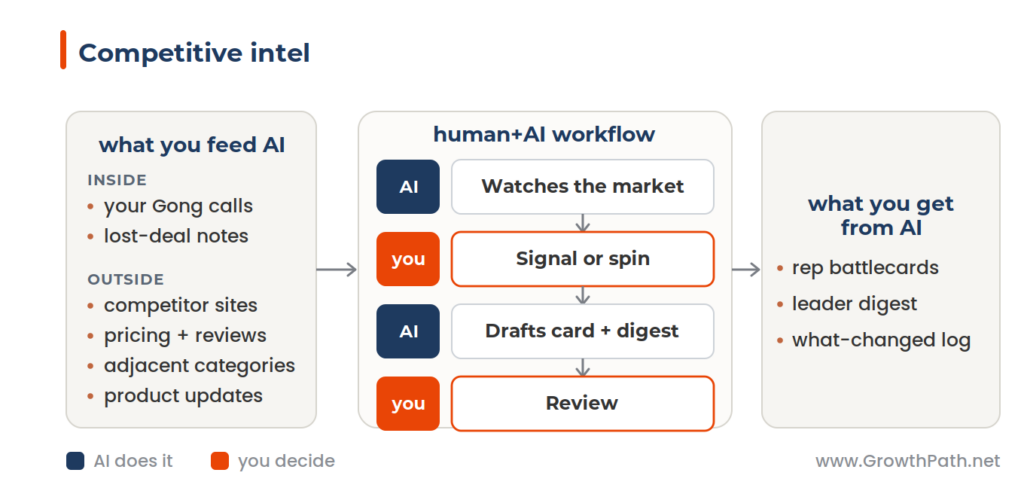
With human+AI:
- AI watches continuously across the market, adjacent categories, and your own calls.
- Reps get current battlecards with both sides, offense and defense, tied to the objections buyers are raising now.
- Leaders see the change early. When a competitor repositions or a new objection spreads across calls, you can adjust messaging and packaging before it impacts pipeline.
The most insightful input is your own call recordings and customer reviews. What a buyer says about a competitor is more honest than what the competitor says about itself.
3. Tailor the proof and practice to each deal (sales enablement)
Today, with an all-human team:
- Enablement builds one deck and one pitch for everyone, because tailoring the proof to each deal takes more time than any team has. So reps get generic material and adapt it on their own.
- The buyer’s own costs and savings sit in a spreadsheet a rep may or may not build well under deal pressure.
- Reps practice on live prospects. The hard objection gets worked out in a real deal and they learn too late, typically in the loss review.
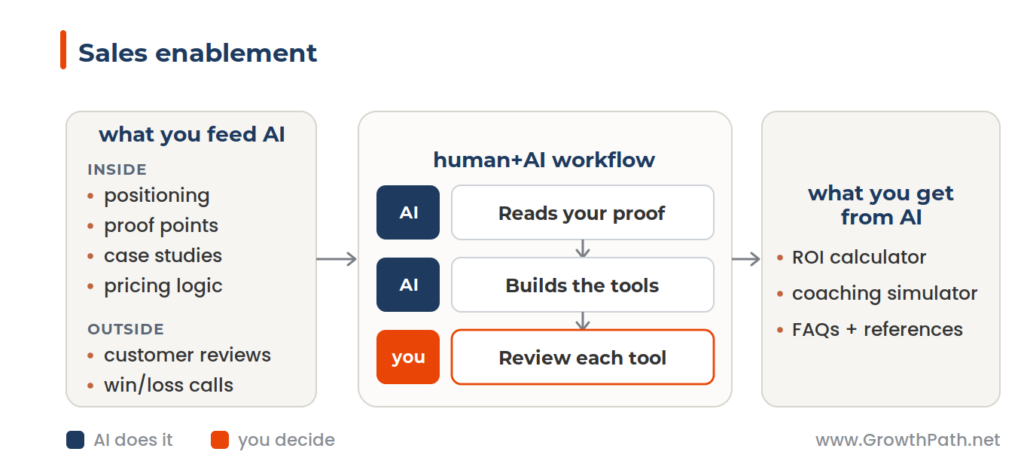
With human+AI:
- Reps get proof built for the deal they’re working, an ROI case using the buyer’s own numbers, and messaging informed by what buyers in your category actually struggle with, not just your own talking points.
- The tools are self-serve and always current, so every rep gets the same quality of prep, whether it’s the day before a big call or ten minutes before.
- Reps practice the hard conversation before the call, against a simulated buyer who pushes back, so the first real objection isn’t the first time they’ve answered it.
The simulator isn’t scripted. Each run is a live conversation, so the rep faces a different buyer and/or situation every time.
4. See how you show up when buyers ask AI (AI search)
Today, with old habits:
- We optimized for keywords and rankings. That still helps AI find us, but ranking for a term and being the one AI recommends are not the same thing.
- We led with features and capabilities. AI can’t tell from a feature list who we serve best or which problems we’re the right choice for, so it fills the gap by guessing, and you may not like the guess.
- We treated our own website as the source of truth. AI also reads review sites, communities, and third parties, and leans on what others say about us, not only what we say about ourselves.
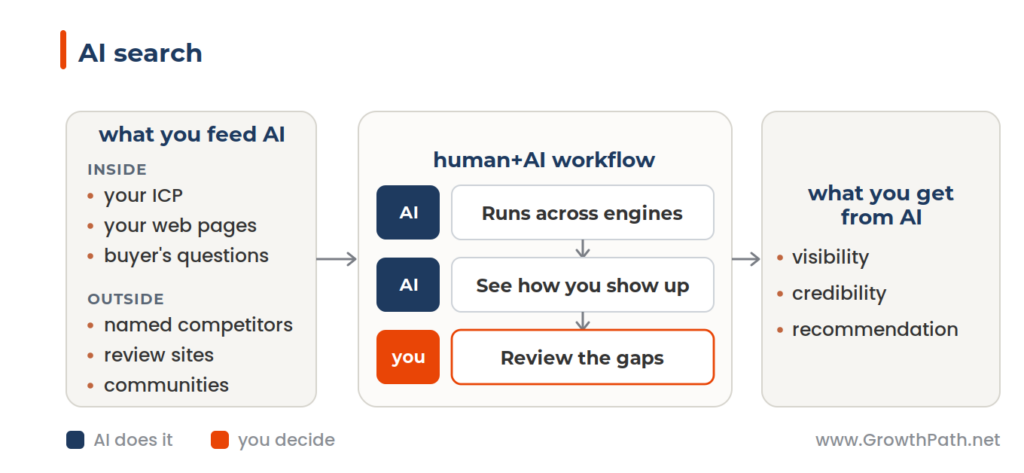
With human+AI:
- You see how AI describes and recommends you across the major engines, whether you show up, how you’re framed, whether you’re on the short list, and which sources were cited.
- You find the gaps that lose deals like a wrong description, a missing proof point, a competitor recommended over you, before more buyers form the same impression.
- The fix is clarity. When you say plainly who you serve best and where you’re not a fit, AI routes the right buyers to you and steers the wrong-fit ones elsewhere. You win more of the deals you should win, and spend less time on the ones you can’t serve well.
One run is a snapshot but it’s not the full picture. Reliable signal takes many runs over time, and for some teams an AEO/GEO tool built for scale might be the better solution. I go deeper in When AI Judges Your Brand Before Humans Do.
5. Understand how customers are changing, inside and out (customer signals)
Today, with an all-human team:
- The signs that an account is growing or at risk are split across your own systems, usage, tickets, engagement, call notes, and the customer’s own world, funding, acquisitions, leadership changes. No one watches across all of it.
- CS has too many accounts to watch closely, so the quiet ones get noticed only near renewal or after a problem shows up.
- The signal that matters most is often external and easy to miss. A customer being acquired is a churn risk. A customer acquiring is potentially an expansion opportunity. You usually find out too late to act on it.
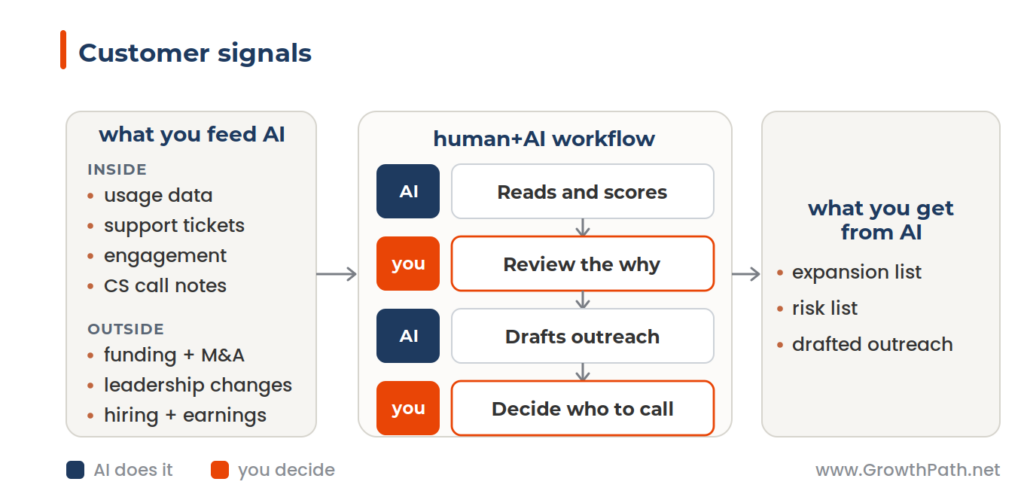
With human+AI:
- The workflow reads your internal signals and watches each account’s public external world, then scores the account for expansion or risk with the reasons behind it.
- Your team sees which accounts need attention and why, early enough to act. That includes changes in the customer’s business you’d never see in your own data.
- The customer gets the right support at the right moment, a check-in when they’re stuck, a conversation when their business is changing, an offer that fits where they actually are.
The insight that matters most is often outside your data. A customer being acquired can tell you more about churn risk than any usage trend.
This is also where silos cost you: the signal one team sees that another needs. AI reading across all of it is how fewer things fall through the handoffs. More on that in No Daylight.
The Outside-In Advantage
All five workflows share the outside-in advantage. The campaign reads the market alongside your own numbers. Competitive intel watches adjacent categories, where substitutes and new entrants tend to appear first. AI search shows you how the market already sees you. Customer signals look at public events in your customer’s world that usage data alone would miss. Even enablement gets better when it pulls in what buyers across the market struggle with.
A human still judges whether an outside idea applies. Some are useful, some aren’t. What changes is you have options you didn’t have before.
What’s Common Across Workflows
One thing was true of every workflow: A human makes the final call and is accountable.
The best workflows use human gates. You approve the plan before it goes forward. You review the output before it goes out. Quality checks run at key points.
At each gate, we instruct AI to show its work, not just hand over an answer: options with tradeoffs, confidence levels, risks flagged, what’s likely to land and what isn’t. That’s critical thinking built into the workflow. More on that in AI Is Only as Sharp as Your Questions.
Some workflows earn more autonomy over time. Once one proves itself, you can check the output instead of every step. Keep the gates where a mistake is costly or hard to fix. Let it run where the work is low-stakes and easy to undo.
It’s Only as Good as What You Feed It
These workflows are only as good as what you feed them and how you guide them. They need clean data from a single source of truth, clear instructions and context, the right access and permissions, human oversight on the judgment calls, and governance for safety, compliance, and cost. Someone has to own each one. And the outside-in research uses public signals only, news, filings, and announcements, not private surveillance.
But those are not reasons to wait. You don’t need all of it perfect to start. Pick one workflow, get the data and guardrails right for that one, and learn. A simple way to start: upload company-approved documents and data rather than connecting systems directly to AI.
Think big, start small, move fast.
Faster is the Floor
If your AI strategy is focused on efficiency alone, you’re building a case for fewer people. If it’s focused on reimagining work to grow the business, you’re building a case for why humans are essential.
Growing companies keep adding humans. Stagnant ones start asking why they need so many.
The difference is whether you use AI only to do old work faster, or also to do new work that wasn’t possible before.
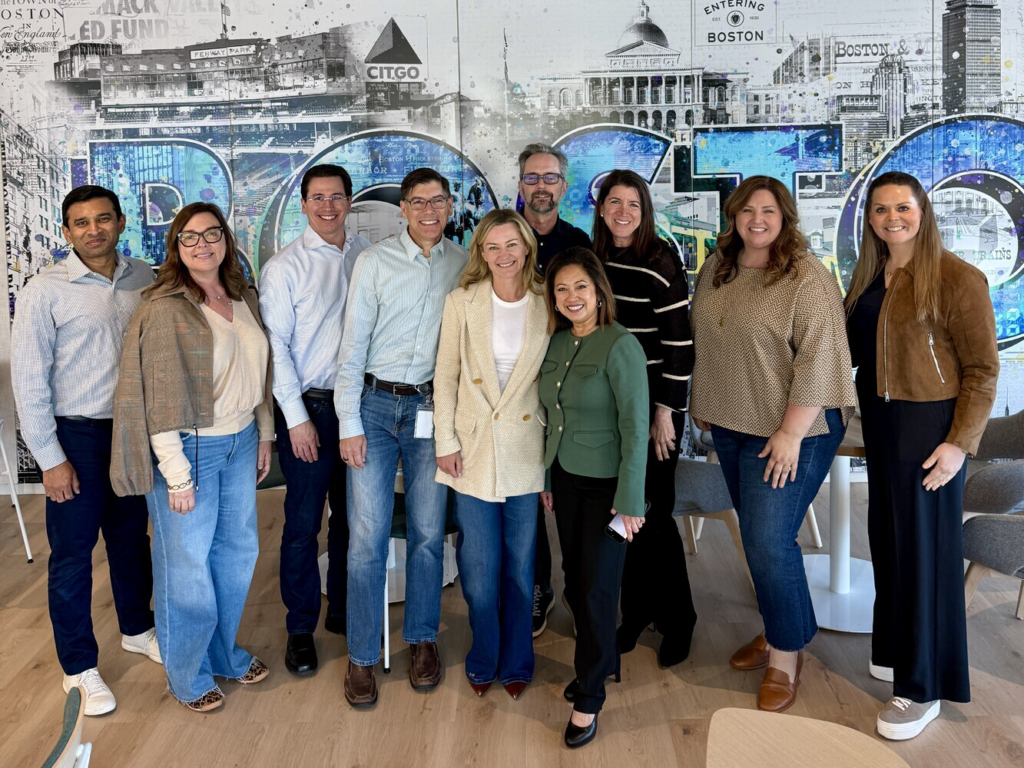
Laura Heisman, Chief Marketing Officer of Dynatrace, got hands on keyboard with her leadership team instead of just directing the work.

“This isn’t about using AI to write a better email. It’s about rethinking how we actually do things. The leaders who win this chapter are the ones who translate AI into better ways of working for their customers and teams.”
There’s a timing piece to this. Today, reimagined work is an advantage. Over time, it becomes what customers expect, and the advantage fades. So the question is when you do this work, and who decides. The teams that move now get ahead of it. Wait, and you’re matching a standard someone else set.
You can build these in whatever AI tools your team already uses. They all run agentic workflows now.
If you want the system for deciding what to hand to AI and how much, I offer some guidance in Think Before You Build.
Digital twins help here too, used as thinking partners more than task-doers. I’ve gone deep on those lately. A Cox Automotive team and a Morningstar team each built their own.
Where to Start
Pick one task your team stopped doing because it was too hard, too slow, or too expensive to do at scale. Ask whether it’s still hard, or just historically hard. Most of the time now, it’s the second one. That’s your first workflow.
Reimagining from a blank page is hard. It gets easier once you’ve seen a few examples, because you stop asking “what could AI do” and start asking “what did we stop doing that’s worth another look.”
What’s the one task your team stopped doing that might be worth another look?
The Practical AI in Go-to-Market newsletter shares learnings and insights in using AI responsibly. Subscribe today and let’s learn together on this AI journey.
For applied learning: Explore our applied AI workshops, offering both strategic sessions to shift mindsets through practical AI uses and hands-on sessions to build human+AI workflows. You’ll leave with either a clear plan or working solutions. Office hours provide follow-on support to keep momentum going.
For ongoing advisory: I work with leaders as a strategic advisor through their AI transformation, providing guidance, frameworks, and a sounding board as they build. If that’s what you need, let’s talk.
For team transformation: I partner with GTM leaders to move from scattered AI adoption to an operating model where human and AI teammates work together across workflows. See real examples: a lean GTM team’s step-by-step playbook and a global cybersecurity leader scaling to 150+ marketers with 57 AI teammates integrated into daily workflows.
For speaking: Here are virtual and in-person events where I’ve covered a variety of AI topics. I’ve also keynoted at many conferences and corporate events.
If any of this resonated, I’d love to hear from you. Reply to this email, find me on LinkedIn, or come say hi at an event.