• Skip to primary navigation
  • Skip to main content
GrowthPath Partners LLC

GrowthPath Partners LLC

Empowering Purpose-Driven Growth

  • Engagements
  • Speaking
  • Newsletters
  • About
  • Contact
  • Show Search
Hide Search

customer experience

AI Is Making the Human Side of Work Harder to Avoid

Liza Adams · September 17, 2026 ·

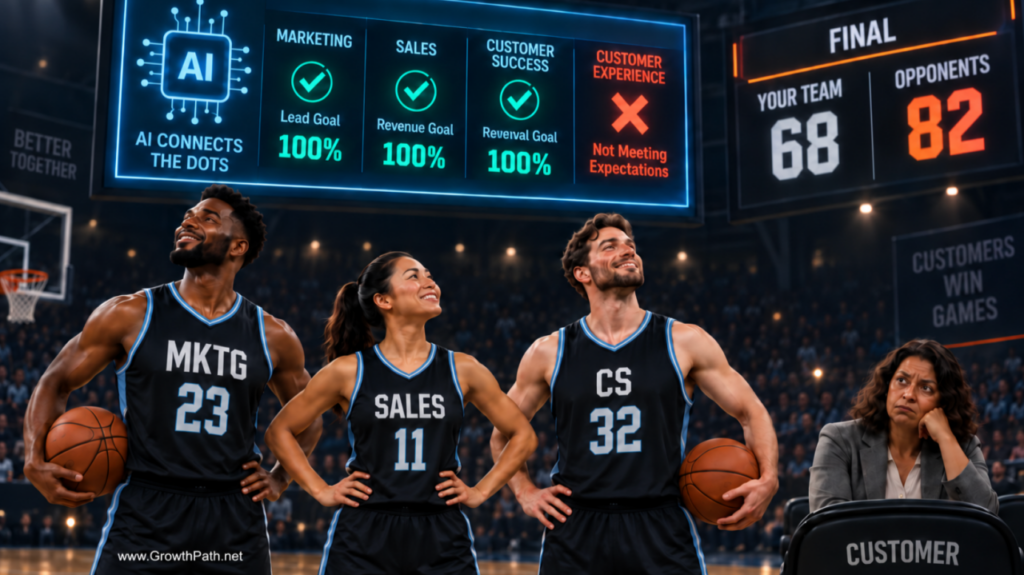
Basketball players in Marketing, Sales and CS jerseys celebrating individual goals while the team loses

Marketing hits its lead goal. Sales hits its revenue number. Customer Success hits its renewal target. And the customer can still have a lousy experience.

You wouldn’t call a basketball team successful because every player hit an individual stat while the team lost. A point guard can lead in assists, a center in rebounds, and a forward in points, and they can still lose to a less talented team that plays better together. Players still have individual roles and stats, but the team is also judged on the outcome. We understand that in sports. At work, we often reward each function for hitting its own number even when the customer experience suffers.

Nobody has to be doing a bad job. Each team can be doing exactly what it was asked to do. The customer moves across Marketing, Sales, and Customer Success, while our goals, systems, processes, and incentives often stop at the functional boundary.

For years, some of those gaps were hard to fix. Customer information sat in different systems, context got lost in handoffs, and connecting what one function knew to the next took more time and coordination than teams could sustain. AI can remove more of those constraints.

As it does, the human questions get harder to avoid. Will we trust what we learn? Will we act when the evidence challenges something we believe? Will Marketing, Sales, and Customer Success change how they work when a better customer outcome requires different choices?

Quick Take

AI can solve more of the mechanics behind disconnected GTM work. What I’m seeing is how quickly that exposes the harder human work.

  • AI can carry customer and market context across functions. People still have to decide where functional accountability ends and shared accountability begins.
  • Better information only helps when people trust it enough to act, especially when it challenges an existing belief or decision.
  • Reimagining a workflow can change roles, ownership, decision rights, and how teams work together.
  • I’ve seen AI improve a Marketing-to-Sales handoff enough to move SDR open rates from 15% to 40%. The workflow improved, but the teams still had to make the organizational decisions around it.
  • Companies start from different places. History, hierarchy, culture, regulation, resources, and what they need to protect affect how quickly the human side can change.

Watch or Listen Instead

To support different learning styles and time constraints, this newsletter is also available as a 5-min cinematic AI video explainer and a 18-min AI podcast with two AI hosts. Both were made with Gemini Notebook and personally reviewed for accuracy and responsible AI use.

AI Can Solve More of the Handoff Now

I’ve seen this with a global cybersecurity company I work with. One workflow gave SDRs consistent company, industry, role, and messaging context instead of requiring them to recreate it for every prospect.
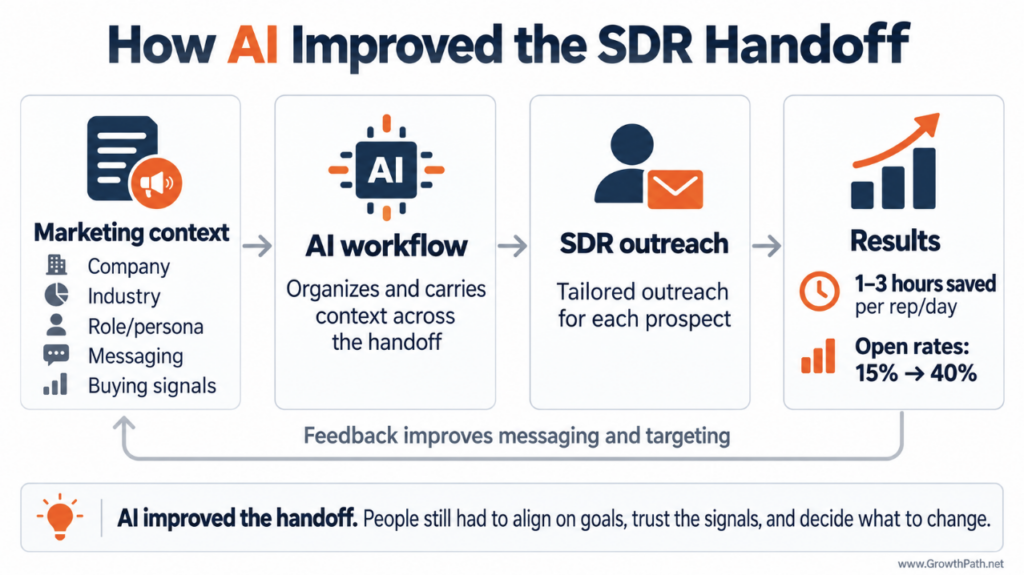
How AI improved the SDR handoff: marketing context, AI workflow, tailored outreach, open rates from 15% to 40%

Reps saved one to three hours a day, and open rates increased from 15% to 40%.

AI solved an important part of the handoff. The workflow could carry context, but Marketing and Sales still had to decide what they should optimize for together, which customer signals to trust, and what to change when new evidence challenged how they were working.

Those are the kinds of human questions I keep seeing as more of the mechanics get easier.

Where the Human Work Shows Up

In my work with GTM teams, I’ve observed three key human challenges. They aren’t new, and I don’t think they’re the only ones. But as AI makes more of the mechanics easier, they’re becoming harder to work around.
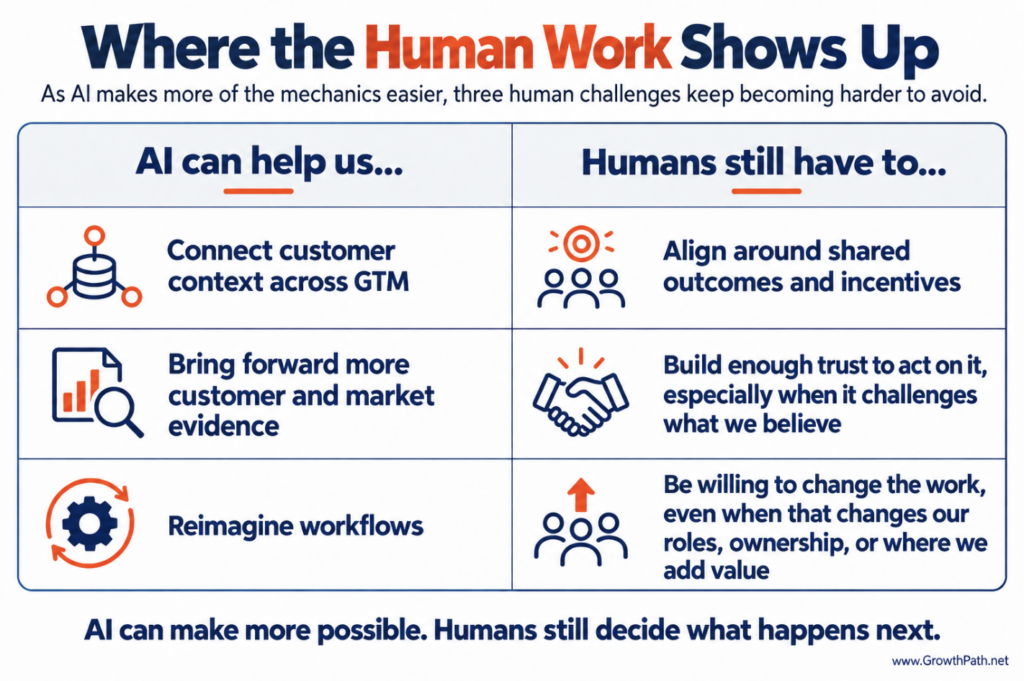
Where the human work shows up: what AI can help with and what humans still have to do

1. Better Information Doesn’t Create Shared Outcomes

AI can make customer context much easier to share. That still doesn’t align what each team is accountable for.

Marketing can see what happens after a lead becomes an opportunity. Sales can know more about what brought the buyer in. Customer Success can start with more of the history. But if Marketing is measured on leads, Sales on the close, and Customer Success on renewal, each team can make a rational decision for its own number that works against the customer outcome.

The measures don’t need to be identical, and I don’t think the answer is to abandon functional goals. Sales still needs a quota. Marketing and Customer Success need measures tied to their own responsibilities. The harder question is where to add shared accountability so each function also has a stake in the customer outcome.

That could mean a shared goal, a common scorecard, or in some cases incentives tied partly to outcomes such as getting the right customers, time to value, retention, expansion, or overall customer satisfaction.

2. More Insight Requires More Trust

AI can synthesize far more customer and market information than any one person can process. The challenge comes when the evidence contradicts something we’ve already invested in.

  • Customer conversations may challenge positioning we’ve spent a year building.
  • Win/loss analysis may suggest the problem isn’t sales execution.
  • Support tickets may show that something we considered minor is affecting customers far more than we realized.

Trust doesn’t mean accepting AI output at face value. We still need to check the evidence, add context, apply judgment, and decide whether it’s strong enough to act on.

It also requires trust between people. Someone needs to be able to bring uncomfortable evidence into a cross-functional conversation without it becoming an attack on someone’s work.

Curiosity and intellectual humility become more valuable as AI gives us more ways to test what we think we know. That only helps if we’re willing to be wrong and change our minds when the evidence supports it.

3. Reimagining Work Means Letting Go of Some Old Work

Changing a workflow gets harder when it changes who does the work, who owns the decision, or where someone’s expertise is needed.

People have spent years building expertise, careers, and influence around existing roles and processes. When AI makes a different way of working possible, we may be asking them to reconsider work they’re good at, responsibilities they own, or where they believe they add value.

That uncertainty deserves to be taken seriously. But if work that once required several people, multiple handoffs, and approval steps can now happen differently, we should be willing to rethink the process.

Stacy Simpson, CMO of athenahealth, is working through this now. Her team mapped the full campaign process and identified where individual agents could take on parts of the work. They’re now at the point where the process itself can change.

Headshot of Stacy Simpson, CMO of athenahealth
Stacy Simpson, CMO of athenahealth

“We’re in the middle of the story. We know the outcome we want, but the process isn’t predetermined. We started by identifying where individual agents could help. Now we’re asking how the process itself should change, how agents hand work to each other, and where humans need to step in.”

Changing the process also changes what we need from the people doing the work. Siddharth Taparia, Global CMO of JLL is thinking about that from the role and talent side.

Headshot of Siddharth Taparia, Global CMO of JLL
Siddharth Taparia, Global CMO of JLL

“AI fundamentally changes what we ask people to do and the skills they need. For example, a campaign manager will spend less time building campaigns and more time orchestrating and evaluating AI outputs. That means we have to rethink how we develop talent. The skills that matter most are shifting. Strategic thinking, cultural awareness, curiosity, and adaptability will become critical.”

We may not know exactly what every role becomes yet. That makes it more important to involve people in redesigning the work and help them see where their judgment, experience, and relationships can add more value.

I went deeper on five examples in 5 Reimagined Workflows: Work We Skipped That AI Now Does.

Different Starting Points

Organizations are starting from very different places. An established company may have customers, revenue, specialized roles, approval layers, regulatory requirements, and systems that already work. Changing any of those carries real risk.

A smaller company may have fewer people, less budget, and less technical support, but also less to unwind. When adding people isn’t an option, there can be more reason to rethink how the work gets done.

I think what a company has to protect may be a bigger factor than size. The more that already works, the more carefully people have to decide what should change and what should stay.

I covered this topic in more detail in The Boldest AI Moves are Coming From the Smallest Budgets.

Where Competitive Advantage May Come From

AI capabilities will keep advancing, and access to similar models and tools will get easier. The difference I’m watching is what companies do when AI gives them better information or makes a different way of working possible.
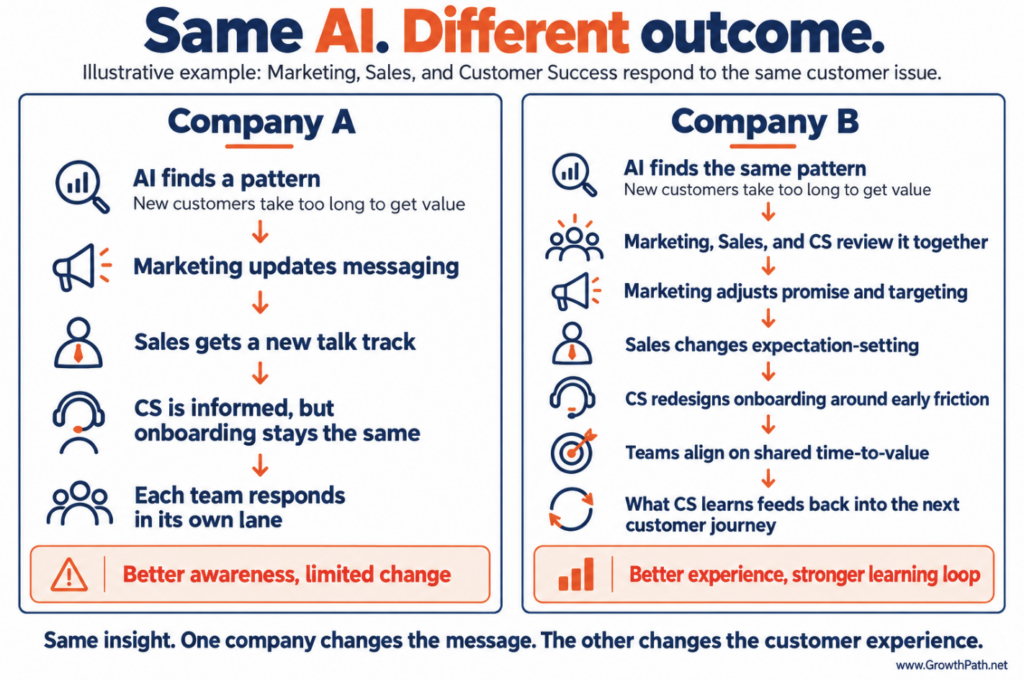
Same AI, different outcome: two companies respond differently to the same customer insight

Over time, a company willing to change how the work gets done learns more than how to use AI. Its people learn where AI works well, where human judgment is needed, and how to change when new evidence gives them a reason to.

That’s where I think some of the advantage comes from. Technology can be bought. Trust, judgment, shared accountability, and the ability to change how people work together take longer to build.

Michael DiPietro, an operating advisor at JMI Equity who works across its portfolio companies, keeps the test grounded in business results:

Headshot of Michael DiPietro, Operating Advisor at JMI Equity
Michael DiPietro, Operating Advisor at JMI Equity

“We encourage our portfolio companies to focus their AI initiatives on high-impact workflows and change. These should not only drive better business outcomes but ideally create a better customer experience. As one of our portfolio company leaders said, ‘It’s not AI transformation, it’s business transformation.’ We want them to think of AI as a means, not an end.”

I also don’t think this stays a competitive advantage forever. Over time, a more connected, context-aware experience may simply become something customers expect.

Customers don’t care how our org chart works. They expect us to know what they’ve already told us, carry that context across the journey, and respond as one company. As AI makes more of that possible, some of the gaps we’ve learned to live with become harder to justify.

I wrote more about the CMO’s role in carrying that customer context across the business in CEOs Are Looking for a Different Kind of CMO. Are You It?

Think big, start small, move fast. Try something, learn, adjust, and be willing to zig and zag.

A Few Questions I’d Ask

These are three questions I’d bring into a GTM leadership conversation:

  • Shared outcomes – Where should Marketing, Sales, and Customer Success keep distinct goals, and where should they share accountability for the customer outcome?
  • Trust – What happens when customer or market evidence challenges something an influential person or function believes?
  • Willingness to change the work – If we designed this work from scratch today, would we give the same people and functions the same responsibilities and decision rights?

What I’m Still Figuring Out

What I’m still trying to understand is what helps people move from agreeing that work should change to being willing to change their own work.

Hands-on experience seems to help. I see belief change when people use AI on their own problems, see what it can and can’t do, and have a hand in redesigning the workflow.

I’m also watching what happens when the next role isn’t clear yet. People may be more willing to let go of familiar work when they can see where their judgment, experience, and relationships will add more value. But we won’t always have that answer before the work starts changing.

We’re asking people to help redesign work that may also change their own roles. I think they need a real hand in shaping what comes next.


The Practical AI in Go-to-Market newsletter shares learnings and insights in using AI responsibly. Subscribe today and let’s learn together on this AI journey.

For applied learning: Explore our applied AI workshops, offering both strategic sessions to shift mindsets through practical AI uses and hands-on sessions to build human+AI workflows. You’ll leave with either a clear plan or working solutions. Office hours provide follow-on support to keep momentum going.

For ongoing advisory: I work with leaders as a strategic advisor through their AI transformation, providing guidance, frameworks, and a sounding board as they build. If that’s what you need, let’s talk.

For team transformation: I partner with GTM leaders to move from scattered AI adoption to an operating model where human and AI teammates work together across workflows.

For speaking: Here are virtual and in-person events where I’ve covered a variety of AI topics. I’ve also keynoted at many conferences and corporate events.

If any of this resonated, I’d love to hear from you. Reply to this email, find me on LinkedIn, or come say hi at an event.
CEOs Are Looking for a Different Kind of CMO. Are You It?

Liza Adams · September 3, 2026 ·

CEOs Are Looking for a Different Kind of CMO. Are You It? title graphic

One of the CEOs I spoke with wanted a CMO who could walk into a board meeting and make a credible case for where the market was heading: what customers were telling them, what was changing around those customers, what it could mean for the business, and what the company should consider doing next.

A couple of CEOs asked me recently what to look for in a CMO now, given what AI is making possible.

I spent years leading marketing. My work since then with CMOs and GTM teams, founders, leadership teams, and PE and VC partners has given me a view of what AI is changing in the role and what companies increasingly expect.

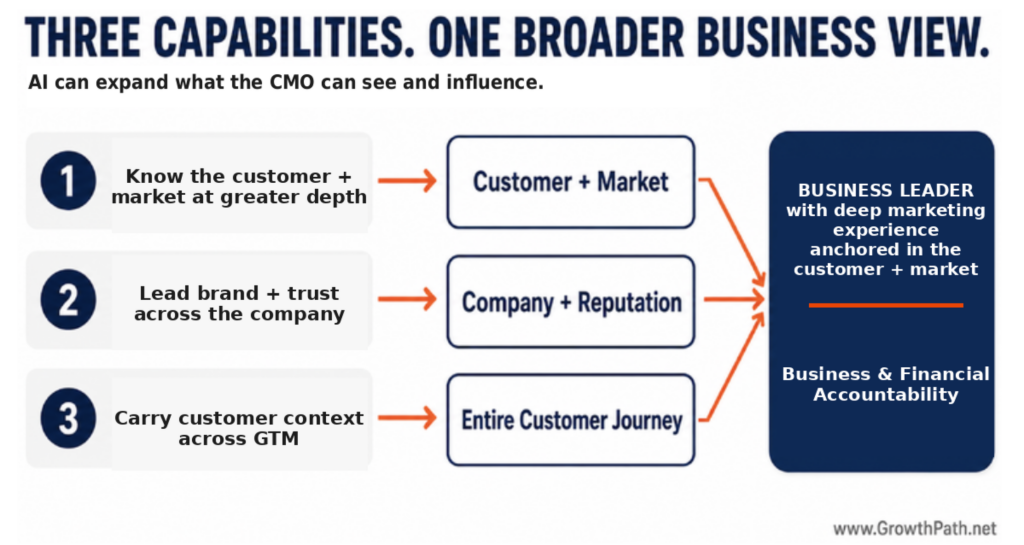
Three areas consistently come up: knowing the customer and market at a depth that wasn’t practical before, leading brand and trust across the company, and carrying customer context across the GTM journey.

Quick Take

What connects these three areas for me is an outside-in view of the business, starting with the customer and market rather than the marketing function.

  • Know the customer and market at a depth that wasn’t practical before – AI can connect signals teams couldn’t reasonably track at the same scale or timing.
  • Lead brand and trust across the company – AI brings customer, employee, leadership, community, and company signals into the same view.
  • Carry customer context across the GTM journey – AI can connect context across Marketing, Sales, and CS and help close the gaps customers experience.
  • Bring people through the change – The CMO still has to build trust, influence across functions, and help teams change how they work.
  • Connect all of this to business and financial outcomes – A broader view of the customer, market, company, and customer journey gives the CMO more to bring to business decisions.

These are observations from current work and conversations, rather than a best- practice model.

Three capabilities, one broader business view: customer and market, company and reputation, entire customer journey

Watch Or Listen Instead

This newsletter is also available in two additional formats for different learning styles. The 6-min cinematic AI video explainer is a broad overview of the argument. The 18-min AI podcast goes deeper. Both were made with Gemini Notebook and personally reviewed for accuracy and responsible AI use.

What Experience Gives Us

Experience builds judgment. You’ve seen enough situations to recognize patterns, ask better questions, and identify problems earlier. That experience is useful, but it can also make us rely too heavily on what worked before.

CMOs have always been expected to understand customers, earn trust, know the business, and work across the leadership team. AI is making more of that practical at a scale and cadence that were hard before: working across far more customer and market information, helping teams rethink workflows, roles, handoffs, and the customer journey.

Katy Keim has lived the CMO-to-CEO path more than once. She was CMO at Lithium Technologies and EVP of Marketing at ServiceSource before becoming CEO of LQ Digital and most recently LeanData.

Headshot of Katy Keim, CEO of LeanData
Katy Keim, CEO of LeanData

“I’ve been in the CMO seat, and I know how easy it is to default to what worked before. The leaders who stand out aren’t running a playbook. They’re curious. They’re learning from their peers, picking up new signals from the market, and connecting it all back to the customer. It’s about pattern recognition from their experience, not stale tactics. This market demands a new growth mindset from marketing leaders.”

In my work, three areas show how AI can make this broader CMO role more practical:

1. Know the Customer and Market at a Depth that Wasn’t Practical Before

AI lets us bring together more customer and market information, more often, then connect signals that would otherwise stay separate.

A few examples I’m seeing:

  • Bring more customer signals together – Usage, support tickets, call notes, engagement, renewal history, and other internal data can be analyzed alongside public information such as funding, acquisitions, leadership changes, or industry news. Declining engagement and usage mean something different when they happen alongside a leadership change. An acquisition may signal an expansion opportunity.
  • Keep market and competitive intelligence current – AI can watch competitor positioning, pricing, reviews, category conversations, analyst commentary, and the language buyers use. Teams can move from periodic competitive updates to a much more current view. I’ve found this to be one of the clearest examples of work an all-human team couldn’t keep up with at the same cadence.
  • Pressure-test decisions with simulated buyers – Before a pricing change, repositioning, or campaign, teams can build AI advisors trained on what they know about buyer priorities, challenges, roles, objections, communication styles, and sources they trust. They use them to challenge the thinking before it lands in market.

Human judgment stays central. AI handles collection, synthesis, analysis, and scale. People decide what applies, where the AI may be wrong, and what the business should do.

That gives the CMO a richer view of customers and the market to bring into product, GTM, strategy, and board conversations. I went deeper on several of these workflows in 5 Reimagined Workflows: Work We Skipped That AI Now Does.

2. Lead Brand and Trust Across the Company

Brand is what people experience and say about a company.

Marketing contributes to that experience. So do Product, Sales, Customer Success, HR, leadership, partners, and employees.

AI makes those connections easier for people outside the company to see. Ask an AI to search about a company and it can pull from the website, customer reviews, analyst coverage, community conversations, press, employee experiences, and other public information. Buyers increasingly get a full view assembled from many sources, not just the story marketing publishes.

That gives the CMO a broader leadership opportunity: help the company understand what those experiences add up to, where they reinforce the brand promise, and where they don’t.

Anna Griffin has led brands across complex enterprise environments including CA Technologies, Smartsheet, Intercom, and now Commvault. Her experience spans the parts of the company that create the brand and the people outside it who ultimately decide what to believe.

Headshot of Anna Griffin, Chief Marketing Officer of Commvault
Chief Market Officer of Commvault

“Brand has never been what you say about yourself. It’s what every customer, employee, partner, and prospect experiences and says about you. That’s always been true. What AI has done is make it visible all at once, at scale, in ways that are very hard to ignore. You either build it intentionally across the whole company, or the market and AI build it for you.”

A few ways I’m seeing this show up in the work with AI:

  • Look at the company from the outside in – Search as a buyer, customer, candidate, or partner. Look at the situations they’re in, the problems they’re trying to solve, what they hear about you, and where the story feels unclear or inconsistent.
  • Be useful and honest about where you fit – Create content around customer situations, questions, and outcomes rather than leading with features and capabilities. Be clear about who you’re ideal for, where you’re not, and what customers actually achieved. That gives people and AI clearer evidence about when to recommend you.
  • Find gaps marketing can’t close alone – If the brand promises “easy to work with” but onboarding is painful, that requires work with the team responsible for onboarding. If the company talks about transparency while candidates experience something different, changing the careers page only fixes one part of the problem.

AI search is part of this too: make owned properties clear, create useful content, structure information so machines can understand it, and monitor how AI represents the company. I went deeper on this outside-in view in When AI Judges Your Brand Before Humans Do.

But AI is also picking up experiences marketing doesn’t control. I saw a post recently where a job candidate asked for the salary range before an interview. The CEO responded that if money was their main driver, they weren’t the right fit. I wondered how that same CEO would respond if a buyer asked for a price range before agreeing to a sales call.

Marketing has been trying to explain what brand is for years. AI search may have just shown it for us.

Anna also uses a phrase I like: brand is rented, not owned. You keep earning it through the experiences people have with you and the evidence those experiences leave behind.

3. Carry Customer Context Across the GTM Journey

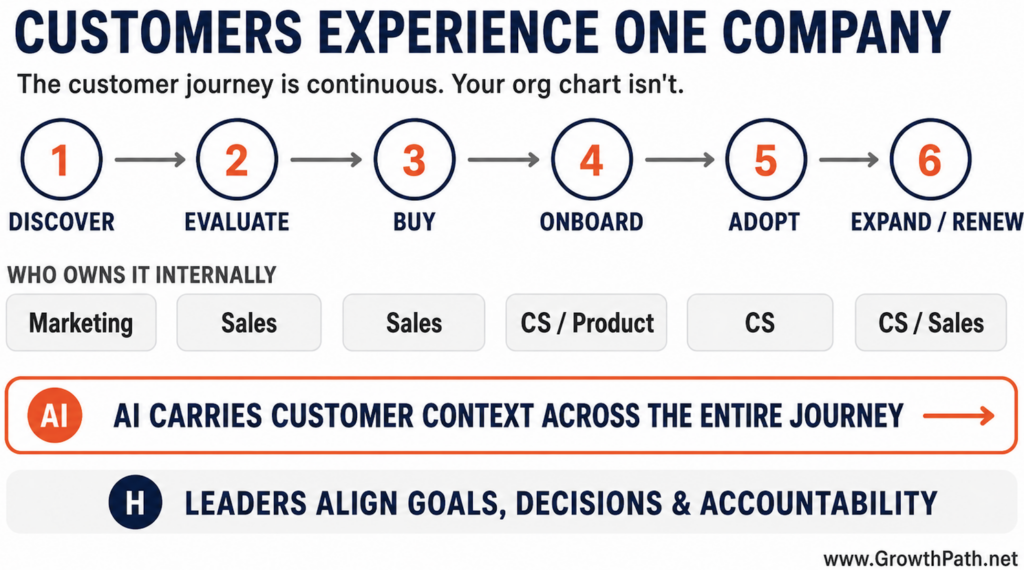
Customers experience one company, even though we organize ourselves into Marketing, Sales, and Customer Success. They experience the marketing, sales conversation, handoff, onboarding, product, support, renewal, and everything between.

AI is particularly useful here because it can carry context from one part of that journey to another.

There’s also evidence that AI can help people work across those boundaries. A Harvard-led field study with P&G professionals found that AI helped commercial and R&D specialists produce more balanced solutions that drew on both areas of expertise. Wharton professor and AI researcher Ethan Mollick described the result this way: “The distinction between specialists virtually disappeared in AI-aided conditions.”

Customers experience one company: six journey stages owned by different teams, connected by AI

The harder part is getting people to trust new inputs, change workflows, and reconsider practices that have worked for years. A sales leader may trust instinct built over decades. A CS leader may trust the data their team already uses. The CMO has to bring people along through real work, shared wins, and clear human judgment.

  • Carry context across the customer journey – AI can look across calls, CRM notes, onboarding feedback, support tickets, usage, and renewal data so the customer’s story doesn’t keep restarting as they move between teams.
  • Find where the experience breaks – Something showing up as a CS problem may have started with expectations set during the sales process. An adoption problem may trace back to positioning or onboarding. AI makes those connections easier to see.
  • Work toward shared customer outcomes – When I ask Marketing, Sales, and CS what success looks like for the same customer, the answers come back as functional metrics: qualified leads, sales-cycle length, churn. Then we ask what result the customer needs from all three, such as time to first value, adoption, satisfaction, retention, or expansion. The conversation changes.

I explored what this could look like organizationally in No Daylight: How AI is Reorganizing GTM Teams Around Customers, Not Departments.

Changing shared goals, workflows, and long-standing ways of working still requires trust between leaders and compassion for the people doing the work. Some people move quickly with AI. Others need more time, support, practice, or evidence.

AI can help connect the work. Leaders still have to bring people along.

What This Adds Up To

CMOs are also being held more accountable for the results of the business. In the Spring 2025 CMO Survey, 63% reported increased pressure from the CFO and 61% from the CEO to prove marketing’s value. IBM’s 2025 CMO Study found that 64% of CMOs globally are accountable for profitability and 53% for revenue growth.

That requires connecting what customers experience and what GTM does to the economics of the business.

I often start with time to value, customer satisfaction, and net revenue retention because they begin with outcomes the customer experiences. From there, we use the company’s data to connect those outcomes to adoption, retention, expansion, referrals, payback, efficiency, and growth. That’s a more useful board conversation than trying to force every dollar of revenue back to a marketing touch.

Kate Bullis, Global Marketing Practice Leader at ZRG, runs 20 to 25 executive marketing searches a year and sees firsthand how the hiring conversation is changing.

Headshot of Kate Bullis, Global Marketing Practice Leader at ZRG Partners
Kate Bullis, Global Marketing Practice Leader at ZRG Partners

“The most successful GTM leaders aren’t just functional experts; they’re business leaders who think like GMs. CEOs are expecting GTM to show up this way. Great GTM leaders optimize entire customer and market experiences, not just their department, because they understand customers don’t care about your org chart. The importance of this is not new, but AI has made it increasingly important.”

Much of this broader role depends on influence. Product, Sales, CS, HR, Finance, and other leaders bring expertise and accountability of their own. The CMO earns influence by bringing something useful to the table: customer intelligence that changes a decision, a clearer view of the market, a gap in the customer experience, or evidence that connects the work to the business.

The company has a role too. Some leadership teams want the CMO operating this broadly; others have a different mandate. Company stage, business model, goals, and leadership relationships will affect what makes sense.

Some CMOs will want to stay focused on leading the marketing function, and some companies will continue to want that. A more functional role brings clearer boundaries and deeper focus within marketing, but potentially less influence over the customer experience, market decisions, and business outcomes beyond the function.

The broader role comes with tradeoffs too: more shared ownership, more influence without direct authority, and more accountability for outcomes the CMO may not fully control. If CEOs want that kind of business leader, the mandate, measures, decision rights, and relationships around the role need to support it.

Both sides have to want the broader version. It takes two to tango.

A Few Questions Worth Asking

If I were advising those CEOs today, these are some of the questions I’d suggest they ask:

  1. What’s a playbook you believed in that you no longer use? What evidence changed your mind?
  2. Tell me something AI helped you see about customers or the market that changed a business decision.
  3. Describe a cross-functional change that required people to work differently. How did you bring them along?
  4. Walk me through a time AI helped you connect a customer or GTM issue to a financial outcome. What did you do with that insight?

I’d pay as much attention to the follow-ups as the first answer. Can they get into the actual work, explain what AI helped them see or do, where it fell short, what they changed, and what they learned?

Nobody has all the right answers yet. I’d look for intellectual humility, curiosity, ability to bring people through change cross-functionally, and evidence that they’re learning from real work. That can be hard at this level because we’ve spent our careers being rewarded for what we know and what has worked before. AI keeps asking us to question both.

I’m still learning with the leaders and teams working through this. What I see so far is an opportunity for a broader business role, with deeper accountability for customers, the market, the company experience, and business outcomes.

For CMOs, the question is whether that’s the role you want to grow into, and whether you understand what comes with it.


The Practical AI in Go-to-Market newsletter shares learnings and insights in using AI responsibly. Subscribe today and let’s learn together on this AI journey.

For applied learning: Explore our applied AI workshops, offering both strategic sessions to shift mindsets through practical AI uses and hands-on sessions to build human+AI workflows. You’ll leave with either a clear plan or working solutions. Office hours provide follow-on support to keep momentum going.

For ongoing advisory: I work with leaders as a strategic advisor through their AI transformation, providing guidance, frameworks, and a sounding board as they build. If that’s what you need, let’s talk.

For team transformation: I partner with GTM leaders to move from scattered AI adoption to an operating model where human and AI teammates work together across workflows.

For speaking: Here are virtual and in-person events where I’ve covered a variety of AI topics. I’ve also keynoted at many conferences and corporate events.

If any of this resonated, I’d love to hear from you. Reply to this email, find me on LinkedIn, or come say hi at an event.

Copyright © 2026 · GrowthPath Partners LLC · Log in

  • LinkedIn