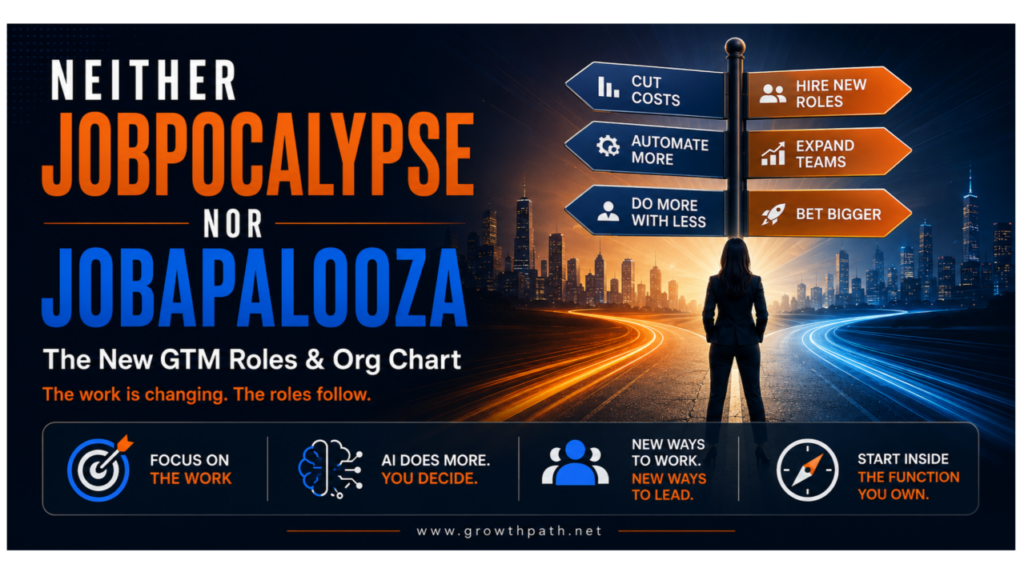
At a GTM leadership dinner recently, three leaders described three different plans. One had been told to use AI to cut his team by 30%. One was weighing whether to hire a GTM engineer, and what other new roles to plan for. One was redesigning workflows and restructuring her org.
The headlines keep swinging between jobpocalypse and jobapalooza. We didn’t debate that much. We talked through the questions most have not figured out yet. If you run a GTM team, you know this conversation.
None of the three said it this way, but all three were asking the same thing: What’s happening to the work? Answer that first, and the roles and the org follow.
Putting AI in the old org chart just makes old work faster. That gets you efficiency, not growth. Reimagining the work to do what wasn’t possible before is how you grow the business. New work creates new roles, and the new roles redraw the org chart.
Quick Take
AI is already changing what one person can do. Reimagined work leads to reimagined roles, and reimagined roles change the org chart.
Key takeaways:
- Put the jobs debate aside. The key question is what happens to the work, because the work is changing and the roles follow.
- AI does the repetitive work and acts as a thinking partner. People keep judgment, taste, and accountability.
- In some workflows, one person with AI can do what used to take three. Whether you’ll have a smaller or bigger team is your choice, not AI’s.
- Combining roles is not the same as cutting people. The time AI frees up can go to work that grows the business, and a growing business needs more good people, not fewer.
- Four kinds of work take on more judgment: builders, orchestrators, specialists, and governors. The people who grow their judgment and range step into the wider roles, and those who stay only in the tactical work are the most exposed, so that’s where to put support and time.
- Specialists keep the deep expertise the whole team draws on, even as the work combines. The orchestrator relies on them and doesn’t have to know everything.
- The org chart starts to organize around the customer’s goals, not departments. Start inside the function you own.
Watch Or Listen Instead
To cater to different learning styles and time constraints, this newsletter is also available as a 5-min AI video explainer and a 16-min AI podcast with two AI hosts. Both were made with Google’s NotebookLM and personally reviewed for accuracy and responsible AI use.
Even the loudest voices have moved toward the middle. Sam Altman (CEO of OpenAI) said in May that he was “pretty wrong” about the white-collar job losses he expected. Dario Amodei (CEO of Anthropic), who had warned AI could erase half of entry-level white-collar jobs, now frames it as a multiplier: automate 90% of a job, and the last 10%, the part only people do, expands to fill the role. Andrew Ng (founder of DeepLearning.AI) calls it a jobapalooza, a wave of new work.
Read it with some skepticism. Both OpenAI and Anthropic are heading for IPOs, and a more market-friendly story helps. The job numbers are mixed. The headlines and the CEOs will likely keep changing the narrative, but the change to the work is real. So plan around the work.
Product Teams Went Through This First
Building software used to take three roles: a product manager to decide what to build, a designer to figure out the interface and experience, and an engineer to write the code.
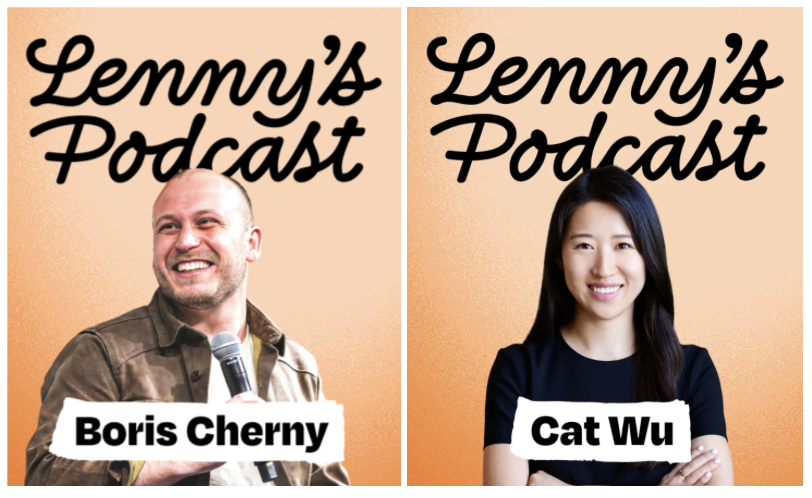
On Lenny’s Podcast, Boris Cherny (who built Claude Code) said the title “software engineer” is turning into something simpler, “builder.” Catherine Wu (head of product at Anthropic) said the scarce skill now is knowing what to build, because building it got easy.
On their teams the back-and-forth goes away. Designers write code, engineers make product calls, and one person with AI owns what used to take three.
Go-to-market is heading the same way. Product marketing, content, and campaigns became separate jobs partly because no one person had all three skill sets, and partly because they call for different kinds of judgment. AI closes the skill gap, so one person with good judgment can do the same. The deeper judgment stays with people. The same is happening across sales development, ops, and enablement.
Start With The Work, Not The Roles
It’s tempting to jump to “what new roles do we need” before looking at the work. The roles change because the work changes, not the reverse.
There’s one exception: You might add new roles up front with people whose job is to drive the change itself, people you hire or outside help you bring in. You don’t redesign everyone else’s roles first. Those change as the work does.
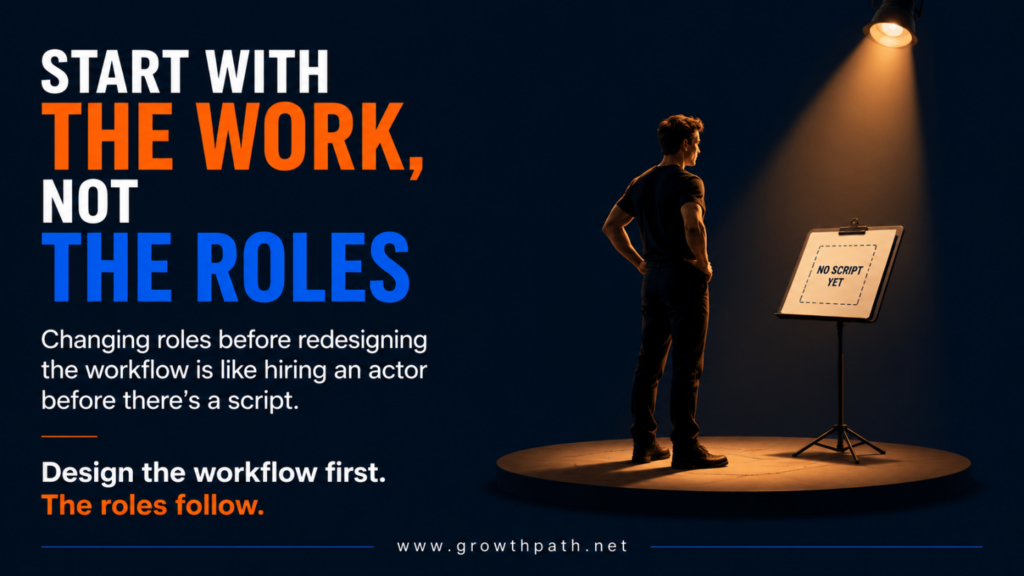
So start with the work. Walk a workflow step by step, like building and running a campaign, and you’ll see which steps are repetitive and which need judgment.
AI takes the repetitive steps and runs them faster. The bigger change is what AI can see across the whole workflow and connect, which is hard for people to do.
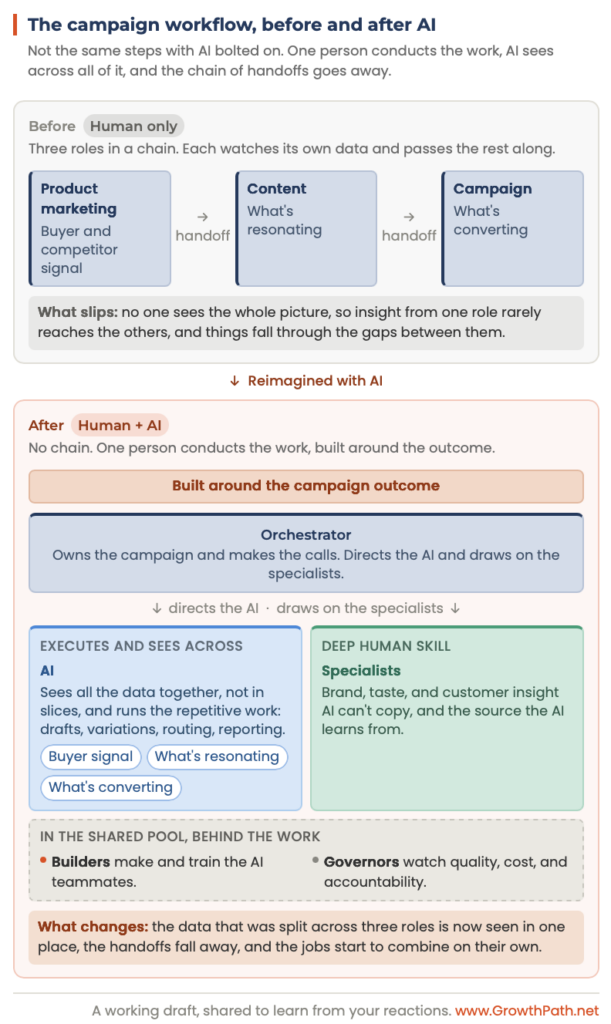
In a campaign, product marketing tracks the buyer and competitor signal, content watches what’s resonating, and the campaign team follows what’s converting. Each acts on its own slice and passes the rest along, so what one learns can get missed by the others.
AI can read across all of it at once and catch what no single team would see. The workflow gets simpler, and no longer needs handoffs because the reason you split the work is gone. The jobs start to combine on their own.
Megan Cabrera, my operations strategy business partner, and I guide and collaborate with GTM teams to sort each workflow by what it needs from AI, decide how much to let AI run on its own, then recommend redesigned workflows and orgs. I wrote about how to do that here, Has the Ground Shifted? Think Before You Build.
What Happens To The Roles
Roles don’t disappear. They get rebuilt around the judgment that stays with people. That work comes in four kinds. Builders create the AI teammates and workflows. Orchestrators direct people and AI together toward an outcome. Specialists bring the deep expertise the rest of the team relies on. Governors set the rules and own the guardrails.
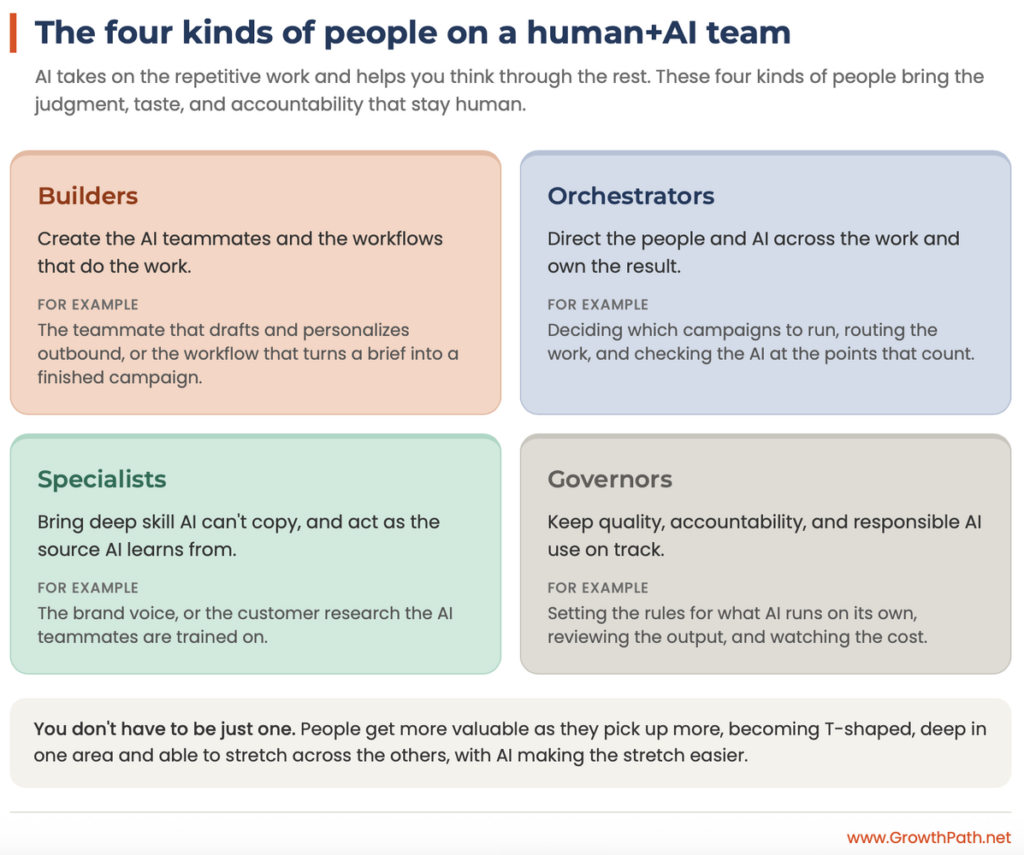
You don’t have to be just one. People get more valuable as they pick up more, growing T-shaped, deep in one area and able to stretch across the others. This can start inside one function and grow across the whole team over time. AI makes growing into more areas easier.
The risk is combining the work into a generalist too thin to be good at anything. The model guards against that two ways: people grow T-shaped rather than shallow, and the deepest expertise stays with specialists the whole team draws on. The orchestrator runs the combined work and leans on them rather than mastering all of it alone.
One person running the combined work has another risk when the AIs fail affecting the entire workflow. The four roles protect against that. Governors set how much the AI runs on its own, builders put a human checkpoint into the critical steps, and the orchestrator checks the AI’s work.
I’ll use marketing as the example. The same logic runs through sales and customer success, and the walls between those teams are already coming down.
Inside marketing, you can see it in everyday roles:
- A content marketer hands first drafts to AI, and grows into directing it on brand and deciding final content strategy.
- A campaign manager uses AI for scheduling and reporting, and expands into running the whole campaign across people and AI.
- Marketing ops guides AI through data cleanup and routine reports, then moves into building the AI teammates and setting the rules.
It looks the same outside marketing. An SDR hands the first-pass outreach to AI and grows into working the accounts that need a person, with AI prepping every touch.
Tricia Gellman, CMO of Box, observes this from inside a company built on content and AI.
“Treating AI as a tooling project is the mistake. So much of the work involves content and knowledge moving between people, and once AI handles that, the old lines between roles blur, and people move to the work AI can’t do.
The teams who taught their people to direct AI well will have an edge over the ones just buying tools.”
We’re seeing the same across the GTM teams we work with.
Step back and you can see roles changing in more than one direction. Three examples:
1. GTM Strategist and Architect
Some evolve. Megan Ratcliff (formerly of Dice, a tech career marketplace) went far. She started as a Campaign Director and grew into a GTM Strategist and Architect working across marketing, sales, and customer success. I shared Megan’s story here.
The cross-department version takes time and the right partners. You can start on the single-function version now.
2. GTM Engineer
Others are brand new. A GTM engineer sits between marketing ops and sales ops and owns the work that used to get missed between the two teams: turning buying signals into plays sales actually runs, and the lead handoff each side assumed the other had. The old chart didn’t have that role. One person owns it now.
3. Forward Deployed Engineer
And the market is already paying for it. One of the most sought-after hires in tech right now is the forward deployed engineer (FDE), someone an AI company places inside a customer’s team to build AI into their work. We see more postings and the pay runs well into six figures.
It’s the same capability you’ll want to have on your own team, whether you assign someone internally or bring in some outside help. Their job is rebuilding how the work gets done.
Does This Mean Layoffs?
When AI lets one person do what took three, the first instinct is to cut to one and keep the savings. That’s the easy move but loses sight of the bigger gain.
Two things to consider:
1. Reimagined Work Grows the Business
The same AI that lets one person do more can be redirected at work you could never staff before: customer journeys that feel like one experience instead of three handoffs, offers that are relevant and hit the key pain, testing at a scale no team could do by hand.
Reimagined work with humans and AI working together has a better shot at growing the business than speeding up the old work does. A growing business needs more good people, not fewer.
This is already working. Lean teams have run close to this for a while. With fewer people, they had to combine the roles and organize around the customer, some of it before AI. They got here first out of necessity. AI makes it easier now, and open to everyone by choice.
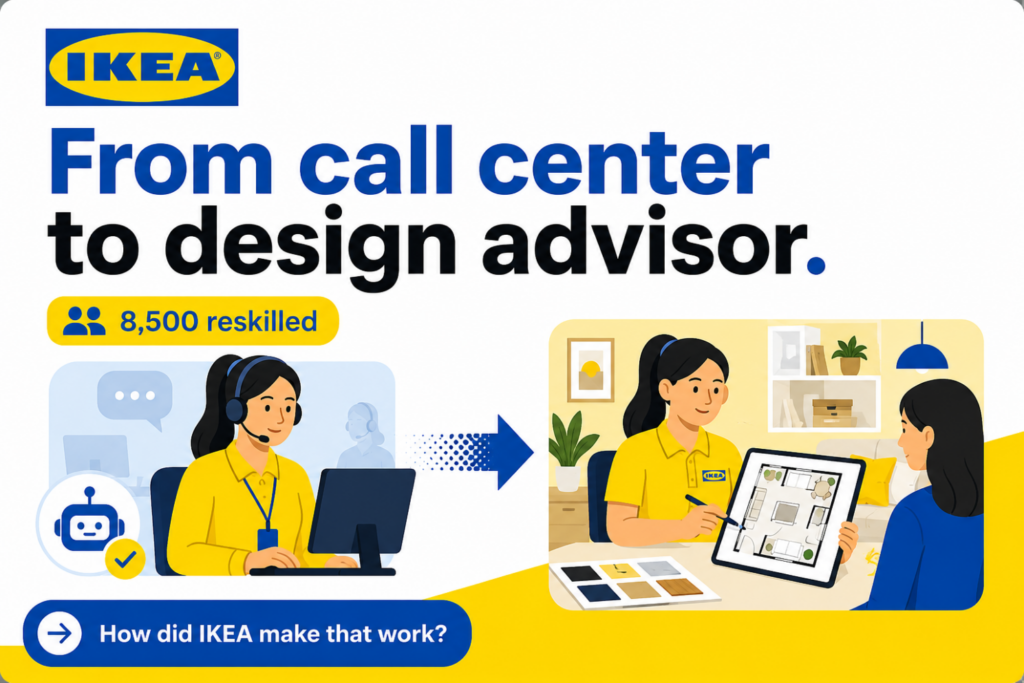
IKEA showed the approach before ChatGPT even launched. Starting in 2021, as its Billie chatbot took on about 47% of customer queries, the company reskilled 8,500 call center workers into remote interior design advisers rather than cutting them. Design takes taste and a feel for the customer. AI is bad at that, so it’s exactly the work IKEA moved people into.
The remote design channel brought in about 1.3 billion euros, and IKEA says headcount didn’t drop. The tools are more advanced now. The choice is the same.
2. The Savings Are Smaller Than They Look
AI isn’t free, and the bill keeps going up with how much you run it, how much you let it run on its own, and how capable a model the work needs. Charlie Treadwell, CMO at Elisity, told me his team got more productive while some workflows got more expensive and harder to predict. It isn’t one team’s quirk. Uber ran through its entire 2026 AI budget in four months, then capped how much AI its engineers could use.
This State of AI article covers other companies like Microsoft, Amazon, and Walmart experiencing the same.
I dug into why the cost keeps climbing here: You’re Building AI Teammates and Workflows. Do You Know What They Cost?
So AI doesn’t decide whether you cut or grow. You do. A cut is a cut, and reimagining the work won’t put everyone back.
Then The Org Chart Changes
Once the work and the roles change, the org chart does too. The old org chart is built by function: marketing, sales, customer success, partnerships, and operations, each chasing its own numbers.
- Allison Munro, Chief Marketing and Ecosystem Officer at Vena Solutions,
puts it this way:
“Every team is being asked to use AI, so every team comes back with its own plan. But activity comes at a cost. Outcomes drive business impact, and that takes redesigning how the business works, not just what each team does.”
The customer doesn’t experience the org chart. They experience the seams between functions. They want someone to help them understand their problem, make the case to their boss, and get value quickly.
The team starts to organize around the customer’s goals instead of departments, with the four kinds of people on each team and a shared group of specialists they all pull from.
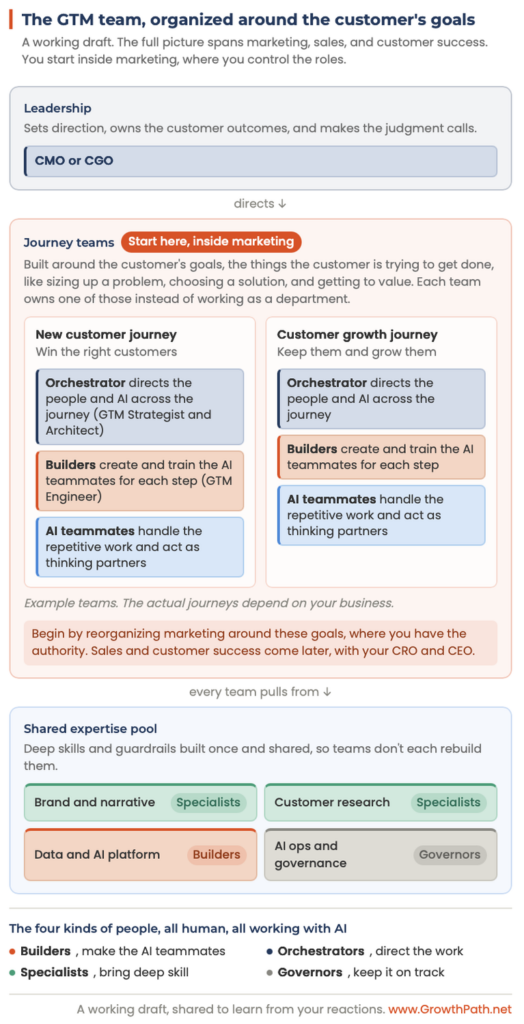
I went deeper on this structure, journey teams plus a shared expertise pool, in an earlier piece, No Daylight: How AI is Reorganizing GTM Teams Around Customers, Not Departments. Here’s how it could evolve across GTM:
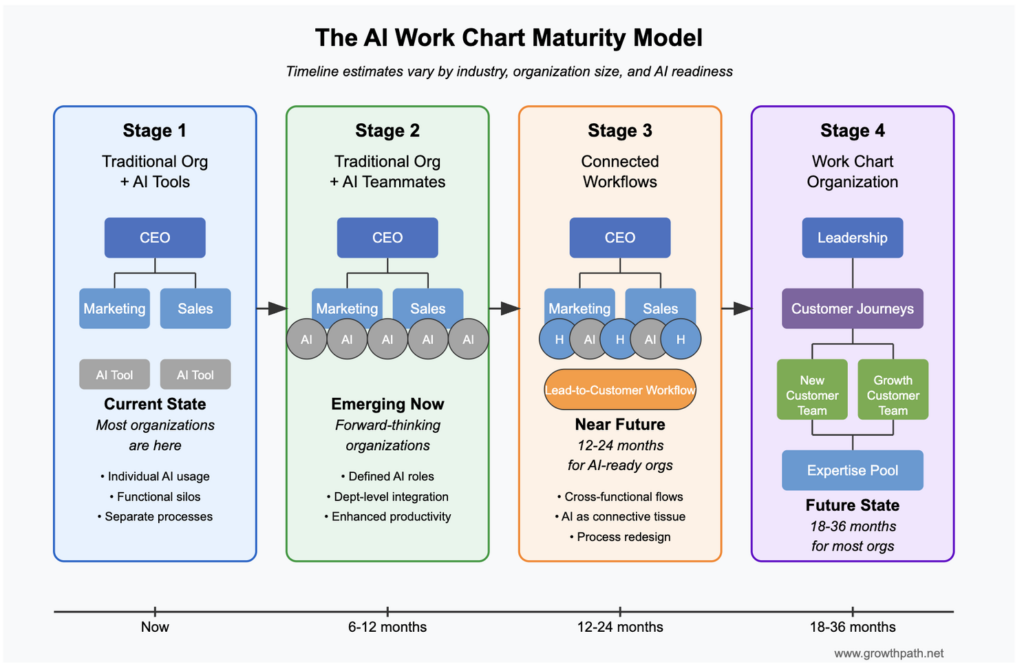
There’s one caution here. The full picture crosses marketing, sales, and customer success, so you can’t build all of it alone. It’s the vision. Your first move is inside the function you own, reorganized around the customer’s goals. If that’s marketing, start there. The cross-department version needs your CRO and CEO, and that’s a later conversation.
I’m not handing you a best practice model. It’s an informed starting point, built from working with GTM teams, comparing notes with others, and connecting what’s already happening. I’m still working it out, so poke holes in it and share your thinking.
Where To Start
You don’t need the final answer to begin. A few suggestions:
1. Map a real workflow and separate the repetitive steps from the judgment. Hand the repetitive steps to AI, then redesign what’s left around what AI can see across the whole workflow, rather than simply speeding up the old version.
2. Grow the judgment in every role, and grow people T-shaped, deep in one area and able to stretch across the others. That’s what upskilling means right now, and it’s the part you control.
The people who build that judgment and range get more opportunity and a wider role. The ones who stay in the tactical work are the most exposed. Not everyone moves at the same pace, so this needs real support and time.
If AI does the work that used to teach junior people, how do they develop judgment? That’s the open question, and we’re still working it out.
More on ways to upskill and drive change management here, Human Change Management: From Applied AI Workshops to Hackathon to New Operating Model.
3. Use the time AI frees up to serve customers better, build trust, and drive more growth.
The Choice
It comes back to this: reimagined work leads to reimagined roles, and reimagined roles change the org chart.
Think about the three leaders at that dinner. The one told to cut 30% may still have to. His real choice is what he does with the work that’s left, and whether the people who stay lean into judgment or just run the old job faster. The one weighing a GTM engineer is seeing the work between her teams change, and that’s where the new role comes from. The one redesigning her workflows is the furthest along, because she started with the work and let the roles and the org follow.
Whether AI grows your team or shrinks it comes down to one choice. You can use it to do the same work with fewer people, or to do more for your customers and grow. That second path is what I mean by people first, AI forward. AI handles what it’s good at, and people own the judgment.
If you reorganized your team around the customer’s goals, where would you start?
The Practical AI in Go-to-Market newsletter shares learnings and insights in using AI responsibly. Subscribe today and let’s learn together on this AI journey.
For applied learning: Explore our applied AI workshops, offering both strategic sessions to shift mindsets through practical AI uses and hands-on sessions to build human+AI workflows. You’ll leave with either a clear plan or working solutions. Office hours provide follow-on support to keep momentum going.
For ongoing advisory: I work with leaders as a strategic advisor through their AI transformation, providing guidance, frameworks, and a sounding board as they build. If that’s what you need, let’s talk.
For team transformation: I partner with GTM leaders to move from scattered AI adoption to an operating model where human and AI teammates work together across workflows. See real examples: a lean GTM team’s step-by-step playbook and a global cybersecurity leader scaling to 150+ marketers with 57 AI teammates integrated into daily workflows.
For speaking: Here are virtual and in-person events where I’ve covered a variety of AI topics. I’ve also keynoted at many organization and corporate-wide events.
If any of this resonated, I’d love to hear from you. Reply to this email, find me on LinkedIn, or come say hi at an event.