Your market intelligence is probably broken. Automating it as-is would just be a faster path to failure.
AR tracks the analyst reports. PMM runs customer interviews and listens to Gong calls. CI does competitive research. Brand watches customer reviews. Each team actions what they see. Rarely does anyone pull it all together, consistently, to find what cuts across every source. So you get fast action on individual signals and little action on the signals that only appear when you look at everything at once. Those that should drive your messaging, your positioning, and your buying committee strategy get missed.
You don’t fix that by adding more meetings or better hand-offs. You redesign the workflow.
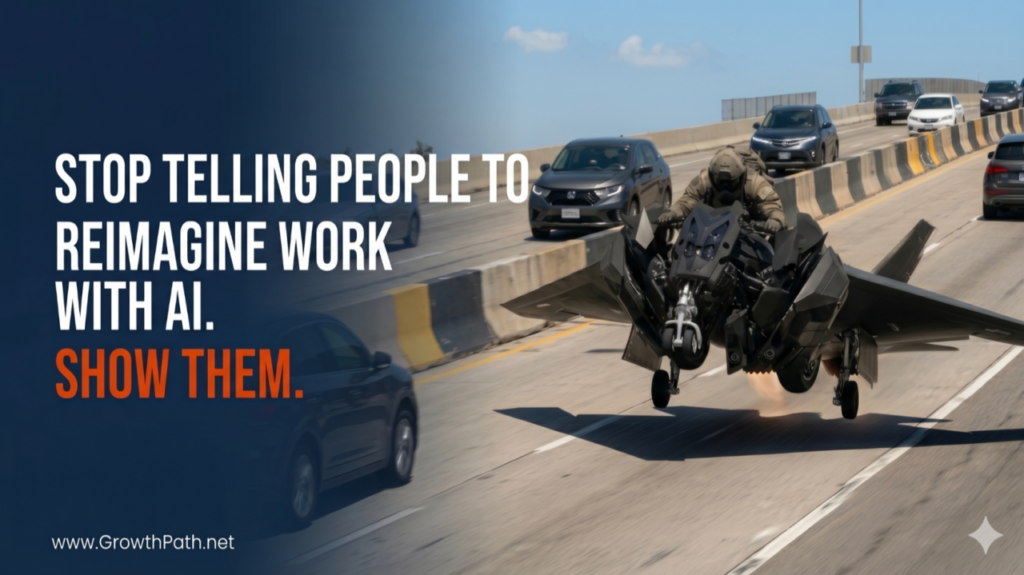
Productivity-only AI makes the case for fewer people. Reimagined work makes the case for more of what people uniquely bring. This newsletter shows you what reimagined work looks like.
Why Reimagining Is Hard
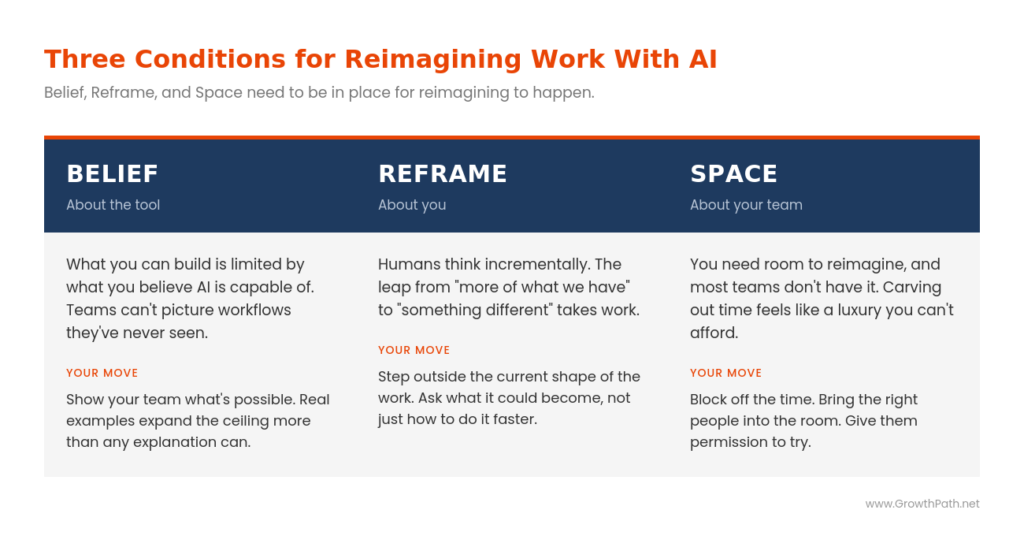
Writing a newsletter that says “reimagine your work” is easy. Doing the reimagining is much harder. Three conditions need to be in place. I call them Belief, Reframe, and Space.
- Belief is about the tool. What you can build is limited by what you believe AI is capable of. If your team’s experience with AI is mostly faster drafts and summarized reports, that’s the ceiling they’ll build to. They can’t picture a workflow that reads every Gong call, customer review, win/loss note, and analyst report from the quarter and tells them which three buyer objections are gaining steam and what messaging is working against them. They’ve never seen one. (I went deeper on this in Your Team Will Only Build What They Believe AI Can Do.)
- Reframe is about you. Humans think linearly and incrementally. Given the problem of unreliable taxis, the natural conclusion was “we need more taxis.” Uber and Lyft didn’t solve for more taxis. They reframed the problem as trust plus access to vehicles and built a different system: an app, drivers using their own cars, and a layer that made strangers comfortable getting in. The leap from “more of what we have” to “something different” takes work.
- Space is about your team. You need room to innovate, and most teams don’t have it. Your people are already busy delivering on what’s on their plate. Carving out room to rethink the work itself feels like a luxury you can’t afford, even when you can’t afford not to.
This newsletter is here to give you a head start on all three.
Quick Take
This piece walks through a real workflow I built in Claude Cowork and demoed live at Content Jam in Chicago a few weeks ago. It shows what becomes possible when market intelligence stops sitting in silos and starts producing tailored content strategy for every member of a buying committee. It also covers what it takes to make the outputs genuinely good.
- Reimagining a workflow means doing work that was not possible before. Faster reports and better drafts are good starting points, and they are not redesigned work.
- AI can do things at scale that a human team cannot, no matter how well- coordinated. That is where redesign starts.
- The quality of what comes out depends on the quality of thinking you put in. There are no shortcuts on that part.
AI Video Explainer and AI Podcast Versions of This Newsletter
To support different learning styles and time constraints, this newsletter is available as a 5-min AI cinematic video and a 19-min AI podcast with two AI hosts. I used Google’s NotebookLM to create these and personally reviewed them for accuracy and responsible AI use.
The Shift That Made This Possible
AI just crossed a capability threshold that changes what workflows can do. My friend Lisa Sharapata, Founder and CEO of 4Profit GTM and former CMO of Metadata, captured the change in a fun, visual way.
The old analogies (building the plane while flying it, changing a tire on a moving car) describe upgrades to something we already understood. Lisa reframed it with her post and the video below. It goes beyond fast. It’s different.

“We’re not just building in motion anymore. The motion itself is transforming mid-flight. We’re dealing with a motorcycle on the highway that transforms into a plane and takes off while moving. It’s fundamentally different. That’s what agentic GTM actually feels like. I helped drive this at Metadata, and I’m guiding leaders as they work through the same right now.”

Sam Altman describes five levels of AI: Chatbot, Reasoner, Agent, Innovator, and Organization in the 60-sec video below. We just crossed from Reasoner into Agent late last year/early this year. Innovator and Organization come next.
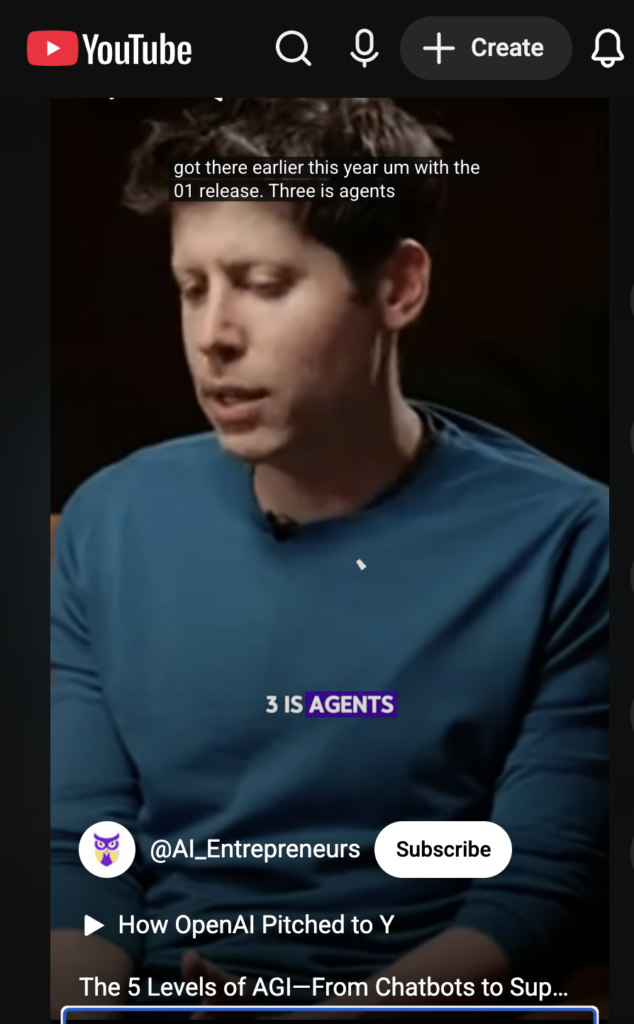
What changed in practice: AI moved from giving answers to delivering work. That is the agentic shift, and it is what makes a new category of workflow possible. (More details here, AI Moved Fast: What Changed and What to Do Next.)
What AI Can Do That Your Team Can’t
Most of this work today gets done in batches by people doing their best with limited hours: a dozen Gong calls reviewed, a sample of reviews skimmed, one pricing scenario at a time. Rethinking starts with the capabilities that change what’s possible when you stop working in batches. Look for these in your own work.
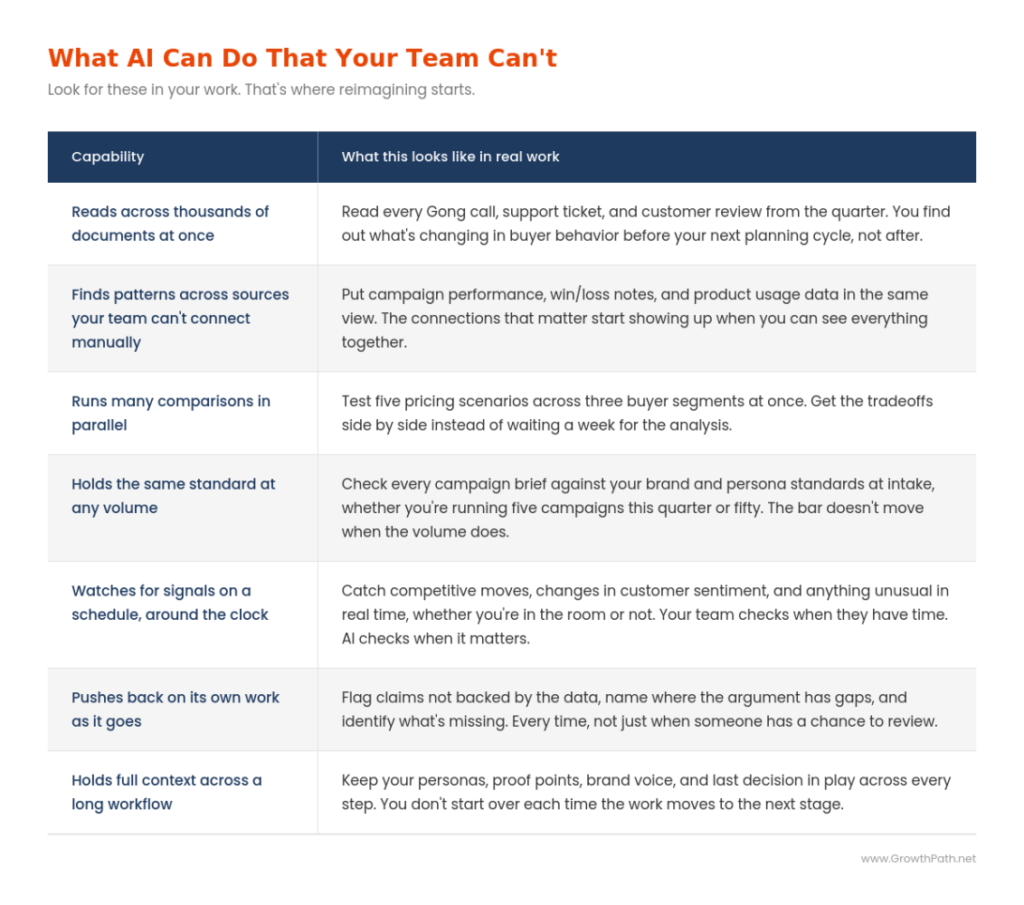
When you build a workflow around capabilities like these, the output is work a human team alone couldn’t produce at this quality, consistency, and cost.
One thing to check before you start: is the workflow itself sound? Automating a broken process gives you a faster path to failure. Innovating starts with workflows worth redesigning, not workflows that need fixing first.
The Workflow in Action
I built a Market Signals-to-Content Strategy workflow in Claude Cowork and demoed it live at Content Jam in Chicago. The workflow turns market intelligence into a persona-tailored content strategy. For the demo, I ran a product launch through it.
Note: the company and data in this demo are fictional. The workflow, the build, and the outputs are real.
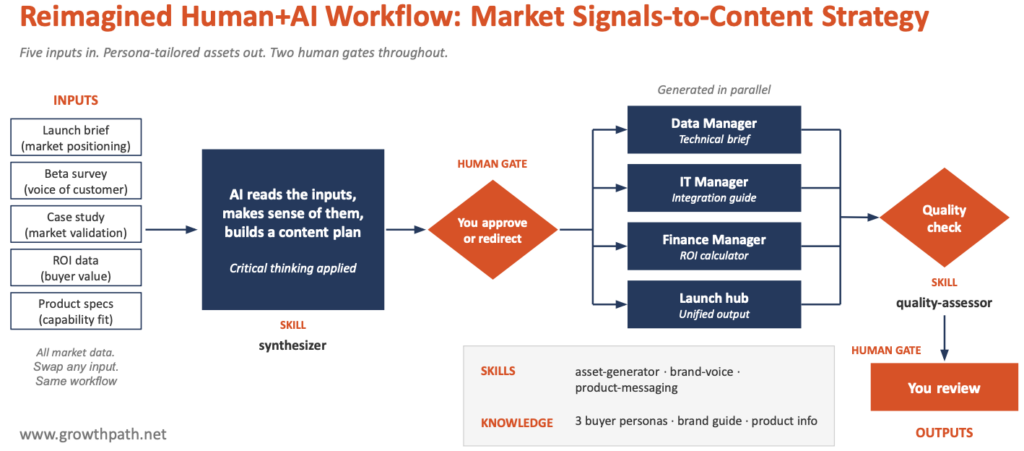
The inputs were all market data:
- The launch brief captured how the product fits the current market.
- The beta survey reflected the voice of customer.
- The case study showed where the market validated the product.
- The ROI data quantified where the product creates value for the buyer.
- The product specs translated market needs into capability.
The workflow doesn’t care what kind of market intelligence you load into it. The same workflow runs on analyst reports, Gong calls, competitive signals, or any combination you have.
AI reads everything and builds a content plan. You review and approve the plan, or redirect and challenge it, before a single asset gets produced. Then AI generates four outputs in parallel, each tailored to a different member of the buying committee, each quality-checked before it reaches you.
Imagine doing this with an all-human team in less than 10 mins. Not possible without AI.
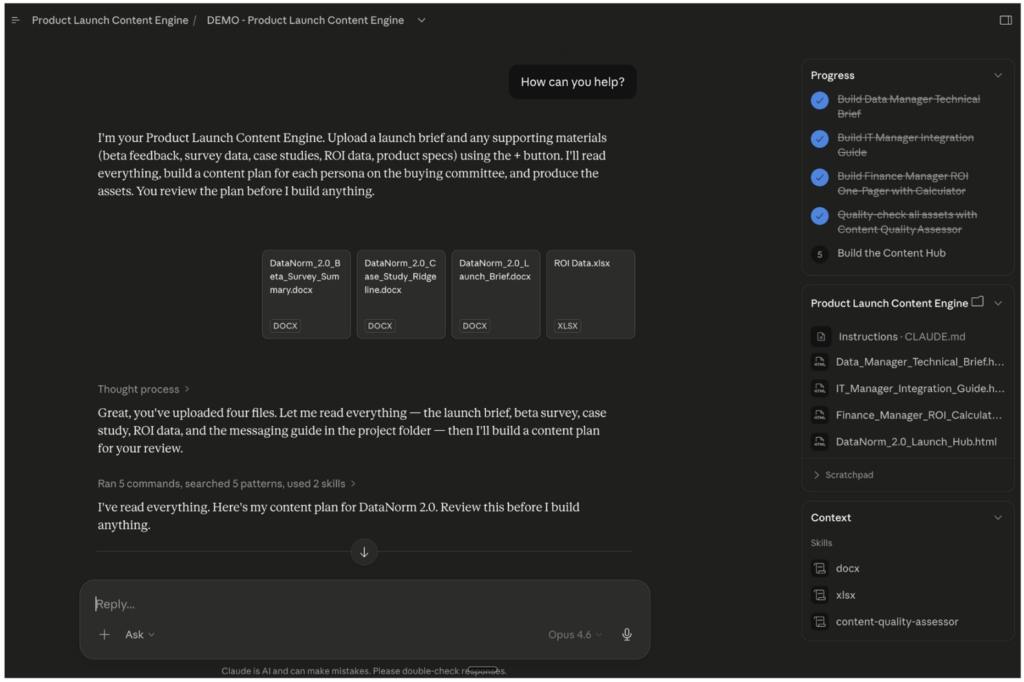
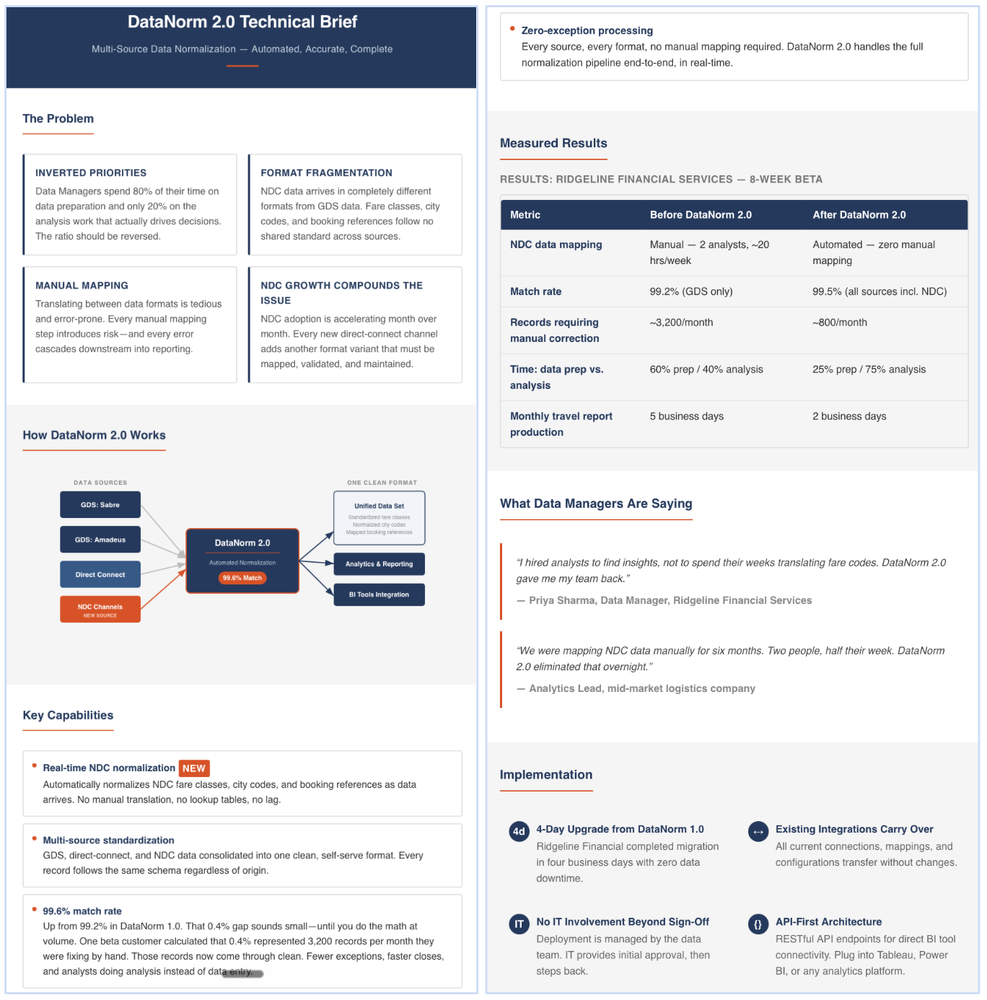
Here are the outputs of the workflow.
Data Manager: Technical Brief. Built for the person evaluating whether this fits the architecture.
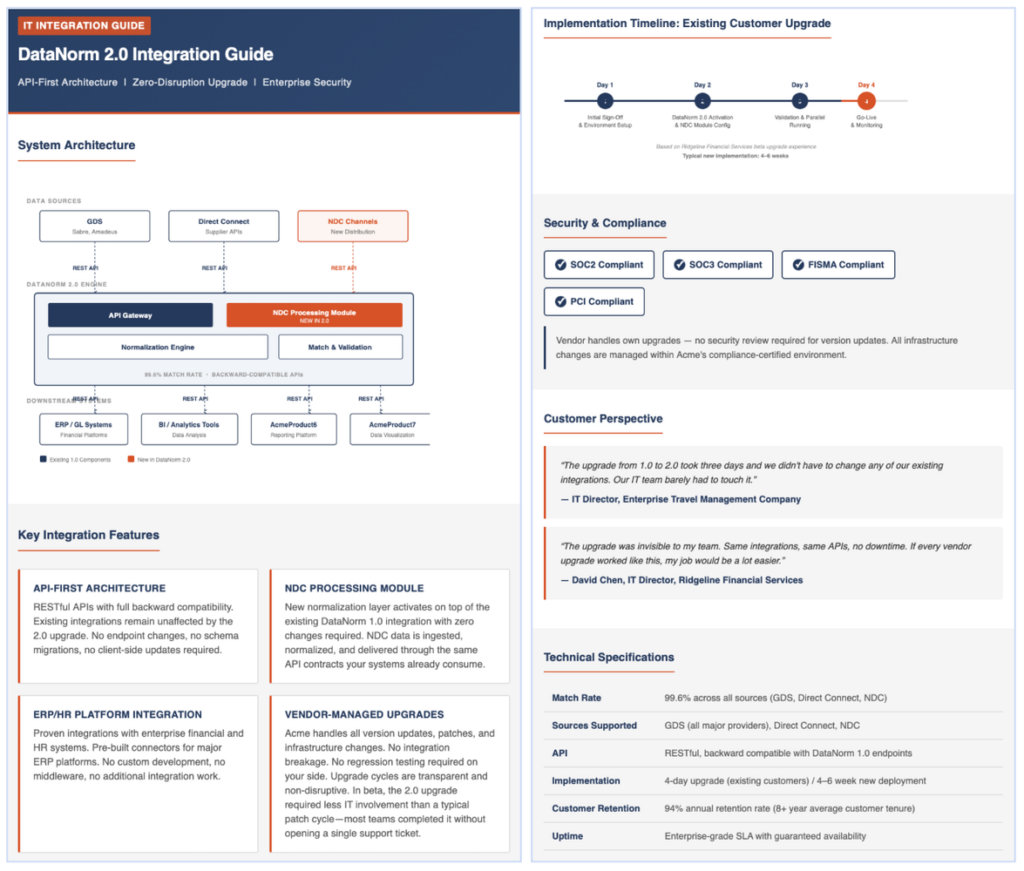
IT Manager: Integration Guide. Built for the person who has to set it up without breaking everything else.
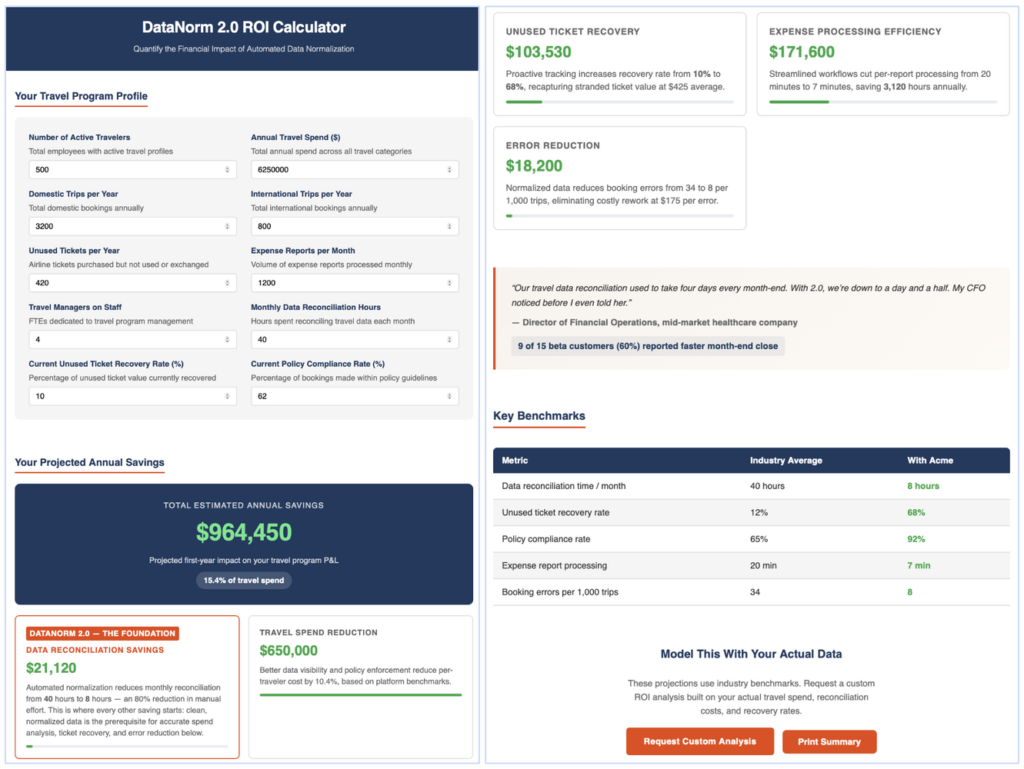
Finance Manager: ROI Calculator. Built for the person who has to justify the investment. Inputs are adjustable. The math updates as you change them.
You are accountable for the outcome. You are in control at every gate. And even with the built-in quality check, you still review the outputs and make the final call.
Seeing a workflow run end to end is what shifts what teams believe is possible. That’s the first condition in motion.
If you’re interested, here are the links to each of the HTML outputs. Download them and run them on a browser:
Also, here’s a 6-min cinematic video (built with NotebookLM) explaining this workflow.
Showing What’s Possible
Last week, I ran a strategic hands-on AI workshop in Boston for the global marketing team at Klaviyo. About 200 marketers in cross-functional groups spent the day reimagining real workflows from their day-to-day work. By the end of the day, every group built something, and the show-and-tell was truly inspiring. Just as the team learned from me, I learned from them as well.
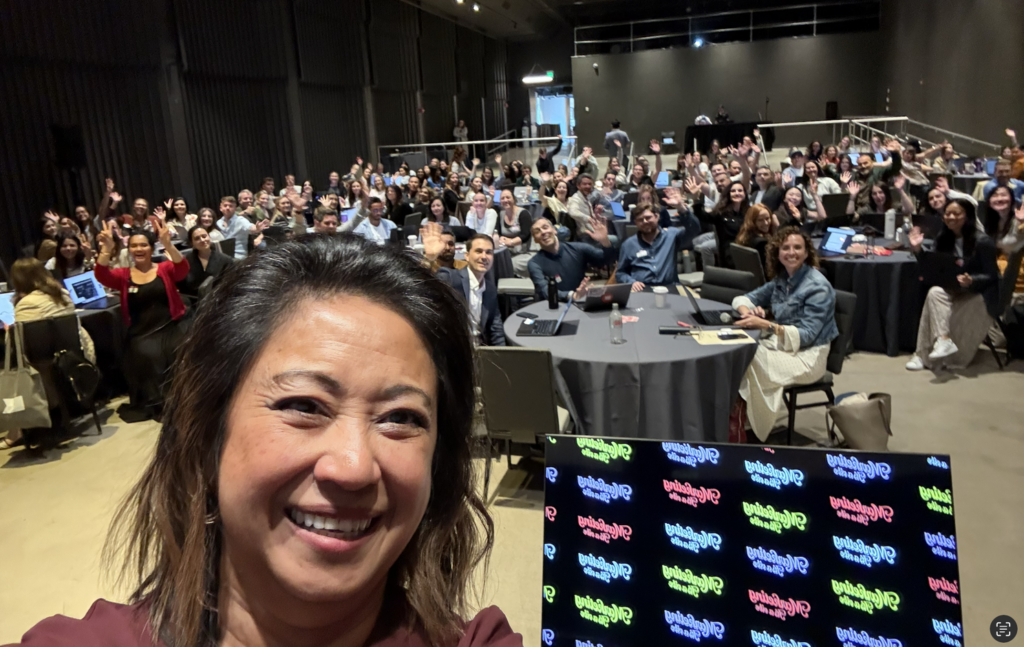
The workshop worked because Jamie Domenici, CMO of Klaviyo, and her leadership team created Space. They blocked off the time, brought the right people into the room, put hands on keyboards, challenged the team, and gave them permission to try.

Jamie put it plainly:
“We’re past, ‘How do we do this faster?’ The work now is rethinking how marketing grows the business: how to scale what works, how to use AI as a sparring partner, how to build secure infrastructure, and when to build versus buy. We carved out the time and put everyone in a room with hands on keyboards.
In just a few short hours, the teams built new workflows spanning creative, analytics, product launch, and integrated campaigns. That’s what it looks like when people can put the thinking into practice.”
You don’t get this kind of output by handing people the tools and asking them to innovate on their own time. You get it by giving them space, examples, and the chance to learn from each other in the same room. The conditions you create for your team count for more than the tools.
The Outputs Are Only as Good as Your Thinking
A word of caution before you walk away inspired.
Anthropic’s AI Fluency Index, published in February 2026, found that when AI produces a polished artifact, users are measurably less likely to question its reasoning. The more finished the output looks, the less people verify it.
The workflow handles execution. What it cannot do is supply good judgment, honest inputs, or the willingness to push back on what it gives you. Accept the first answer and you get average work at scale. Garbage in, garbage out is not a cliché. It is the most predictable failure mode in AI-assisted work.
The work pays off when you treat AI as a sparring partner, not an answer machine. Neuroscientist Vivienne Ming ran an experiment with real-world prediction teams and found that the 5 to 10 percent who outperformed everyone, including professional prediction market experts, were the ones who pushed back, demanded evidence, and challenged their own assumptions. The two qualities that separated them were perspective-taking and intellectual humility, or being ok with being wrong.
Keri Brooke, CMO of Enverus, saw this firsthand in a working session where we explored what reimagined workflows could look like for her team:

“We’ve been pushing hard on automation and our team has built a lot. And while we’ve always worked well together, AI is pushing us to think and operate as one team in ways we hadn’t before.
Seeing real examples of reimagined workflows, not just faster automation, made it real and inspired the team. Now the question isn’t how we speed up what we’re already doing. It’s what we do with the time AI gives back.”
That last line is the Reframe in action. The question shifts from “how do we go faster” to “what do we do with the time AI gives back.” That’s a different conversation entirely.
Two prior newsletters go deeper on this. AI Made Me More Human covers five qualities AI develops in you when you treat it as a thinking partner. How to Think Critically with AI, No Matter What You’re Working On gives you a practical framework for getting past the first answer.
This Will Keep Evolving
Reimagining is a practice. As AI advances, the ceiling of what’s possible keeps rising. Keep innovating and you keep growing.
I’m still working through two things myself.
The first is where to put the human gates. Too few and quality drifts. Too many and the workflow stops being agentic. The right balance varies by team, by workflow, and by how much risk you can absorb if something slips through.
The second is when to rebuild. The capability is moving fast enough that a workflow you build today might be solvable with a single prompt in six months. Knowing when to invest versus when to wait is genuinely hard, and I don’t have a clean answer yet.
Where to Start
Productivity-only AI makes the case for fewer people. Reimagined work makes the case for more of what people uniquely bring.
Pick one workflow where your team is working harder than the output warrants. Map what AI can do in that workflow that your team can’t do at scale. Build a small version and test it.
You don’t need Belief, Reframe, and Space perfectly aligned to start. Pick one and the others tend to follow.
Think big, start small, move fast.
The Practical AI in Go-to-Market newsletter shares learnings and insights in using AI responsibly. Subscribe today and let’s learn together on this AI journey.
For applied learning: Explore our applied AI workshops, offering both strategic sessions (use cases and roadmaps) or hands-on building (create AI teammates during the workshop). You’ll leave with either a clear plan or working solutions. Office hours provide follow-on support to keep momentum going.
For ongoing advisory: I work with leaders as a strategic advisor through their AI transformation, providing guidance, frameworks, and a sounding board as they build. If that’s what you need, let’s talk.
For team transformation: I partner with GTM leaders to move from scattered AI adoption to an operating model where human and AI teammates work together across workflows. See real examples: a lean GTM team’s step-by-step playbook and a global cybersecurity leader scaling to 150+ marketers with 57 AI teammates integrated into daily workflows.
For speaking: Here are virtual and in-person events where I’ve covered a variety of AI topics. I’ve also keynoted at many organization and corporate-wide events.
If any of this resonated, I’d love to hear from you. Reply to this email, find me on LinkedIn, or come say hi at an event.