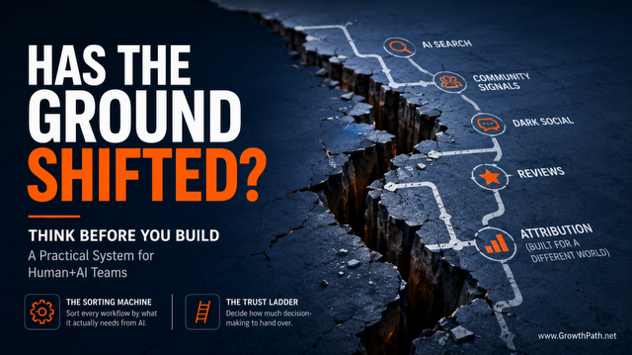
GTM teams are automating workflows that were broken. Speed will not fix them. It will get you to failure faster.
Take channel attribution. A team automates the model that tracks which marketing channels lead to deals. It runs faster, processes more data, produces cleaner reports. The model is still measuring a linear funnel: ad impression to website visit to demo request to close.
That funnel does not reflect how their buyers find and evaluate them anymore. AI is creating shortlists before any human at the buyer’s company is in the loop. Buyers pull from signals attribution pixels cannot see: community conversations, peer recommendations, review sites, social posts.
The team has made a precise measurement of the wrong thing, faster.
Two frameworks have come out of helping GTM teams avoid this trap. They are not the definitive answer, but they give teams a structured way to have the conversation before they build. One sorts your workflows by what is needed from AI. The other helps you decide how much autonomy AI should have in each one.
Quick Take
This newsletter introduces two frameworks I use with GTM teams: the Sorting Machine and the Trust Ladder. Together they form a practical system for deciding what your workflows need from AI and how much decision-making to hand over.
- The Sorting Machine uses one triage question and five paths to sort every workflow by what it needs from AI.
- The triage question (“has the ground shifted?”) catches workflows built for a market or buyer that no longer exists. Channel attribution is a prime example.
- The Trust Ladder has four levels of AI autonomy, from conversation to fully autonomous.
- The tool you buy does not determine the level of trust you give it. The same platform can operate at any level.
- Each sorting path maps to a natural starting level on the Trust Ladder.
- Both frameworks can be run as a 30-minute team exercise.
AI Video Explainer and AI Podcast Versions of This Newsletter
To support different learning styles and time constraints, this newsletter is available as a 5-min AI cinematic video and a 20-min AI podcast with two AI hosts. I used Google’s NotebookLM to create these and personally reviewed them for accuracy and responsible AI use.
The Sorting Machine
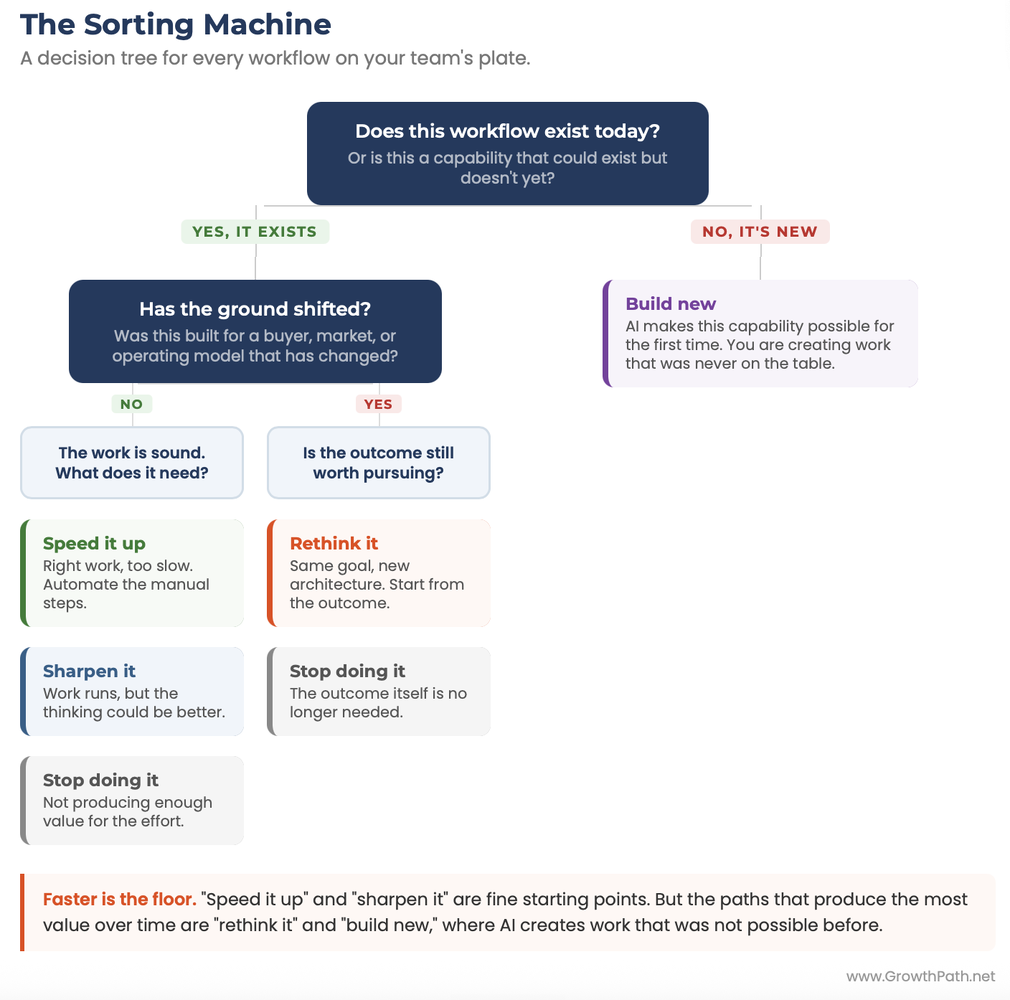
Every workflow enters the Sorting Machine through one of two entries.
Entry 1: This workflow already exists and your team runs it today.
Entry 2: This capability does not exist yet, but it could.
The triage question: has the ground shifted?
Before tools and automation, you ask: was this workflow designed for the world we are operating in right now? Or was it built for a buyer, a market, or an operating model that has changed since?
I wrote about four AI-driven shifts in buyer behavior in a recent newsletter. If your workflow was built before any of those shifts, making it faster will not fix what is wrong with it. That workflow needs to be different.
The traditional channel attribution model measured a linear funnel. The buying process had become something else entirely. Faster was not going to help.
Five paths out
1. Speed it up
The work is right but it just takes too long. You are looking for manual steps that do not require human judgment: data entry, formatting, scheduling, first-draft generation.
An AI teammate that drafts meeting summaries from recorded calls is a “speed it up” example. The summary was always needed. AI gets it done in seconds instead of 30 minutes.
2. Sharpen it
The workflow runs, but the thinking could be better. AI becomes a thought and sparring partner for the judgment calls.
A product marketing team that pressure-tests a launch plan through three buyer lenses (the IT Director, Marketing Manager, and Procurement Manager) is improving the quality of the work.
Speed-it-up and sharpen-it are good starting points. But those should not be the ceiling of what we do with AI. The paths that produce the most value over time are rethink-it and build-new, where AI creates work that was not possible before. I will spend more time here.
Jamie Domenici, CMO at Klaviyo, put it this way when she reposted my last newsletter. She captured the spirit of the rethink-it path in her post:

“We’re past ‘how do we do this faster’ with AI. The real work is rethinking how marketing grows the business… That’s the bar I’m holding my team to. Not just faster but different.”
3. Rethink it
The world this was built for has changed. You need to start from the outcome and work backward.
Take product launch content as an example. The old workflow runs like this: product marketing writes a brief, hands it to content, content writes a blog post, brand reviews, social writes captions, demand-gen builds the campaign. Each handoff loses context, and each persona on the buying committee ends up with a generic version of the same asset because the team does not have time to tailor for all of them.
Old workflow: Brief → Content → Brand review → Social → Demand-gen → Generic assets per persona
Rethought workflow: Shared market intelligence → Synthesis (human approval) → Specialist agents in parallel → Quality check → Persona-specific assets
The rethought version starts from the outcome. Each buying-committee persona gets an asset built for what they care about, generated from the same underlying market intelligence. I built one in Claude Cowork and walked through it in a previous newsletter, Stop Telling People to Reimagine Workflows. Show Them.
Five inputs go in (launch brief, beta survey, case study, ROI data, product specs). A synthesis step builds the content plan, you approve or redirect, and four specialist agents work in parallel to produce assets for the technical buyer, the IT buyer, the finance buyer, and a unified launch hub. A quality assessor checks the output. There were two human gates in the process.
Channel attribution is another rethink-it candidate. The outcome you need (understanding which activities influence pipeline) has not changed, but the inputs, the signals, and the buyer journey have. The rethought version combines traditional tracking with AI search visibility, community signal monitoring, and dark social (private channel conversations analytics tools can’t see).
4. Build new
With rethink-it, the outcome existed before in some form. With build-new, the outcome itself was not possible with humans only. The line is not always clean, and some workflows have elements of both. The question is which one dominates.
AI makes a capability possible for the first time. You are not improving old work. You are creating work your team has never done.
An AI mystery shopping workflow that walks through your entire buyer experience as a prospect, testing every chatbot, email sequence, and web page, then reporting back with a friction map, is a “build new” example. No team had the capacity to do that manually at scale.
5. Stop doing it
This work no longer produces enough value to justify the time it takes. GTM teams are notorious for hoarding legacy processes, and the biggest trap is using AI to automate reports or meetings nobody actually reads or needs anymore.
Derek E. Weeks, SVP of Marketing at Anaconda, has carried this philosophy across two marketing organizations.

“I have brought this thinking to two marketing organizations. The instinct is always to speed up what exists. The breakthroughs came when we asked whether the workflow still made sense given how our buyers behave and how our teams are organized.
That pushes us to redesign how different functions work together instead of optimizing each team in its own lane. We rebuild the handoffs with AI handling the volume and context, and our people handle the judgment calls and relationships. That combination produces better work than anything we just make faster.”
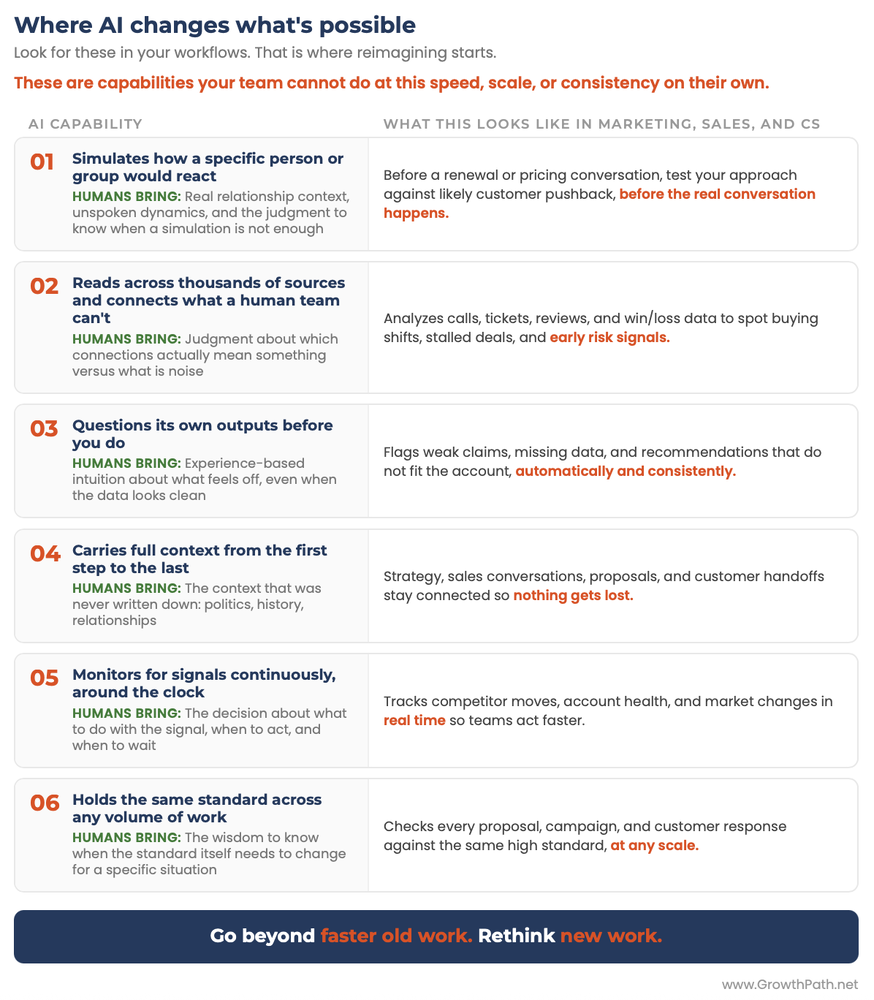
Where AI Changes What’s Possible
When a workflow exits the Sorting Machine on “rethink it” or “build new,” the next question is: rethink it with what? Here are some capabilities that AI brings to workflows that your team cannot match at this speed, scale, or consistency on their own. Each one is paired with what humans bring, because reimagined work is built on both.
Once you can see where AI fits inside a workflow, the next question is how much decision-making to hand over. First, sort the work. Then, set the trust level.
The Trust Ladder
Once the Sorting Machine tells you what a workflow needs, the Trust Ladder helps you decide how much AI involvement is appropriate. It has four levels, each describing a different level of autonomy you give to AI.
Level 1: Conversation
You make every decision. AI responds without memory of past work or context about your situation. Use it for brainstorming, pressure-testing an idea, or getting a second opinion.
Level 2: Specialist
You still make every decision, but AI gives you better input because you have loaded it with deep context: brand voice, data, competitive landscape. Claude Projects, custom GPTs, and Gemini Gems operate here. My digital twin is a Level 2 example, loaded with my newsletters, frameworks, and writing style. When I ask it to challenge an idea, it pushes back like a colleague who has read everything I have written.
Level 3: Guided Workflow
AI executes multi-step work with human checkpoints built in. It does the heavy lifting. You review and approve at specific gates.
The rethought channel attribution system could operate at Level 3. AI analyzes signals across multiple sources (traditional tracking, AI search visibility, community mentions, review sites) and produces a draft attribution picture. A human reviews the analysis before any budget allocation decisions are made. AI does the work. Humans make the calls.
Level 4: Autonomous Workflow
AI runs end-to-end on a schedule with minimal human involvement. The work happens whether anyone is watching or not.
A competitive intelligence workflow that checks five competitor websites every morning and flags changes to Slack is Level 4. It runs, it reports. A human sets the goals, reviews the output, and redirects as needed.
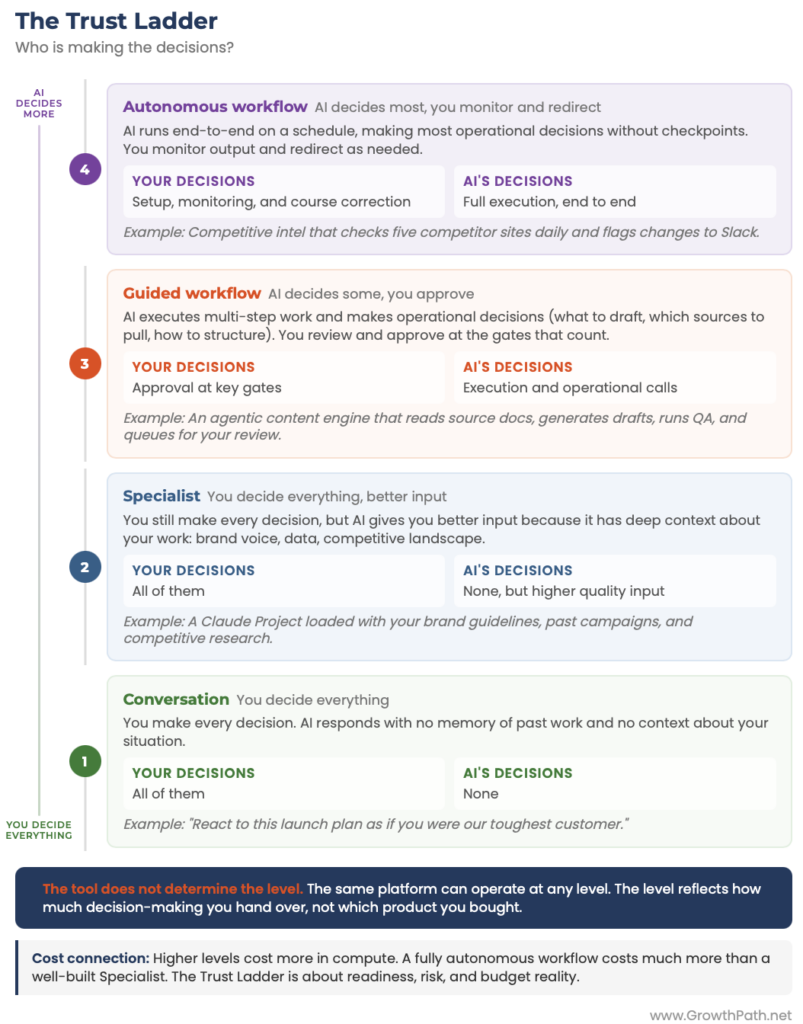
The Tool Does Not Determine the Trust Level
The same platform can operate at any level. Claude can be a Level 1 conversation partner or a Level 3 workflow engine. ChatGPT can be a Level 2 specialist or a Level 4 autonomous agent. A team using Claude Cowork with human review at every gate is at Level 3. The same tool set up to run overnight without checkpoints is at Level 4. The level reflects how much decision-making you hand over, not which product you bought.
When teams map this in workshops, a gap becomes visible: the distance between where the tools can operate and where the team is actually using them. That gap is usually a bigger opportunity than buying new tools.
Three factors should influence where you start on the ladder.
- Criticality – What happens if AI gets this wrong? Brice Challamel (former VP of Innovation at Moderna and now Head of AI Strategy and Adoption at OpenAI) has a useful matrix here. A workflow where a mistake damages your brand or creates compliance risk should start lower than one where a mistake just costs time.
- Cost – Higher levels cost more in compute. A fully autonomous workflow that reasons through multiple steps, calls tools, checks its own work, and retries on failure runs much more expensive than a well-built Specialist. Not every workflow needs the most expensive architecture. (More on what AI costs here.)
- Team Readiness – A team that has never built with AI should not start at Level 3 even if the workflow could technically handle it. The starting level should match the team’s experience. A workflow’s theoretical potential does not override where the team actually is.
How They Connect
The Sorting Machine tells you what a workflow needs. The Trust Ladder tells you how to build it. Each sorting path has a natural starting level.
Here is what that looks like across six real GTM workflows:
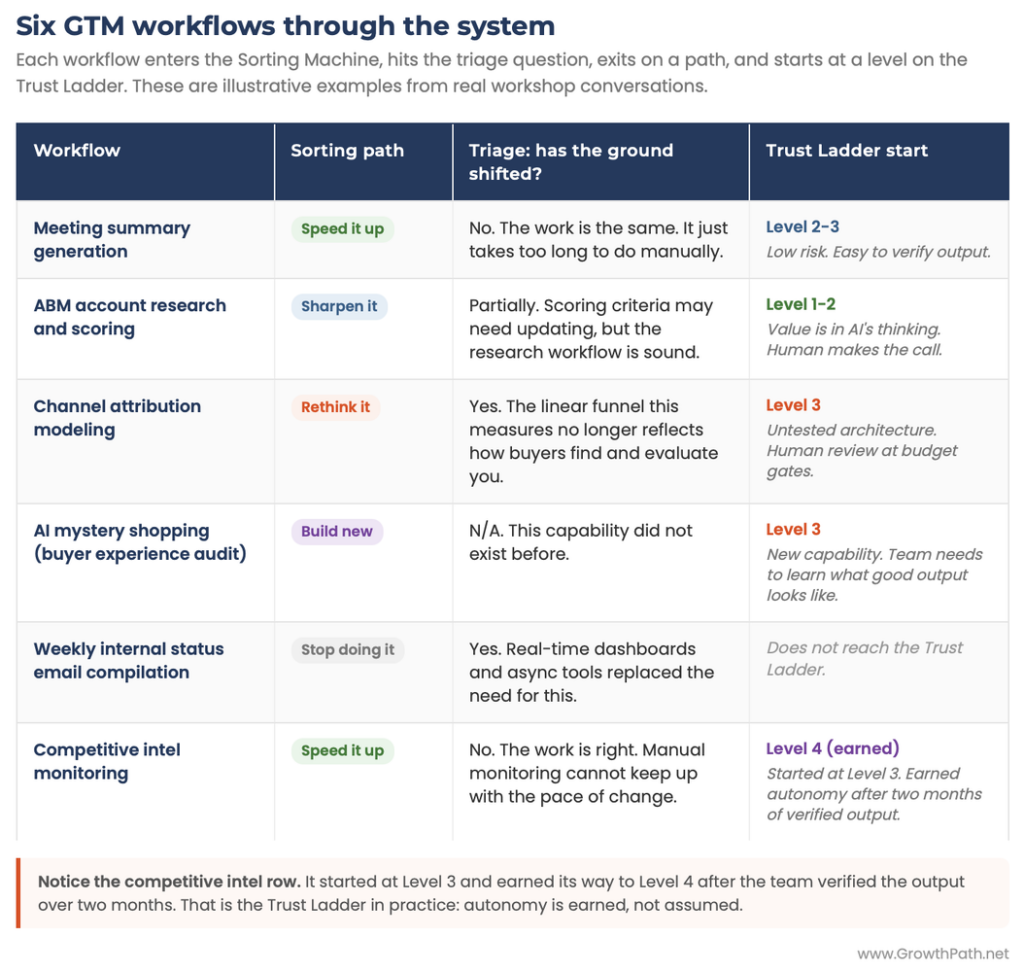
“Speed it up” workflows start at Level 2 or 3 and earn their way to Level 4 because output is easy to verify. “Sharpen it” workflows live at Level 1 or 2 because the value is in AI’s thinking, not its execution. “Rethink it” and “build new” start at Level 3 because the work is untested and the team needs to see what good output looks like.
Run It Yourself
You can run both frameworks with your team in 30 minutes.
Step 1 (5 min): List every workflow your team runs regularly. Do not filter.
Step 2 (15 min): Run each workflow through the Sorting Machine. Start with the triage question: has the ground shifted?
Step 3 (10 min): For every workflow with a path forward, place it on the Trust Ladder. Place it where your team’s trust and experience are right now, not where you want it to end up.
The output is a map of your workflows, sorted by what to do with them and how much AI autonomy to give them. The “stop doing it” pile often creates the most room for everything else.
First, sort the work. Then, set the trust level. That is the whole system.
Megan Cabrera is one of my business partners who runs these frameworks with GTM teams. She previously led the AI transformation for a 150-person marketing organization at a global cybersecurity company, where her team converted 75% of manual execution time into higher-value work. She now works inside client organizations mapping workflows, interviewing stakeholders, and building the blueprint for what changes and how.

“The sorting conversation changes when you are inside the actual workflow. A team will call something ‘speed it up’ until you walk through the steps together and realize half of them exist because of a handoff that does not need to happen anymore. That is when it moves to ‘rethink it.’ The framework gives you the question. The detail work gives you the honest answer.”
What’s Next
If you want to run this with your team, the two visuals in this newsletter are the worksheet. Save them, grab a whiteboard, and walk through the three steps above.
If you would rather have it facilitated with your team, that is what we do at GrowthPath Partners. Feel free to DM me or Megan.
And if you run it on your own and something works differently than I described, or you find a gap, I want to hear about it. These frameworks get better every time a team uses them.
The Practical AI in Go-to-Market newsletter shares learnings and insights in using AI responsibly. Subscribe today and let’s learn together on this AI journey.
For applied learning: Explore our applied AI workshops, offering both strategic sessions (use cases and roadmaps) or hands-on building (create AI teammates during the workshop). You’ll leave with either a clear plan or working solutions. Office hours provide follow-on support to keep momentum going.
For ongoing advisory: I work with leaders as a strategic advisor through their AI transformation, providing guidance, frameworks, and a sounding board as they build. If that’s what you need, let’s talk.
For team transformation: I partner with GTM leaders to move from scattered AI adoption to an operating model where human and AI teammates work together across workflows. See real examples: a lean GTM team’s step-by-step playbook and a global cybersecurity leader scaling to 150+ marketers with 57 AI teammates integrated into daily workflows.
For speaking: Here are virtual and in-person events where I’ve covered a variety of AI topics. I’ve also keynoted at many organization and corporate-wide events.
If any of this resonated, I’d love to hear from you. Reply to this email, find me on LinkedIn, or come say hi at an event.