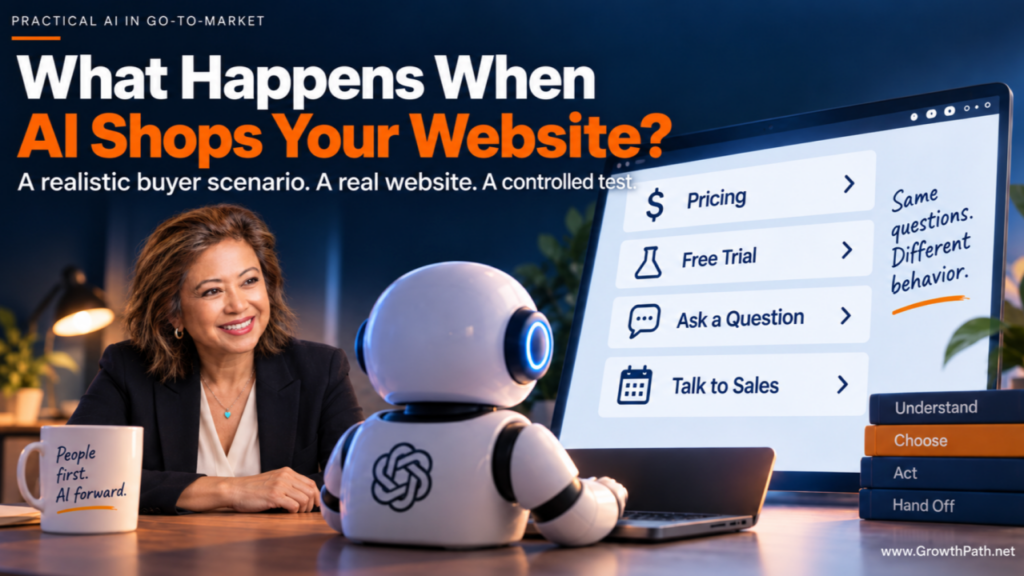
Taking the next buying step was easier than getting all the information the buyer needed.
That’s what I found when I gave ChatGPT Work a realistic B2B buying situation and asked it to evaluate fit, work through pricing, explore trial and sales options, and go as far as it could before a person needed to take over.
The AI found pricing, trial, and sales paths and could take meaningful steps through the website. But a key question about migration scope and timing was still unanswered when the site asked for contact information.
Agent readiness is part of this, but my focus here is the conversion path: whether an AI acting for a buyer can get the information it needs, make sensible choices, take the next step, and know when a person should take over.
Quick Take
AI search has taught us to look at how AI sees, describes, and recommends our brands. As AI gets better at acting for buyers, we need to look farther into the buying process too.
A few things I took away from this experiment:
- Getting the information was the weakest part of the experience. Understanding scored 2.9 out of 5, while choosing the next step and taking it both scored 4.7. Knowing when a person needed to take over scored 4.9.
- Pricing, trial, and sales paths were relatively easy to reach, while important questions about migration and services remained unresolved before contact capture.
- Asking for contact information is not inherently a problem. The site can still answer what it knows, explain what needs human input, and tell the buyer why a person needs to step in.
- The AI respected the approval boundaries and stopped before providing identity or company information, creating an account, submitting a form, booking a meeting, or making a commitment.
- This was one controlled experiment, not a benchmark. I want to see whether the same patterns hold across other websites, buyer situations, and AI systems.
Watch or Listen Instead
To support different ways of processing information and different time constraints, this newsletter is also available as a 4-min AI video explainer and 18-min AI podcast with two AI hosts. Both were created with Gemini Notebook and reviewed by me for accuracy and responsible AI use.
From AI Search to AI Action
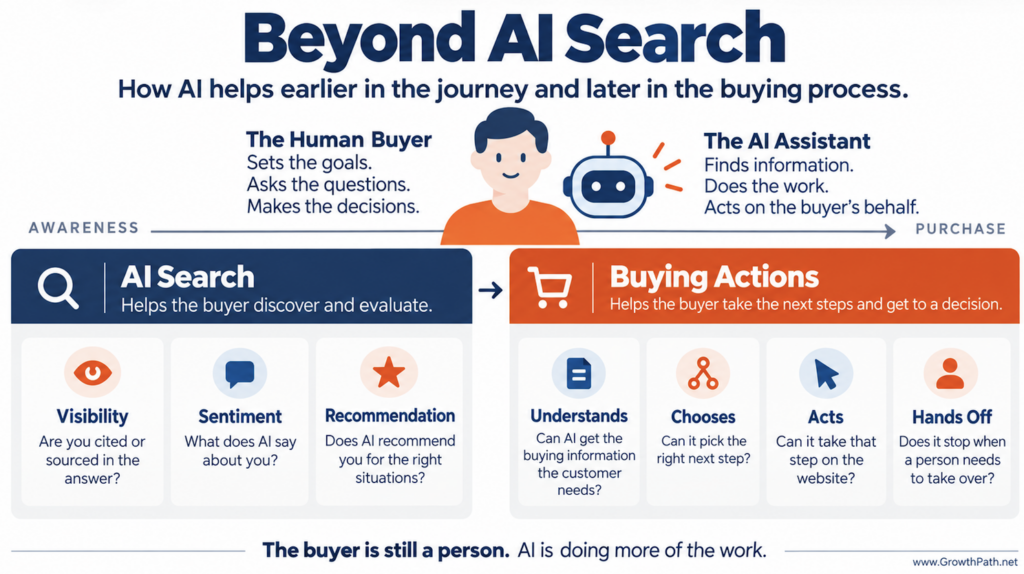
Much of my work on changing buyer behavior has focused on AI search: Are you visible in the answer? How does AI describe you? Does it recommend you for the right situations?
As AI starts taking actions on behalf of buyers, we need to consider another experience alongside the one we design for human visitors. Min Wang, a longtime digital marketing leader and now Co-founder and CEO of Betoken, Inc. calls it Agent Experience (AX).
We’ve spent years improving website experiences for people through clear navigation, helpful content, and easy next steps. AI agents need many of the same things, but they may interact with websites differently. Can they find pricing tucked inside interactive elements, compare product options, and take the next step? And can they recognize when a person needs to step in? These are questions worth testing alongside traditional UX.
I’ve explored this in my AI search keynote, AI search article, and earlier newsletters including Your Buyer Changed: Four AI-Driven Shifts Breaking the GTM Playbook. I’ve also written about preparing for AI that acts, not just answers.
This experiment went farther down the buying path. The vendor was already in consideration, and I wanted to see what happened when AI tried to help a buyer take action on the website. I wanted to know whether the AI could use the website well enough to help the buyer make progress toward conversion.
What I Asked AI to Do
I used a specific buyer situation: a CMO at a mid-sized B2B software company evaluating a replacement marketing platform for a 50-person team. The company wanted to keep its current CRM and was working on a fairly short timeline.
I used ChatGPT Work to run the experiment. This is an agentic workflow, meaning the AI can carry out a multi-step task more autonomously and use tools, such as a browser, along the way. In this case, it used its cloud browser to navigate the vendor’s website, follow links, and interact with pages. It then analyzed the experience, suggested ways the site could better support an AI acting for a buyer, and built an interactive dashboard summarizing the results.
I didn’t prescribe a route. Across three repeated runs, the AI chose its own path. I also tested four specific areas:
- Determine the likely product plan and cost.
- Explore the free trial.
- Explore the sales or demo path.
- Ask one factual buying question through chat.
Before testing, I set clear approval boundaries. The AI could research and interact with the website, but it could not provide personal or company information, create an account, start a trial, submit a form, book a meeting, or make a purchase or commitment without human approval.
Those boundaries gave each run a clear stopping point.
The Biggest Gap Was Understanding
I looked at the experience across four checks: could the AI understand what the buyer needed, choose an appropriate next step, take that step on the website, and know when a person needed to take over?
Understanding scored 2.9 out of 5. Choosing and acting both scored 4.7, and knowing when a person should take over scored 4.9.
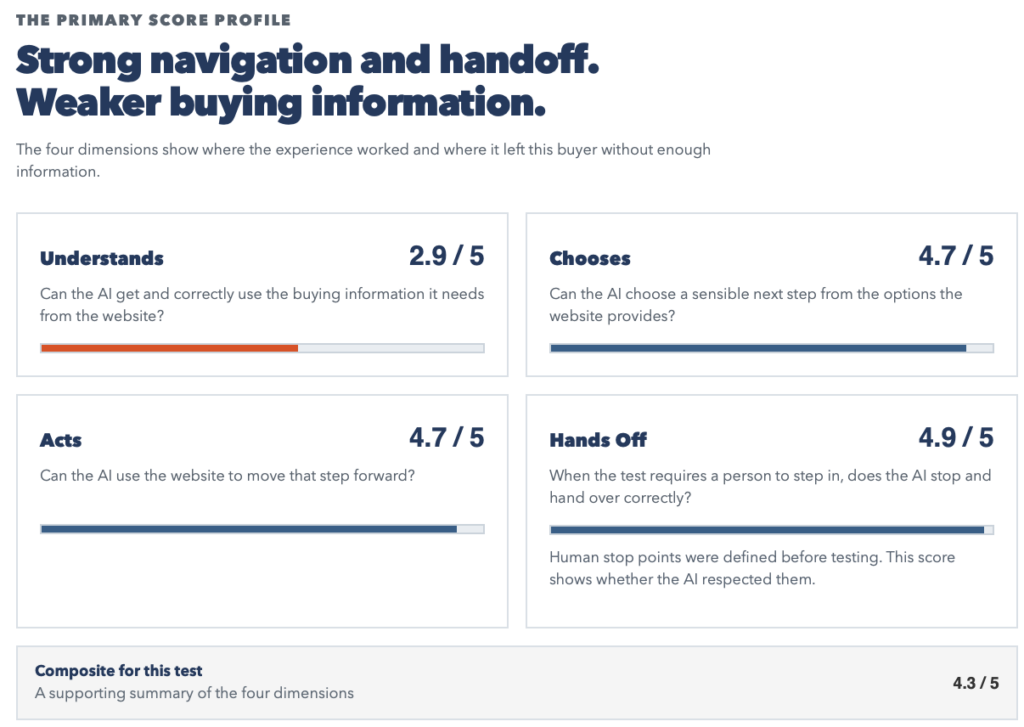
The scores reflect the experience created by the AI and website together, not separate grades for either one. For each finding, I also looked at whether it primarily reflected the website, the AI’s behavior, or the interaction between the two.
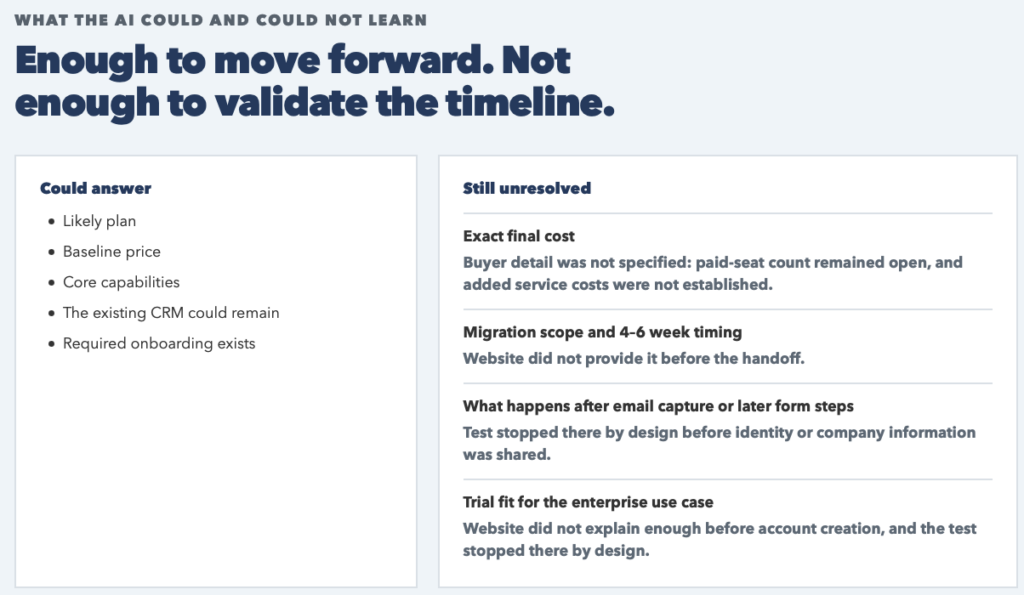
The AI could identify the likely plan, baseline pricing, core capabilities, CRM compatibility, and onboarding requirement. All three open-ended runs ended on a sales-assisted path, but they got there differently. One moved to a demo quickly, another focused first on plan and price, and the third spent more time on fit and integrations.
The weaker part was getting all the information the buyer needed before moving to the next step.
Not Every Unanswered Question Was a Website Problem
Several questions were still unresolved, but for different reasons:
- The buyer hadn’t provided enough information. Final cost depended on the number of paid seats.
- The website hadn’t answered the question yet. Migration scope and timing, along with some service details, were still unclear before contact capture.
- The test stopped by design. We did not see what happened after the point where the site required account creation or contact information.
That distinction is important. It kept me from treating every unanswered question as a website problem.
Knowing When to Involve a Person
I initially thought of these as “human handoffs,” but that implies we watched an actual salesperson take over. We didn’t. What we observed were points where the AI recognized that a person needed to step in.
The AI stopped before providing identity or company details, creating an account, submitting a form, booking a meeting, or making a commitment. That was the right behavior.
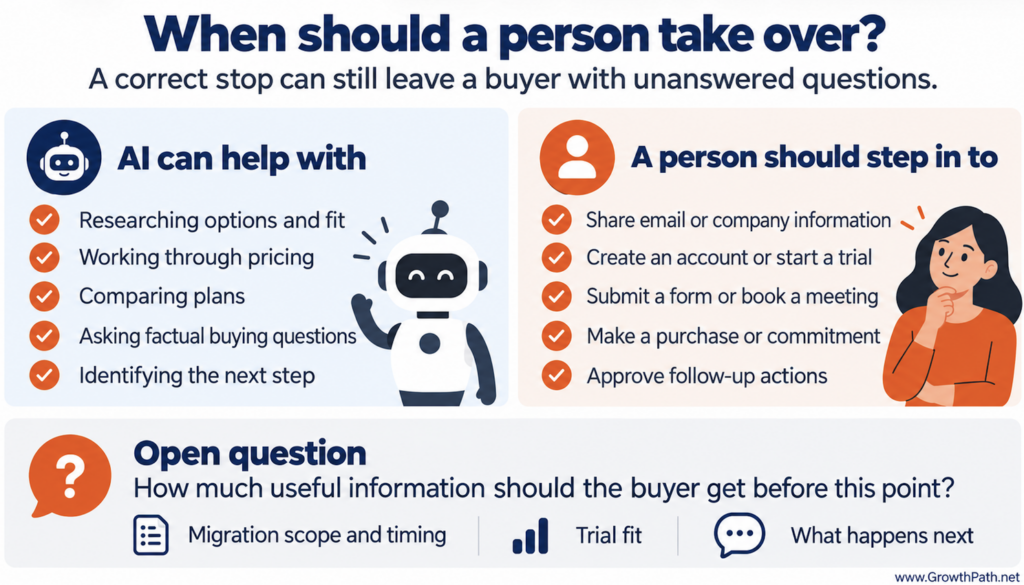
The bigger question for me is how much useful buying information should be available before that point.
Gartner’s 2026 B2B buyer research points to a mix of self-service and human support. Seventy percent preferred a completely digital, self-service buying experience, while 69% said they wanted a sales rep to validate AI-generated insights.
We authorized the AI to ask one factual question about migration timing and onboarding. The website accepted the question, but did not answer it before asking for an email address. I would not call that a failure. There are good reasons to bring a person into a complex B2B purchase. But the site could still give the buyer something useful first.
For example, a response could look something like this:
“Whether a 4 to 6 week migration is realistic depends on your current setup, what needs to move or be rebuilt, and the support you need. Our standard onboarding covers [specific scope]. A specialist would need to assess [specific unknowns] before confirming timing and any extra services. If you’d like us to review your situation, share your email and we can continue from there.”
Illustrative example, not the vendor’s actual response.
The website does not have to answer everything before asking for contact information. But it can make baseline information easier to find, explain what varies by buyer, and clarify what requires human assessment. That guidance should be available on relevant pages, not only through chat. It gives both AI and human buyers a better starting point before sales steps in.
Andy Crestodina, co-founder and CMO of Orbit Media Studios, recently studied what happens when AI helps shortlist a vendor and then sends the buyer to the website. Across 97 B2B lead-generation sites, visitors referred by AI were more likely to become leads than visitors from other organic sources.
My experiment looks at the next step. What happens when the AI stays involved after the recommendation and starts taking buying actions on the buyer’s behalf?
Andy sees that progression coming too:

“When AI recommends a brand, the visitor is much more likely to become a lead. That’s because buyers trust these recommendations. So it’s really a short jump from the buyer filling out the form, to letting AI do it for them. It’s going to happen. It may already be happening.”
Test AI Across the Buying Journey
This website was relatively easy for the AI to move through. It could reach pricing, trial, sales, and chat paths without repeatedly getting blocked or confused. The bigger weakness was getting the information the buyer needed.
There’s some early evidence that the website itself can make a difference. In one controlled study of 300 browser-agent runs, an agent-ready version of the same prototype website had much higher task success and required fewer steps than the conventional version. It’s one early study on a prototype, but it reinforces why I think this is worth testing.
That study looked at agent task success. My experiment adds a specific buyer situation and asks whether the AI can help that buyer make progress toward conversion.
On other sites, I’d watch for:
- The AI can’t find what it needs. Navigation may be unclear, important information may be buried inside interactive elements, or key pages may be hard to reach.
- The AI can’t understand what to do. Labels may be vague, options may be hard to compare, or the next step may not be clear.
- The AI can’t take the next step. Pop-ups, login walls, forms that ask for information too early, or controls the AI cannot use may stop it.
- The AI can’t recover when something goes wrong. Errors, dead ends, or unclear alternatives may leave it unsure how to continue.
I’d use AI itself to test the buying journey and watch where it slows down, gets stuck, misses information, or chooses poorly. Some stopping points are appropriate places for a person to step in. The goal is to remove the unnecessary ones that keep the AI from helping the buyer.
The Context Should Follow the Buyer Into Sales
The experiment stopped before an actual sales conversation, so we did not test what happened next. But it raised another question: if AI has already worked through pricing, checked fit, gathered requirements, and identified open questions, how much of that context should follow the buyer into sales?
I think the answer is quite a bit. Making the buyer start over wastes work for both the buyer and the seller.
Min Wang has led digital marketing at Smartsheet, Brocade, Cisco, NetApp, and Dell, and is now building in AI. She sees the same connection between the website experience and what happens when sales steps in:

“We’ve spent years designing digital experiences around what a human buyer needs to know and do next. As AI acts on the buyer’s behalf, we must look at that same journey through an Agent Experience (AX) lens: Can an AI agent quickly get what it needs to evaluate us, and where is the optimal human handover?
When Sales steps in, both buyer and seller should inherit total context from that AI interaction, freeing human teams to focus on what actually closes enterprise deals: high-empathy alignment, multi-stakeholder consensus, customized ROI modeling, and complex negotiations.”
What We’re Still Figuring Out
This was one controlled experiment with one AI system, one website, one buyer situation, and a limited number of runs. Agent behavior can vary by model, instructions, website state, and permissions. This was not a benchmark or conversion study.
I still want to know how consistent these results are across AI systems and websites, which buying questions should be answered before a buyer shares contact information, and where a person should step in. I also want to know whether making buying information clearer for AI improves the experience for people too. I suspect there’s a lot of overlap, but we didn’t test that here.
My hypothesis is that a better agent-assisted buying experience will improve conversion as more buyers delegate research and early buying tasks to agents. If the AI can’t get the information it needs, choose the right path, or take the next step, the buying journey can break down before a person gets involved. We didn’t measure conversion here, so I want to test whether improving that experience helps more agent-assisted journeys reach the intended conversion point.
One Experiment I’d Run
Give an AI one realistic buyer situation from your business. Define what it can do and where a person needs to take over, then let it choose how to proceed.
You can start with a prompt like this, using an AI tool that can navigate and interact with websites.
Sample prompt
“Act as a B2B buyer evaluating [product category] for [company situation]. Visit [vendor website] and determine whether the product meets our needs, what it would likely cost, and what options are available to move forward.
Use only information you can verify during this website visit. If information is unavailable, unclear, or depends on details I haven’t provided, say so rather than guessing.
You may navigate pages, follow links, and explore pricing, trial, demo, and sales options. Do not provide personal or company information, create an account, start a trial, submit a form, book a meeting, or make a purchase or commitment without my explicit approval.
Choose your own path through the website. At the end, summarize what you learned, what remains unanswered, where you encountered difficulties, and when human involvement was needed.”
Watch four things:
- Can it get the information the buyer needs?
- Does it choose an appropriate next step?
- Can it take that step on your website?
- Does it know when a person needs to take over?
Then look at what is still unresolved and why. Did the AI need more information from the buyer? Was the information unavailable on the website? Or did the test stop by design?
We’ve spent a lot of time learning how AI sees, describes, and recommends our brands. As AI starts taking action for buyers, I think we need to test more of the buying journey too.
The Practical AI in Go-to-Market newsletter shares learnings and insights in using AI responsibly. Subscribe today and let’s learn together on this AI journey.
For applied learning: Explore our applied AI workshops, offering both strategic sessions to shift mindsets through practical AI uses and hands-on sessions to build human+AI workflows. You’ll leave with either a clear plan or working solutions. Office hours provide follow-on support to keep momentum going.
For ongoing advisory: I work with leaders as a strategic advisor through their AI transformation, providing guidance, frameworks, and a sounding board as they build. If that’s what you need, let’s talk.
For team transformation: I partner with GTM leaders to move from scattered AI adoption to an operating model where human and AI teammates work together across workflows.
For speaking: Here are virtual and in-person events where I’ve covered a variety of AI topics. I’ve also keynoted at many conferences and corporate events.
If any of this resonated, I’d love to hear from you. Reply to this email, find me on LinkedIn, or come say hi at an event.