• Skip to primary navigation
  • Skip to main content
GrowthPath Partners LLC

GrowthPath Partners LLC

Empowering Purpose-Driven Growth

  • Engagements
  • Speaking
  • Newsletters
  • About
  • Contact
  • Show Search
Hide Search

AI agents

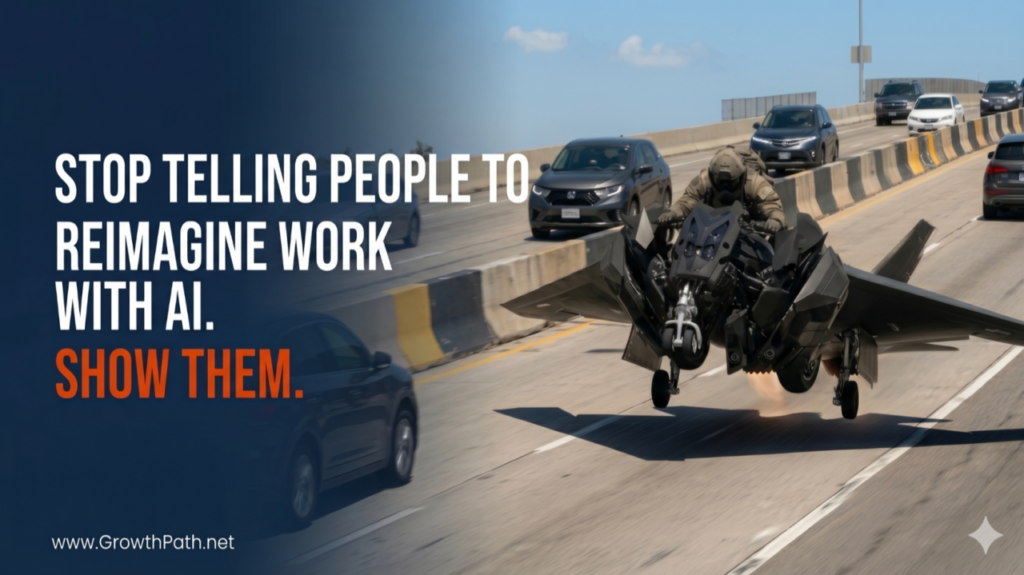
Stop Telling People to Reimagine Work With AI. Show Them.

Liza Adams · May 14, 2026 ·

Stop Telling People to Reimagine Work With AI. Show Them.

Your market intelligence is probably broken. Automating it as-is would just be a faster path to failure.

AR tracks the analyst reports. PMM runs customer interviews and listens to Gong calls. CI does competitive research. Brand watches customer reviews. Each team actions what they see. Rarely does anyone pull it all together, consistently, to find what cuts across every source. So you get fast action on individual signals and little action on the signals that only appear when you look at everything at once. Those that should drive your messaging, your positioning, and your buying committee strategy get missed.

You don’t fix that by adding more meetings or better hand-offs. You redesign the workflow.

Productivity-only AI makes the case for fewer people. Reimagined work makes the case for more of what people uniquely bring. This newsletter shows you what reimagined work looks like.

Why Reimagining Is Hard

Writing a newsletter that says “reimagine your work” is easy. Doing the reimagining is much harder. Three conditions need to be in place. I call them Belief, Reframe, and Space.

  • Belief is about the tool. What you can build is limited by what you believe AI is capable of. If your team’s experience with AI is mostly faster drafts and summarized reports, that’s the ceiling they’ll build to. They can’t picture a workflow that reads every Gong call, customer review, win/loss note, and analyst report from the quarter and tells them which three buyer objections are gaining steam and what messaging is working against them. They’ve never seen one. (I went deeper on this in Your Team Will Only Build What They Believe AI Can Do.)
  • Reframe is about you. Humans think linearly and incrementally. Given the problem of unreliable taxis, the natural conclusion was “we need more taxis.” Uber and Lyft didn’t solve for more taxis. They reframed the problem as trust plus access to vehicles and built a different system: an app, drivers using their own cars, and a layer that made strangers comfortable getting in. The leap from “more of what we have” to “something different” takes work.
  • Space is about your team. You need room to innovate, and most teams don’t have it. Your people are already busy delivering on what’s on their plate. Carving out room to rethink the work itself feels like a luxury you can’t afford, even when you can’t afford not to.
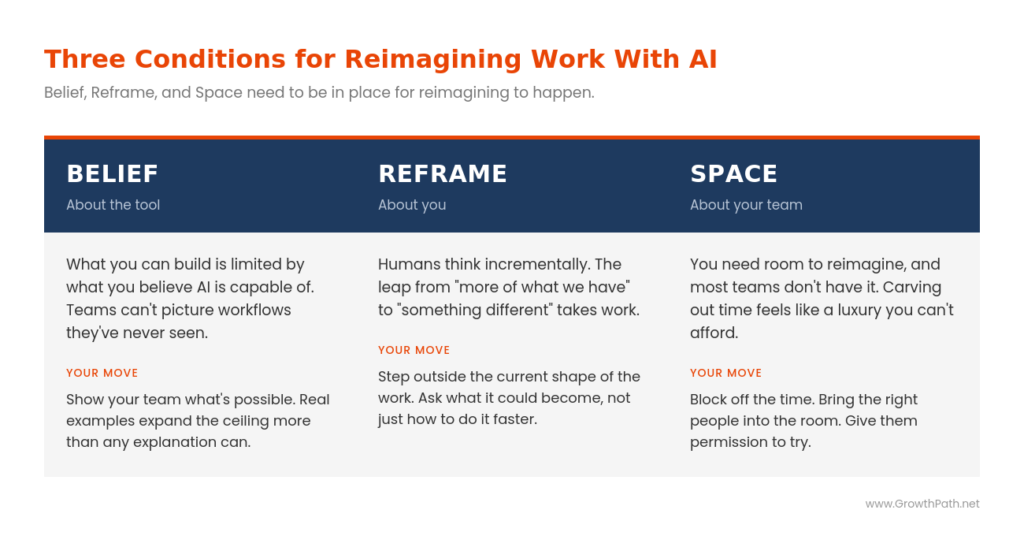
Three conditions for reimagining work with AI: belief, reframe and space

This newsletter is here to give you a head start on all three.

Quick Take

This piece walks through a real workflow I built in Claude Cowork and demoed live at Content Jam in Chicago a few weeks ago. It shows what becomes possible when market intelligence stops sitting in silos and starts producing tailored content strategy for every member of a buying committee. It also covers what it takes to make the outputs genuinely good.

  • Reimagining a workflow means doing work that was not possible before. Faster reports and better drafts are good starting points, and they are not redesigned work.
  • AI can do things at scale that a human team cannot, no matter how well- coordinated. That is where redesign starts.
  • The quality of what comes out depends on the quality of thinking you put in. There are no shortcuts on that part.

AI Video Explainer and AI Podcast Versions of This Newsletter

To support different learning styles and time constraints, this newsletter is available as a 5-min AI cinematic video and a 19-min AI podcast with two AI hosts. I used Google’s NotebookLM to create these and personally reviewed them for accuracy and responsible AI use.

The Shift That Made This Possible

AI just crossed a capability threshold that changes what workflows can do. My friend Lisa Sharapata, Founder and CEO of 4Profit GTM and former CMO of Metadata, captured the change in a fun, visual way.

The old analogies (building the plane while flying it, changing a tire on a moving car) describe upgrades to something we already understood. Lisa reframed it with her post and the video below. It goes beyond fast. It’s different.
Headshot of Lisa Sharapata, Founder & CEO of 4Profit GTM
Lisa Sharapata, Founder & CEO of 4Profit GTM and former CMO of Metadata.io

“We’re not just building in motion anymore. The motion itself is transforming mid-flight. We’re dealing with a motorcycle on the highway that transforms into a plane and takes off while moving. It’s fundamentally different. That’s what agentic GTM actually feels like. I helped drive this at Metadata, and I’m guiding leaders as they work through the same right now.”

Still from Lisa Sharapata's AI transformation analogy video
AI Transformation Analogy Video by Lisa Sharapata

Sam Altman describes five levels of AI: Chatbot, Reasoner, Agent, Innovator, and Organization in the 60-sec video below. We just crossed from Reasoner into Agent late last year/early this year. Innovator and Organization come next.
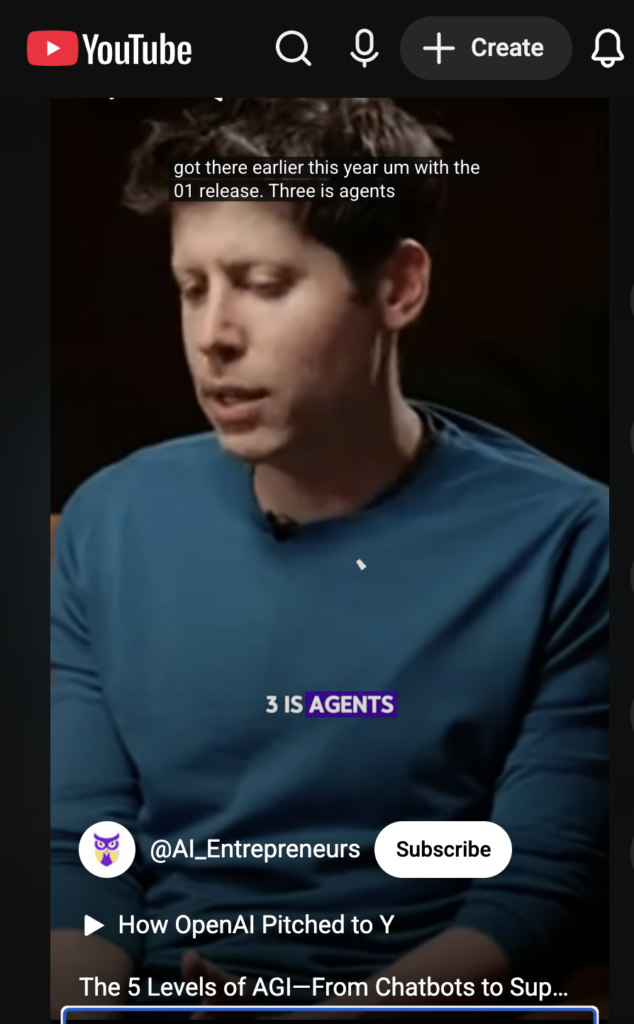
YouTube Short on AI agents

What changed in practice: AI moved from giving answers to delivering work. That is the agentic shift, and it is what makes a new category of workflow possible. (More details here, AI Moved Fast: What Changed and What to Do Next.)

What AI Can Do That Your Team Can’t

Most of this work today gets done in batches by people doing their best with limited hours: a dozen Gong calls reviewed, a sample of reviews skimmed, one pricing scenario at a time. Rethinking starts with the capabilities that change what’s possible when you stop working in batches. Look for these in your own work.
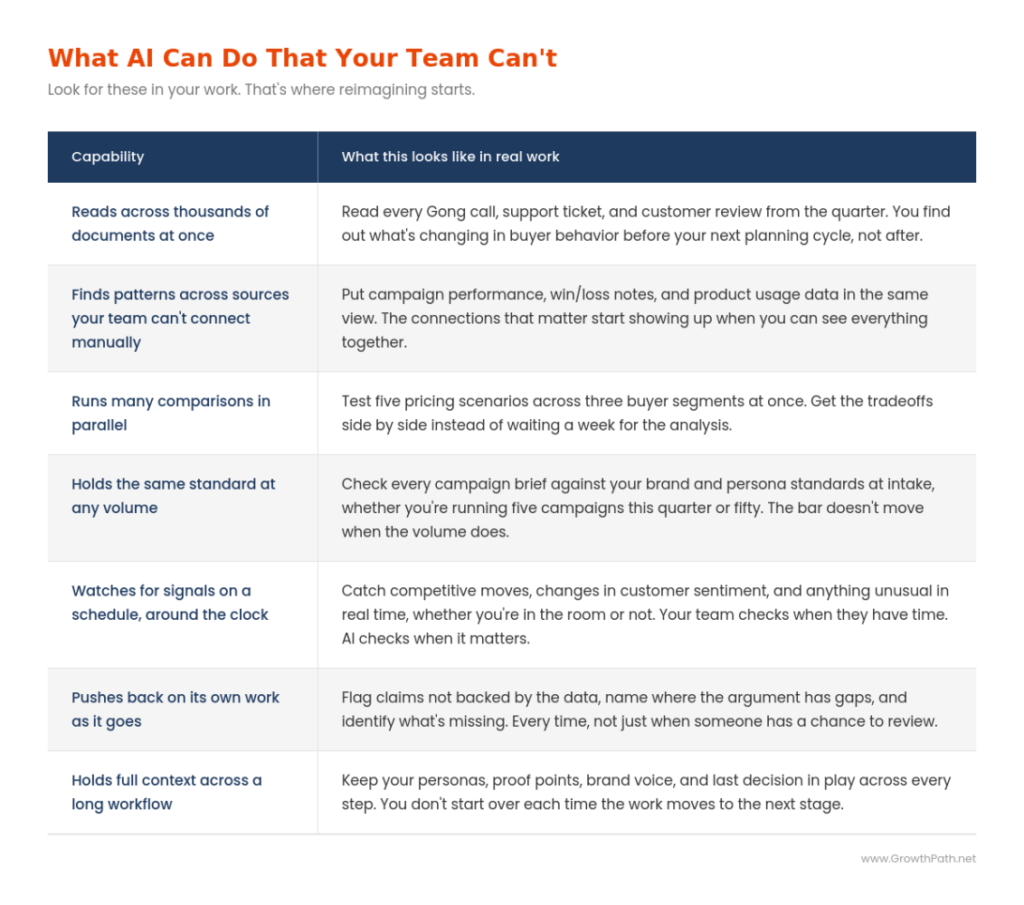
What AI can do that your team can't

When you build a workflow around capabilities like these, the output is work a human team alone couldn’t produce at this quality, consistency, and cost.

One thing to check before you start: is the workflow itself sound? Automating a broken process gives you a faster path to failure. Innovating starts with workflows worth redesigning, not workflows that need fixing first.

The Workflow in Action

I built a Market Signals-to-Content Strategy workflow in Claude Cowork and demoed it live at Content Jam in Chicago. The workflow turns market intelligence into a persona-tailored content strategy. For the demo, I ran a product launch through it.

Note: the company and data in this demo are fictional. The workflow, the build, and the outputs are real.
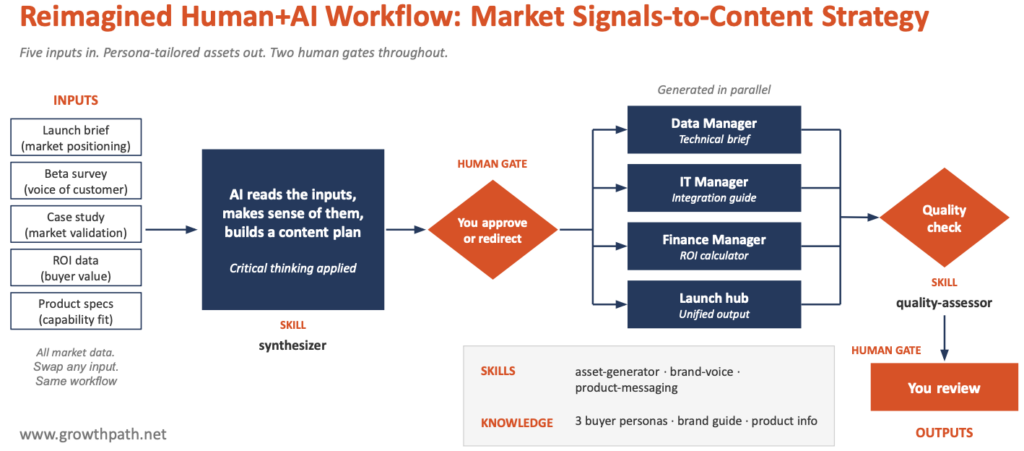
Reimagined human+AI workflow: market signals to content strategy

The inputs were all market data:

  • The launch brief captured how the product fits the current market.
  • The beta survey reflected the voice of customer.
  • The case study showed where the market validated the product.
  • The ROI data quantified where the product creates value for the buyer.
  • The product specs translated market needs into capability.

The workflow doesn’t care what kind of market intelligence you load into it. The same workflow runs on analyst reports, Gong calls, competitive signals, or any combination you have.

AI reads everything and builds a content plan. You review and approve the plan, or redirect and challenge it, before a single asset gets produced. Then AI generates four outputs in parallel, each tailored to a different member of the buying committee, each quality-checked before it reaches you.

Imagine doing this with an all-human team in less than 10 mins. Not possible without AI.
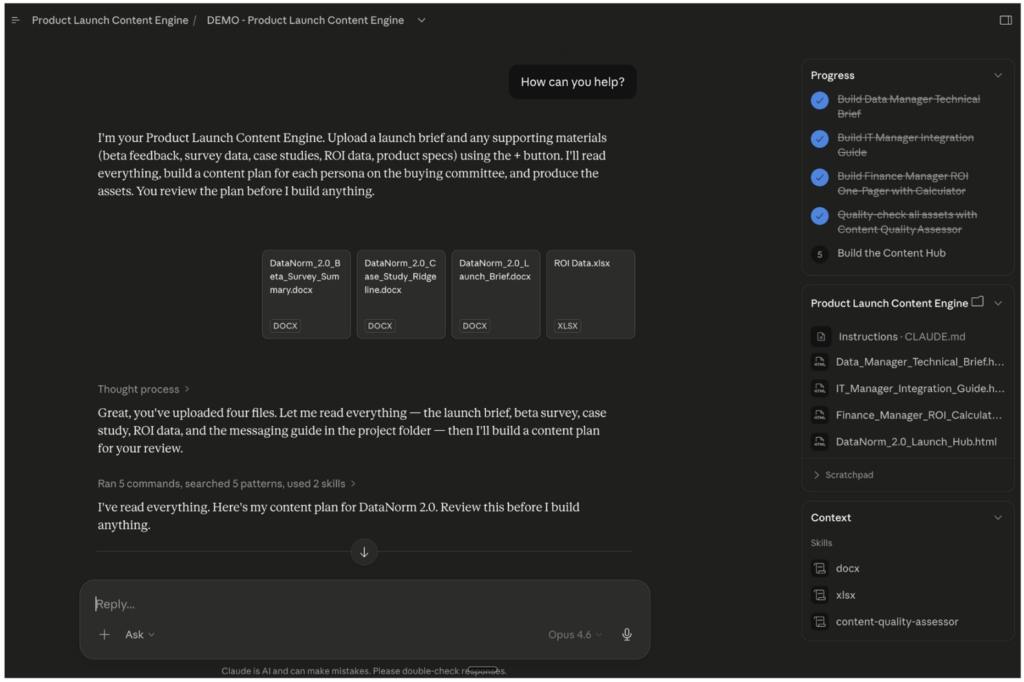
Agentic workflow running in Claude Cowork
Agentic Workflow Executed in Claude Cowork

Here are the outputs of the workflow.

Data Manager: Technical Brief. Built for the person evaluating whether this fits the architecture.
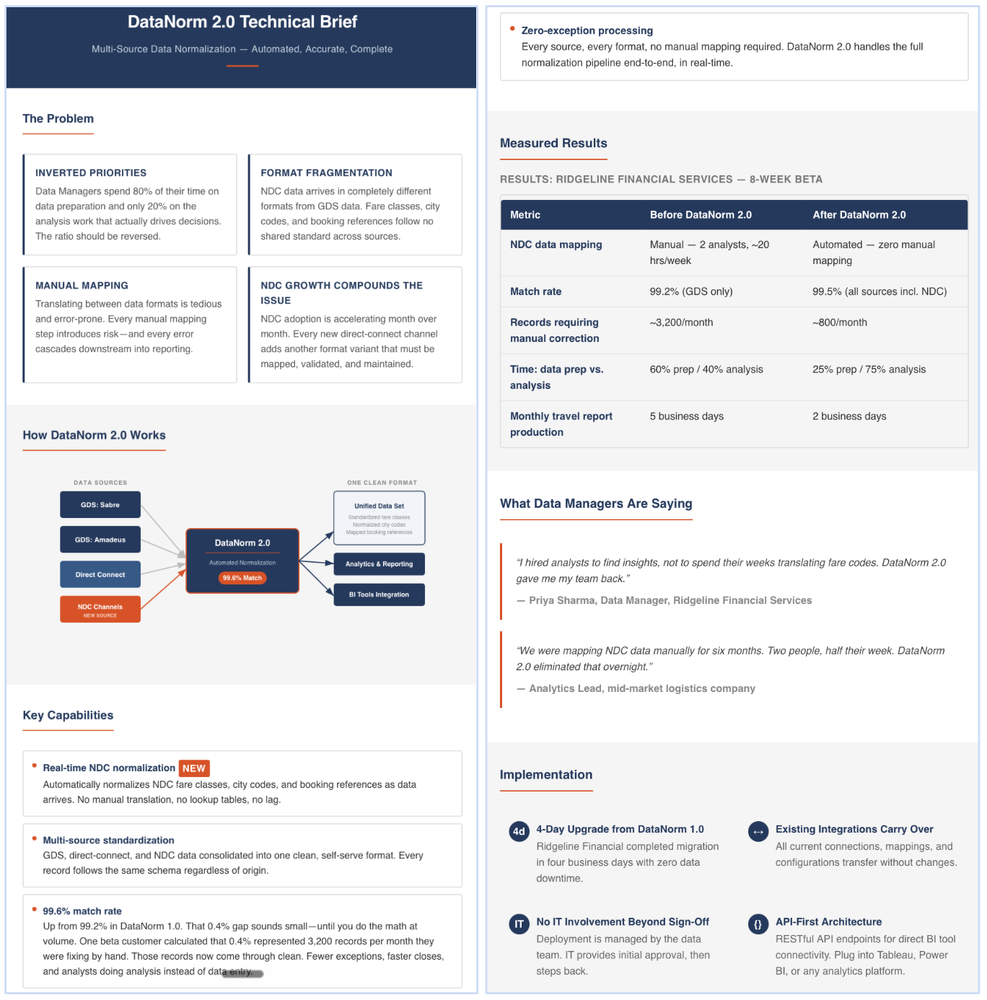
Sample technical brief produced by the workflow

IT Manager: Integration Guide. Built for the person who has to set it up without breaking everything else.
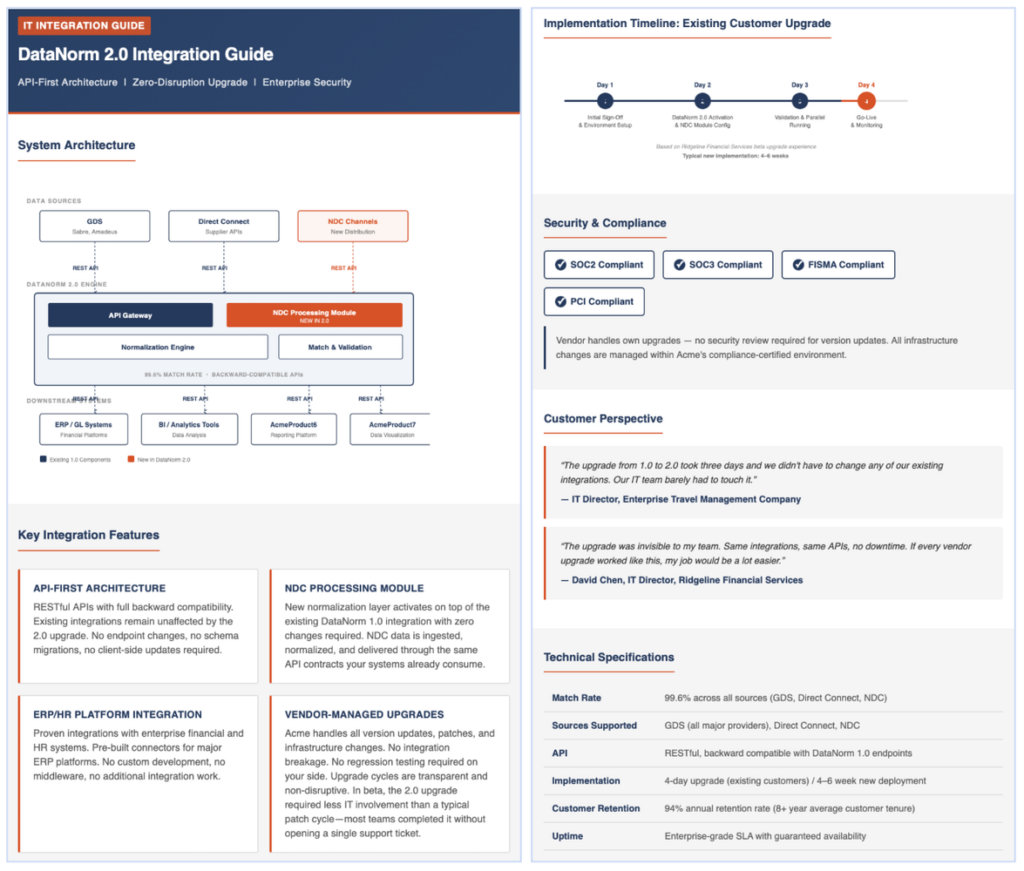
Sample integration guide produced by the workflow

Finance Manager: ROI Calculator. Built for the person who has to justify the investment. Inputs are adjustable. The math updates as you change them.
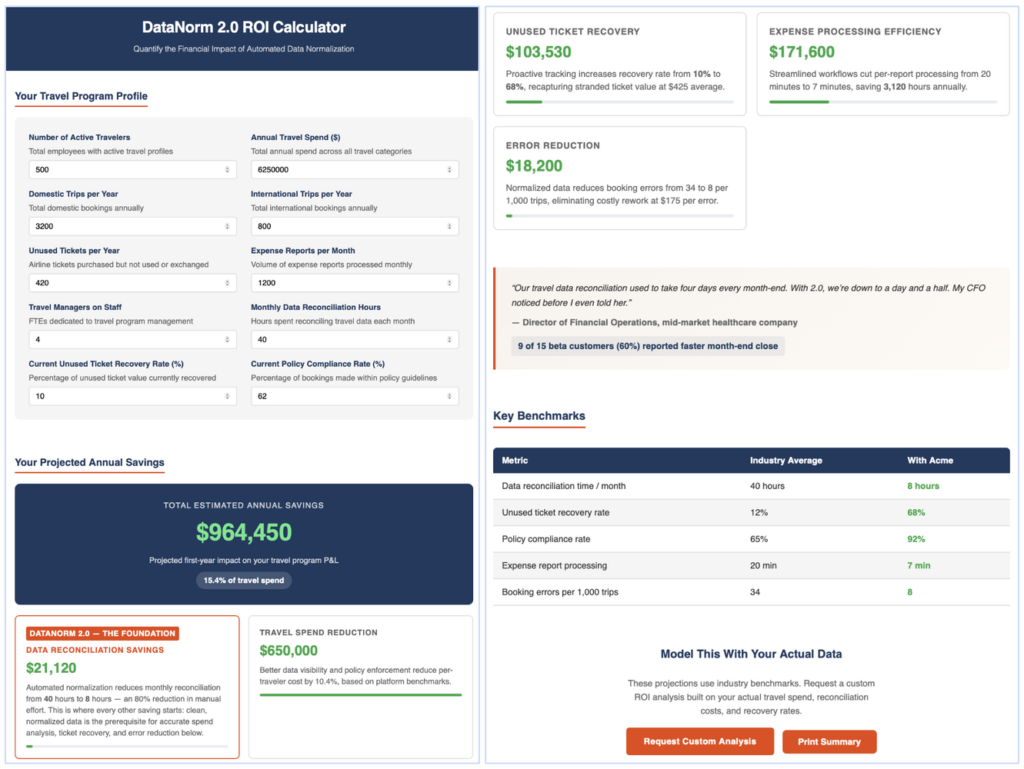
Sample ROI calculator produced by the workflow

You are accountable for the outcome. You are in control at every gate. And even with the built-in quality check, you still review the outputs and make the final call.

Seeing a workflow run end to end is what shifts what teams believe is possible. That’s the first condition in motion.

If you’re interested, here are the links to each of the HTML outputs. Download them and run them on a browser:

  • Technical Brief
  • Integration Guide
  • ROI Calculator
  • Launch Hub

Also, here’s a 6-min cinematic video (built with NotebookLM) explaining this workflow.

Showing What’s Possible

Last week, I ran a strategic hands-on AI workshop in Boston for the global marketing team at Klaviyo. About 200 marketers in cross-functional groups spent the day reimagining real workflows from their day-to-day work. By the end of the day, every group built something, and the show-and-tell was truly inspiring. Just as the team learned from me, I learned from them as well.
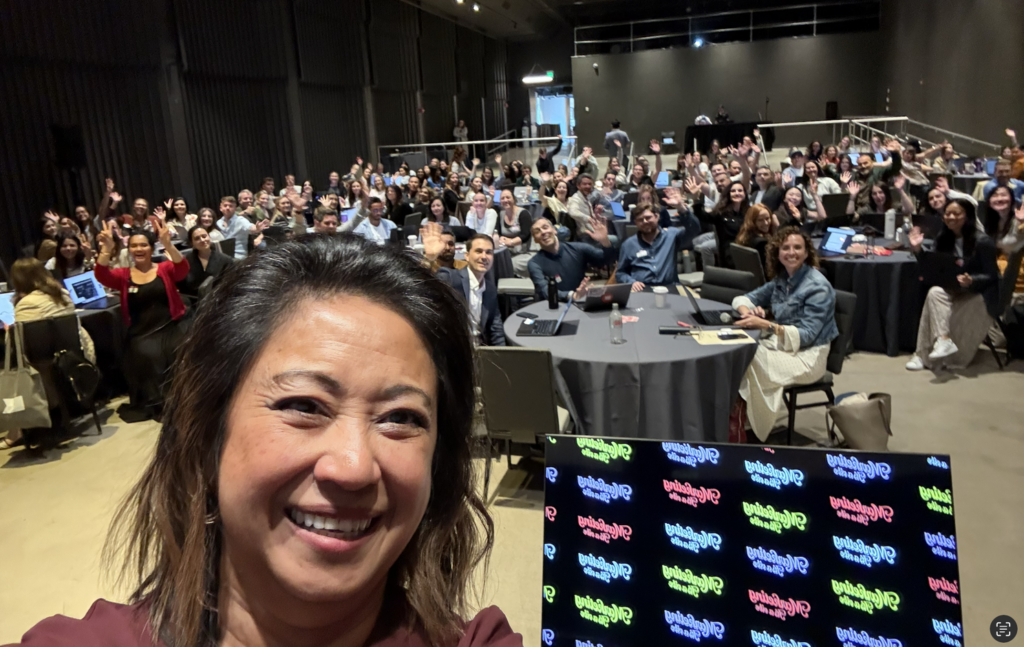
Klaviyo marketing team AI workshop in Boston, May 2026
Klaviyo Marketing Team AI Workshop to Reimagine Workflows, Boston, May 2026

The workshop worked because Jamie Domenici, CMO of Klaviyo, and her leadership team created Space. They blocked off the time, brought the right people into the room, put hands on keyboards, challenged the team, and gave them permission to try.

Headshot of Jamie Domenici, Chief Marketing Officer at Klaviyo
Jamie Domenici, Chief Marketing Officer at Klaviyo

Jamie put it plainly:

“We’re past, ‘How do we do this faster?’ The work now is rethinking how marketing grows the business: how to scale what works, how to use AI as a sparring partner, how to build secure infrastructure, and when to build versus buy. We carved out the time and put everyone in a room with hands on keyboards.

In just a few short hours, the teams built new workflows spanning creative, analytics, product launch, and integrated campaigns. That’s what it looks like when people can put the thinking into practice.”

You don’t get this kind of output by handing people the tools and asking them to innovate on their own time. You get it by giving them space, examples, and the chance to learn from each other in the same room. The conditions you create for your team count for more than the tools.

The Outputs Are Only as Good as Your Thinking

A word of caution before you walk away inspired.

Anthropic’s AI Fluency Index, published in February 2026, found that when AI produces a polished artifact, users are measurably less likely to question its reasoning. The more finished the output looks, the less people verify it.

The workflow handles execution. What it cannot do is supply good judgment, honest inputs, or the willingness to push back on what it gives you. Accept the first answer and you get average work at scale. Garbage in, garbage out is not a cliché. It is the most predictable failure mode in AI-assisted work.

The work pays off when you treat AI as a sparring partner, not an answer machine. Neuroscientist Vivienne Ming ran an experiment with real-world prediction teams and found that the 5 to 10 percent who outperformed everyone, including professional prediction market experts, were the ones who pushed back, demanded evidence, and challenged their own assumptions. The two qualities that separated them were perspective-taking and intellectual humility, or being ok with being wrong.

Keri Brooke, CMO of Enverus, saw this firsthand in a working session where we explored what reimagined workflows could look like for her team:

Headshot of Keri Brooke, Chief Marketing Officer at Enverus
Keri Brooke, Chief Marketing Officer at Enverus

“We’ve been pushing hard on automation and our team has built a lot. And while we’ve always worked well together, AI is pushing us to think and operate as one team in ways we hadn’t before.

Seeing real examples of reimagined workflows, not just faster automation, made it real and inspired the team. Now the question isn’t how we speed up what we’re already doing. It’s what we do with the time AI gives back.”

That last line is the Reframe in action. The question shifts from “how do we go faster” to “what do we do with the time AI gives back.” That’s a different conversation entirely.

Two prior newsletters go deeper on this. AI Made Me More Human covers five qualities AI develops in you when you treat it as a thinking partner. How to Think Critically with AI, No Matter What You’re Working On gives you a practical framework for getting past the first answer.

This Will Keep Evolving

Reimagining is a practice. As AI advances, the ceiling of what’s possible keeps rising. Keep innovating and you keep growing.

I’m still working through two things myself.

The first is where to put the human gates. Too few and quality drifts. Too many and the workflow stops being agentic. The right balance varies by team, by workflow, and by how much risk you can absorb if something slips through.

The second is when to rebuild. The capability is moving fast enough that a workflow you build today might be solvable with a single prompt in six months. Knowing when to invest versus when to wait is genuinely hard, and I don’t have a clean answer yet.

Where to Start

Productivity-only AI makes the case for fewer people. Reimagined work makes the case for more of what people uniquely bring.

Pick one workflow where your team is working harder than the output warrants. Map what AI can do in that workflow that your team can’t do at scale. Build a small version and test it.

You don’t need Belief, Reframe, and Space perfectly aligned to start. Pick one and the others tend to follow.

Think big, start small, move fast.


The Practical AI in Go-to-Market newsletter shares learnings and insights in using AI responsibly. Subscribe today and let’s learn together on this AI journey.

For applied learning: Explore our applied AI workshops, offering both strategic sessions (use cases and roadmaps) or hands-on building (create AI teammates during the workshop). You’ll leave with either a clear plan or working solutions. Office hours provide follow-on support to keep momentum going.

For ongoing advisory: I work with leaders as a strategic advisor through their AI transformation, providing guidance, frameworks, and a sounding board as they build. If that’s what you need, let’s talk.

For team transformation: I partner with GTM leaders to move from scattered AI adoption to an operating model where human and AI teammates work together across workflows. See real examples: a lean GTM team’s step-by-step playbook and a global cybersecurity leader scaling to 150+ marketers with 57 AI teammates integrated into daily workflows.

For speaking: Here are virtual and in-person events where I’ve covered a variety of AI topics. I’ve also keynoted at many organization and corporate-wide events.

If any of this resonated, I’d love to hear from you. Reply to this email, find me on LinkedIn, or come say hi at an event.
AI Moved Fast: What Changed and What to Do Next

Liza Adams · March 5, 2026 ·

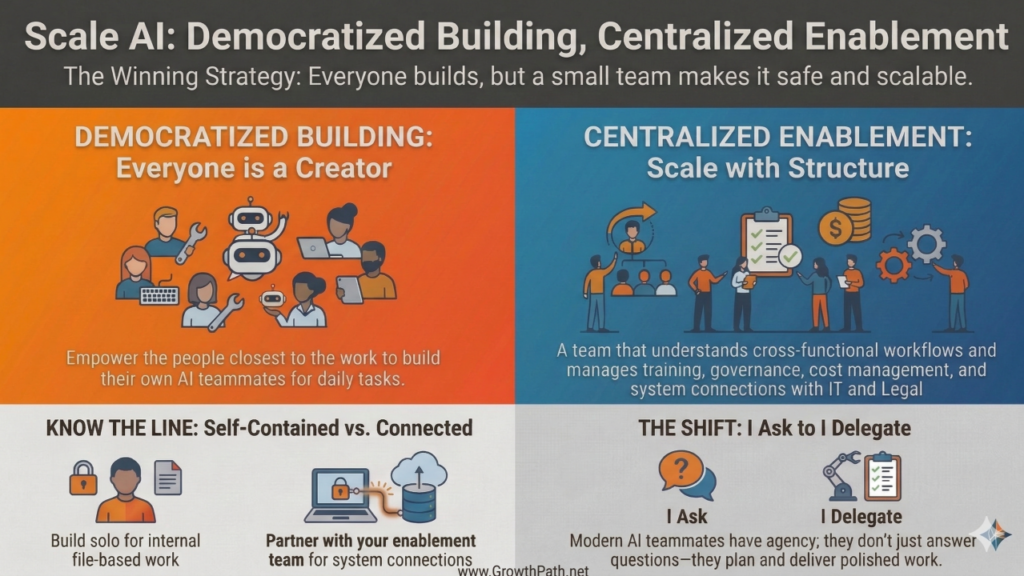
Scale AI: democratized building, centralized enablement

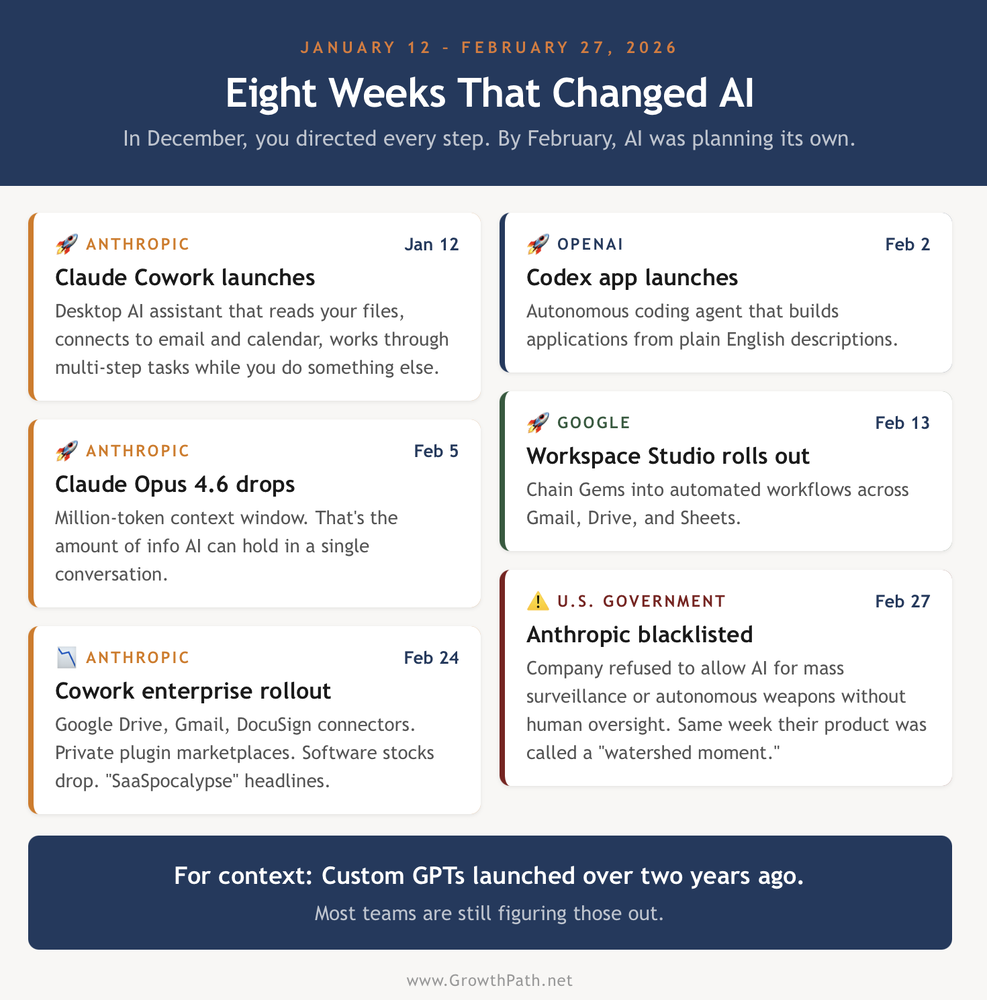
You’ve seen the LinkedIn posts. Someone built an app in 20 minutes. Someone else automated a full content workflow over the weekend. What those posts don’t show: the enterprise security policies, the legal reviews, the IT constraints, the fact that half your team doesn’t have access to the same tools. AI capabilities jumped in the last eight weeks. Your team’s security policies, legal reviews, and IT constraints stayed right where they were.

Quick Take

AI platforms shipped more capability in the last eight weeks than in the previous six months. Autonomous agents, desktop AI assistants, enterprise workflow studios, all went live in a short timeframe. If you feel like you missed a month and everyone else already caught up, you didn’t and they haven’t.

The progression I’ve been writing about still holds: Tool to Teammate to Workflow. But what’s possible inside each stage changed fast enough that your mental model from December needs an update.

Key takeaways:

  • AI teammates now have agency. They plan, execute, and check in at decision points. The shift from “I ask, it answers” to “I delegate, it delivers” is real, and most teams haven’t caught up to it yet.
  • Self-contained workflows stay inside your AI platform. Anyone can build them today. System-connected workflows touch your CRM, HRIS, or marketing automation. Those need IT and Legal. That determines whether you can start now or need to loop in others first.
  • The gap between “what’s possible” and “what’s possible for your team” depends on constraints like security policies, legal reviews, tool access, and organizational complexity.
  • Not everyone needs to be orchestrating human+AI workflows now. Knowing where you are is more important than racing to the next stage.
  • There’s an interactive AI Evolution Framework guide at the end that helps you find your starting point, the right platforms, and whether you need IT involved.

AI Video Explainer and AI Podcast Versions of This Newsletter

To support different learning styles, this newsletter is available as an 6-min AI video explainer (see below) and a 19-min AI podcast with two AI hosts. If you haven’t seen these AIs in action, they’re worth a view. The tech is advancing in amazing ways. I used Google’s NotebookLM to create these and personally reviewed them for accuracy and responsible AI use.

Here’s What Actually Happened

Eight weeks that changed AI: platform launches from Anthropic, OpenAI, Google and others

That’s eight weeks. For context, Custom GPTs launched two years ago and most teams are still figuring those out.

If the people you work with seem confused, stressed, or frozen, this is why. The capabilities moved but the constraints didn’t. IT policies, security reviews, legal approvals, tool access, organizational complexity, these are all right where you left them. And nobody is mapping the difference between “what’s technically possible” and “what’s actually possible for your team, in your org, with your constraints.”

The Stages Haven’t Changed. What’s Inside Them Has.

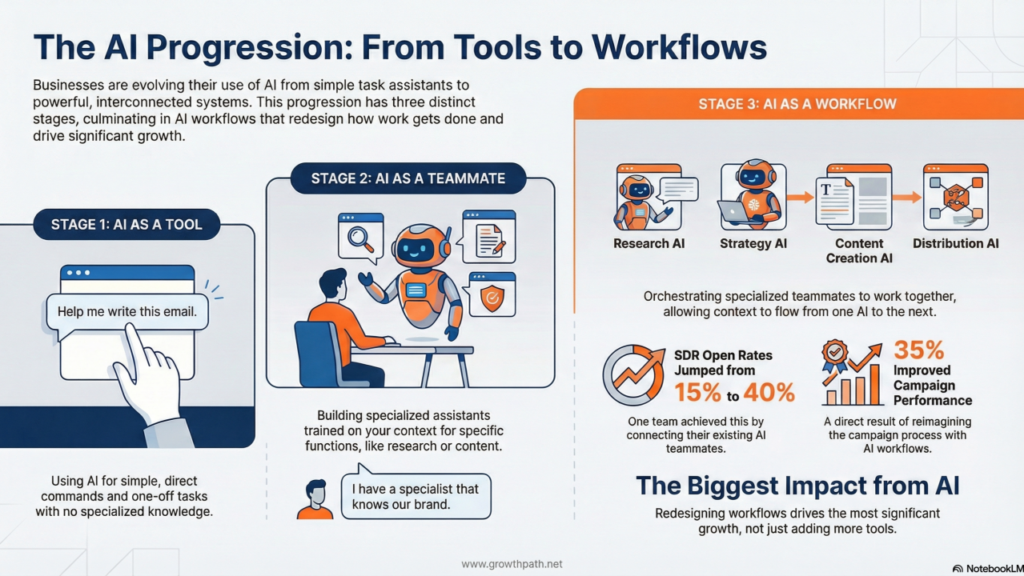
If you’ve been reading this newsletter, you know the progression: Tool to Teammate to Workflow.

Stage 1 got better. When AI gives you a ‘good enough’ answer, you stop pushing. You stay at Stage 1 longer than you need to.

Stage 2 is where the real change happened. AI teammates now have agency. They plan, break work into steps, execute, and check in with you at decision points. The shift from “I ask, it answers” to “I delegate, it delivers” is real. They work inside your computer, navigating files, apps, and browsers to get the job done while you focus on something else.

Anthropic’s head of product described Cowork as enabling AI to “deliver polished, near-final work.” OpenAI’s CEO said you can go “from a clean sheet of paper to sophisticated software in a few hours.”

But the biggest change is at Stage 3. Workflows split into two distinct modes, and the line between them changes who needs to be involved, what you can build on your own, and where governance actually matters.

The interactive AI Evolution Framework guide maps each stage in detail, including platforms and who needs to be involved.

The AI progression: from tools to teammates to workflows

Self-Contained vs System-Connected Workflows

The most important distinction in this whole framework is one you won’t find in any AI product announcement. It’s the line between self-contained and system- connected workflows.

1) Self-contained workflows keep everything inside your conversation or uploaded files within your AI platform. You chain multiple AI teammates together. You feed the output of one into the next. You produce a complete sales toolkit, a campaign brief with supporting assets, a market analysis with recommendations, all from a single starting prompt.

No external system connections. No sensitive data flowing through APIs. You can build these today, by yourself, without permission from anyone.

2) System-connected workflows reach into your CRM, your HRIS, your marketing automation platform. They read and/or write sensitive data. They need connectors, security reviews, and often legal sign-off.

You’ll hear the term MCP (Model Context Protocol) more and more. It’s how AI connects to business systems, and it already has over 100 million monthly downloads. Anthropic and Microsoft both launched enterprise connector ecosystems. This infrastructure is moving fast.

These workflows need an enablement team, working with IT and legal, to build the connections. You bring the knowledge and expertise of the jobs to be done. They provide the infrastructure.

This helps answer the common question: “Can I build this myself, or do I need to loop in others first?”

For self-contained work, start. For system-connected work, partner with your enablement team.

Who Makes This Work at Scale?

When I say “enablement team,” I don’t mean a new department. I mean a function. It might live in marketing ops, rev ops, IT, or a small cross-functional group. Someone who understands how work flows across teams, knows how to build automations and integrations, and can work with IT and Legal on security. People with this combination are hard to find right now.

They’re responsible for:

  • Training people to build well from the start
  • Supporting them when they get stuck
  • Prioritizing which system connections to build now and which to hold
  • Setting up governance so the organization isn’t flying blind
  • Watching the costs, because usage-based pricing on automation tools, API calls, and connectors adds up fast once workflows go live

That last one catches people off guard. Most AI subscriptions are flat-rate but most workflow infrastructure is not. Few teams are budgeting for this yet. The training, support, governance, and cost management are what keep it from breaking.

Here’s what it looks like when you find these people. Some may be in your org already.

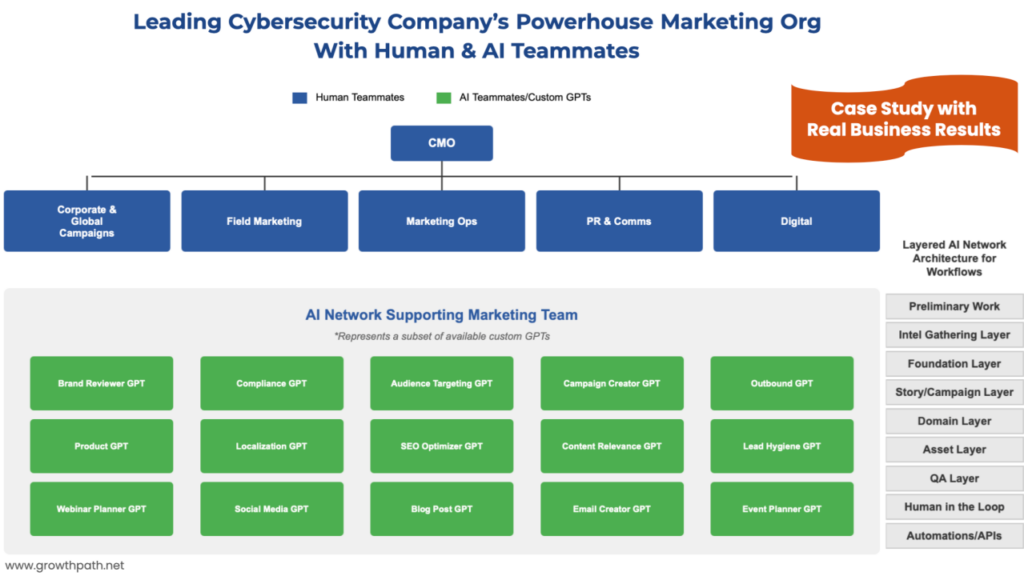
A cybersecurity company's human+AI marketing org with AI teammates
Human+ AI Transformation Case Study with Builders and Enablers

At a global cybersecurity company I work with, Marketing Ops stepped into this role. Everyone across marketing built their own AI teammates freely. Over 200 were created during experimentation. 57 are now in daily use. But when those teammates needed to connect to CRM, marketing automation, or internal repositories, Marketing Ops handled the integration and governance. They worked with Legal and IT to make sure the access was responsible and secure. Full case study here.

The model is democratized building, centralized enablement. Everyone builds. A smaller team makes it safe and scalable. This works because the people closest to the work know what to build. A product marketer knows what a positioning teammate should do. A field marketer knows what an event planning teammate needs. You don’t want to bottleneck that. But when those teammates need to connect to business systems, you need someone who knows how to do that without creating risk.

Dominic Abou-Jaoude is the Director of Marketing Data & Analytics at Sophos, sits on his company’s AI Committee, and built an internal triage system that helps people figure out when to bring in his team.

Headshot of Dominic Abou-Jaoude, Director of Marketing Data & Analytics at Sophos
Dominic Abou-Jaoude, Director of Marketing Data & Analytics at Sophos

“The way I know when to step in is pretty straightforward. If someone is building something with their own files and their own thinking, they should just go do it. I want them to. That’s how they figure out what works.

The second a workflow needs to push or pull from a core system, like Salesforce, then I step in to help. Because one bad connection to a live system could create a stability or a security issue. My job is to work with our engineering and security teams to make sure the plumbing is secure and reliable so people can keep building on top of it.”

Kimber Spradlin, Chief Marketing Officer at Graylog, is coming at this from the other direction. Her team already has custom GPTs. Now she’s moving them toward orchestrated workflows using Claude.

Headshot of Kimber Spradlin, Chief Marketing Officer at Graylog
Kimber Spradlin, Chief Marketing Officer at Graylog

“I built a drag-and-drop workflow designer for our team offsite inspired by Liza’s dynamic ‘AI teammate and workflow Ideator’ app. Vibe-coded the whole thing.

The reason I could design the system is because I’d already built the individual piece using custom GPTs. I knew what each step needed because I’d spent time using them one at a time first. Now we’re moving it to a production server and building the actual agents behind each step. We learned a lot from building and using custom GPTs . It was the reason I could see how the pieces fit together.”

Here’s the dynamic AI workflow app that sparked Kimber’s approach. It offers sample AI workflows and AI teammates for each one.

Dominic and Kimber are at different starting points in the same progression. Both are building.

Find Your Starting Point

Your situation is different from the person sitting next to you. Different tools, different constraints, different starting point. A CMO at a 5,000-person company and a VP of Sales at a 50-person startup are both reading this newsletter right now, and their next move isn’t the same.

I built an interactive AI Evolution Framework guide that helps you figure out yours. It has three tabs.

Start with the decision guide on the first tab. Pick what you’re trying to do, and it maps you to the right stage, the platforms that fit, and whether you need to involve your enablement team. Takes about 30 seconds.

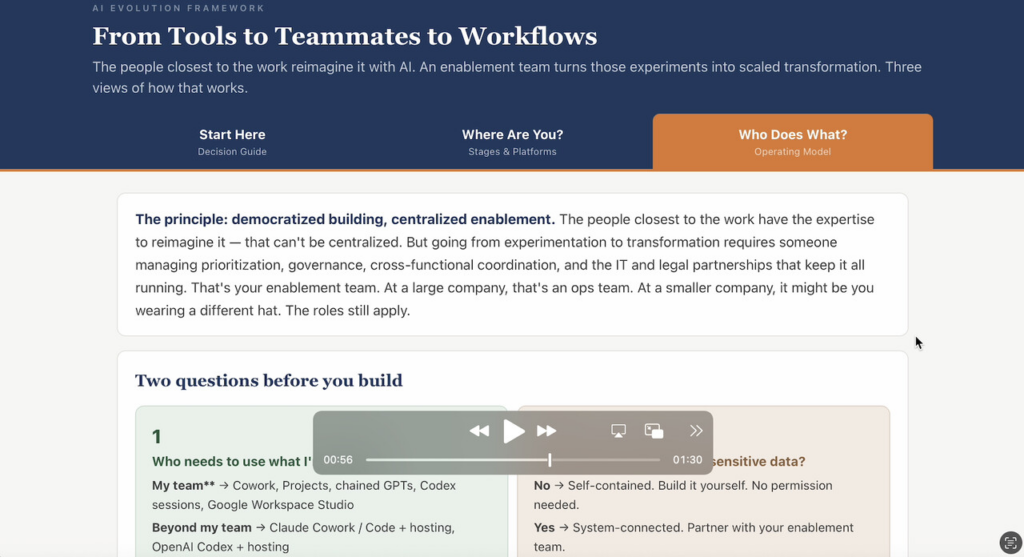
The other two tabs go deeper. One breaks down what’s changed inside each stage, including the platforms available now and how to know where you are. The other shows the operating model: what you build, what your enablement team builds, and how the roles work together. The short video below walks through both.

Interactive AI Evolution Framework Guide

See the 90-sec video preview of the interactive guide below.

Interactive AI Evolution Framework guide: from tools to teammates to workflows
Interactive AI Evolution Framework Guide (90-sec Video Preview)

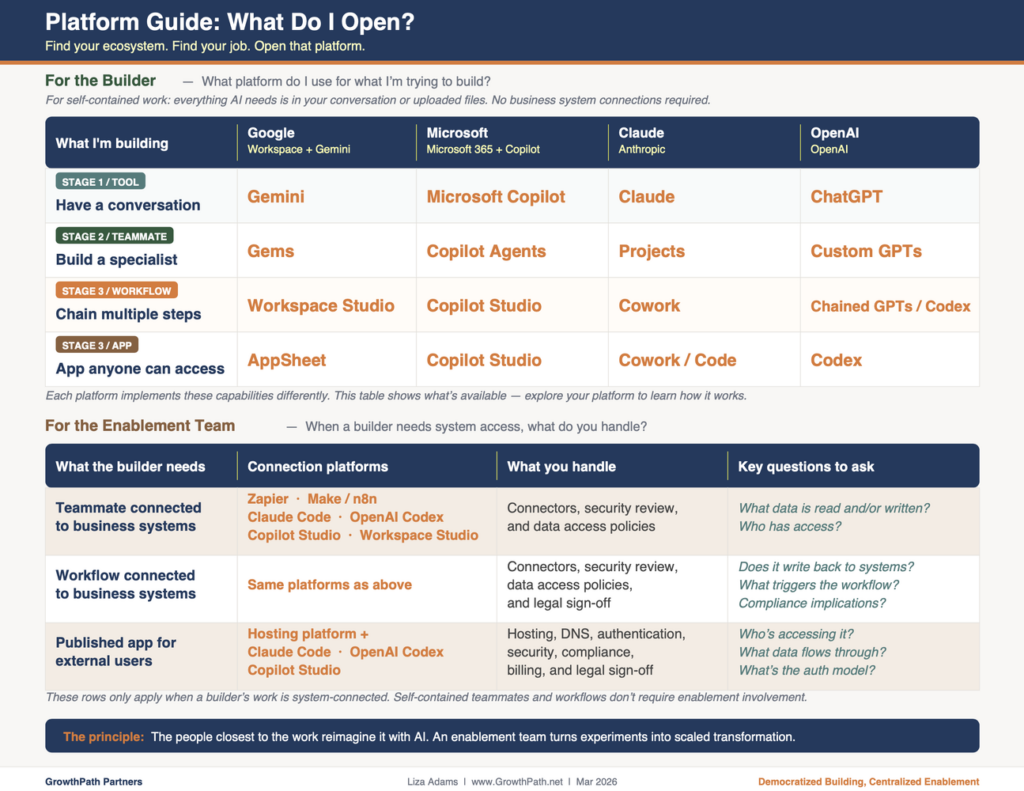
If you want the quick-reference version, the one-pager maps every platform to every stage across all four ecosystems (Google, Microsoft, Claude, OpenAI) on a single page. Keep it open when you’re deciding what to build next. Here’s the one-pager.

Platform guide: which AI tool to open for each kind of work

What Comes Next

The framework gives you a starting point. These are the decisions that come after.

  • How fast should teams move from Stage 2 to Stage 3? Some teams I work with are still building their first AI teammates. Others are ready to orchestrate. The temptation is to push everyone toward workflows, but rushing past the teammate stage means you miss the part where people learn to evaluate AI critically. That skill is what makes Stage 3 work.
  • Where does the enablement team role land in smaller organizations? At a large company, you have an ops team, IT resources, and legal review capacity. At a 50-person company, the person building AI teammates might also be the person managing governance. The roles still apply. The question is how they map when one person is wearing three hats.
  • Are Custom GPTs a dead end? Ethan Mollick said they are. I get why. AI is moving toward systems that orchestrate themselves, picking tools and skills without you directing every step. But the thinking behind the GPTs is important. The knowledge you put in, the way you learned what AI is good at and where it falls short, the judgment about when to trust the output, all of that carries forward. You can’t set up AI-orchestrated workflows well if you’ve never orchestrated them yourself.

Go Deeper

  • Watch three human+AI workflows built live on Leveraging AI with Isar Meitis
  • How to connect individual AI teammates into workflows that produce better results
  • How chained AI teammates move expertise across teams without losing context
  • Applied AI workshops: shift your team’s mindset through applied use cases, then build AI

Your Turn

This is my best thinking right now. It will keep evolving as the platforms advance and as I learn with teams putting this into practice. I want to hear from you.

  • Where is your team in this progression?
  • Where are you stuck?
  • What would be most helpful to go deeper on?

I read every response, and your input directly shapes what I write next. The conversations that feed this newsletter go both ways. Always have.


The Practical AI in Go-to-Market newsletter shares learnings and insights in using AI responsibly. Subscribe today and let’s learn together on this AI journey.

For applied learning: Explore our applied AI workshops, offering both strategic sessions (use cases and roadmaps) or hands-on building (create AI teammates during the workshop). You’ll leave with either a clear plan or working solutions.

For team transformation: See real examples—a lean GTM team’s step-by-step playbook and a global cybersecurity leader scaling to 150+ marketers with 57 AI teammates integrated into daily workflows.

For speaking: Here are virtual and in-person events where I’ve covered a variety of AI topics. I’ve also keynoted at many organization and corporate-wide events.

Whether through the newsletter, multimedia content, or in-person events, I hope to connect with you soon.

  • « Go to Previous Page
  • Page 1
  • Page 2

Copyright © 2026 · GrowthPath Partners LLC · Log in

  • LinkedIn