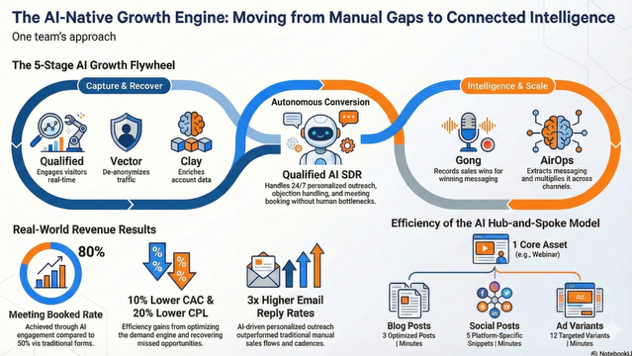
Around 98% of your website visitors leave without taking action. If that many people walked into a physical store, looked at products, checked out price tags, and walked out, you’d fix it tomorrow. Sean McCaffrey at Cin7 decided to fix it online. He built a five-stage AI growth engine designed around how customers actually buy, not around internal workflows. Today, Sean and his team are seeing 80% meeting booking rates, 3x higher email replies, 10% lower acquisition costs, and more human conversations.
Quick Take
This newsletter features how one strategic marketing operations leader built a connected AI system that captures demand in the moment, recovers interest that would otherwise disappear, learns from what closes deals, and feeds those insights back into every customer touchpoint.
Key takeaways:
- AI creates growth when it’s wired into your revenue system around customer needs, not bolted on as isolated tools to do old work faster.
- The right tech stack depends on your situation. This story shows what’s possible, not what to copy.
- If we simply train AI to do old work faster, we unintentionally create a case for automating humans out. But when we use AI to reimagine work that wasn’t possible before, work that drives growth, humans become more essential. AI handles the repetitive work so humans can have better conversations.
AI Video Explainer and AI Podcast Versions of This Newsletter
To support different learning styles, this newsletter is available as an 8-min AI video explainer and a 15-min AI podcast with two AI hosts. If you haven’t seen these AIs in action, they’re worth a view. The tech is advancing in amazing ways. I used Google’s NotebookLM to create these and personally reviewed them for accuracy and responsible AI use.
The Shift
Your buyers are researching in communities, asking peers, and using ChatGPT, Gemini, Perplexity, and Google AI Mode to evaluate vendors before they ever reach your site. They avoid forms. They expect relevant responses the moment they do engage, and if you don’t deliver, they leave without telling you why.
Sean and his team decided to build around the customer instead.
One Team’s Response
Cin7 is an inventory management company serving product sellers. Sean McCaffrey, Senior Director of Marketing Strategy and Operations, joined three and a half years ago. I worked with the team early in their AI journey in 2024 and have watched them build this over time.
His starting point wasn’t “what AI tools should we buy?” It was “how do we actually meet customers where they are?”
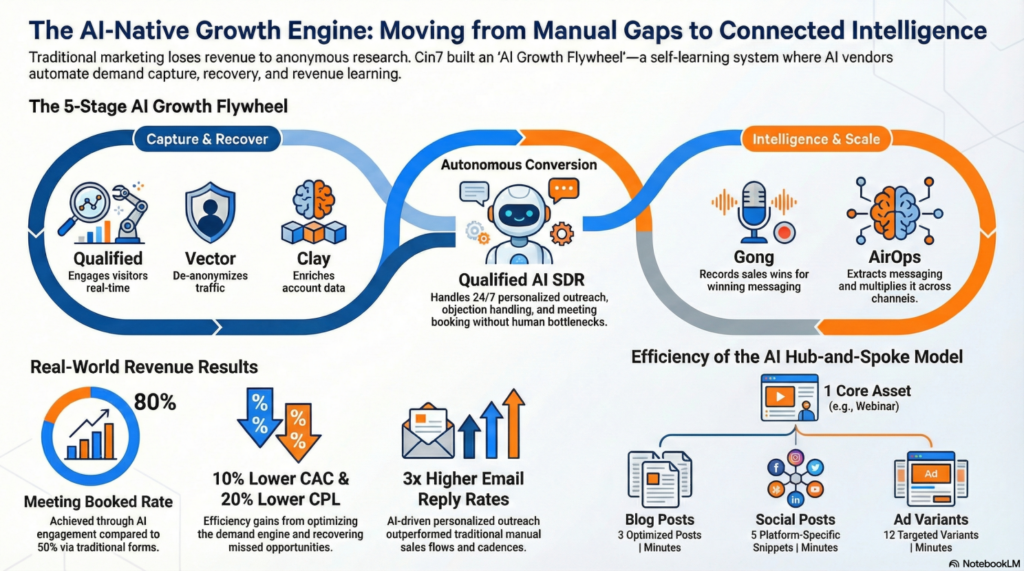
The answer became what Sean calls an AI-native growth engine. It captures demand when buyers are paying attention, recovers the ones who leave before converting, learns from what actually closes deals, and feeds those insights back into every customer touchpoint.
The flywheel has five stages. Each one exists because of a specific customer behavior. Sean and his team didn’t build all five at once. They started with one, proved value, then expanded. You can do the same.
Stage 1: Engage in the Moment
Buyers don’t fill out forms like they used to, but they do respond when something feels relevant.
Sean’s team uses Qualified, an AI SDR that talks to website visitors in real-time. More on the specific tools later. This story is about the approach, not a vendor recommendation. It pulls firmographic data through a Clearbit integration, knows what pages they’ve seen, and adapts the conversation based on industry.
A visitor from a food and beverage company doesn’t get a generic “How can I help you?” They get asked about expiration date tracking and inventory spoilage. The conversation starts with their likely problem, not a blank slate.
Of visitors who engage and meet their criteria, 80% book meetings compared to 50% through traditional forms.
The AI isn’t replacing human conversations. It’s making sure qualified buyers actually get to a human instead of bouncing.

“Before, reps spent 30 minutes asking ‘what do you guys do?’ Now they walk in with full context.”
Stage 2: Recover What Would Otherwise Disappear
Most of those visitors aren’t gone forever. Sean’s team built a way to find them. Vector identifies who visited from the US. Clay adds context and confirms they’re a good fit. Together, they flag the people who looked seriously but didn’t reach out.
These aren’t cold prospects. They’re people who showed interest and match the profile. They just weren’t ready yet.
Stage 3: Re-engage with Context
The follow-up isn’t generic. Those contacts flow back into Qualified, which sends emails on behalf of the human SDRs. The emails are informed by what the system knows: which pages they visited, what their company does, what problems they’re likely facing.
Sean’s team draws a clear line here: lead with helpfulness, not stalking. The email doesn’t say “I saw you on our pricing page.” It offers a point of view on a problem worth solving. That’s the line between creepy and valuable.
The AI handles the repetitive work. Humans step in for the conversations worth having.
Reply rates are 3x higher than before.
Stage 4: Learn from What Closes
Closed-won calls recorded in Gong feed into AirOps, where the team extracts what actually worked: objections that came up, language buyers used, triggers that created urgency, competitive positioning that won.
The team uses those insights to update ad copy, landing pages, email sequences, and the AI SDR’s conversation flows. When “fear of stockouts during peak season” keeps showing up in winning deals, the team puts that same language into ads and outreach. The system learns from every win.
Stage 5: Multiply Without Burnout
Producing one piece of content and moving on leaves value on the table.
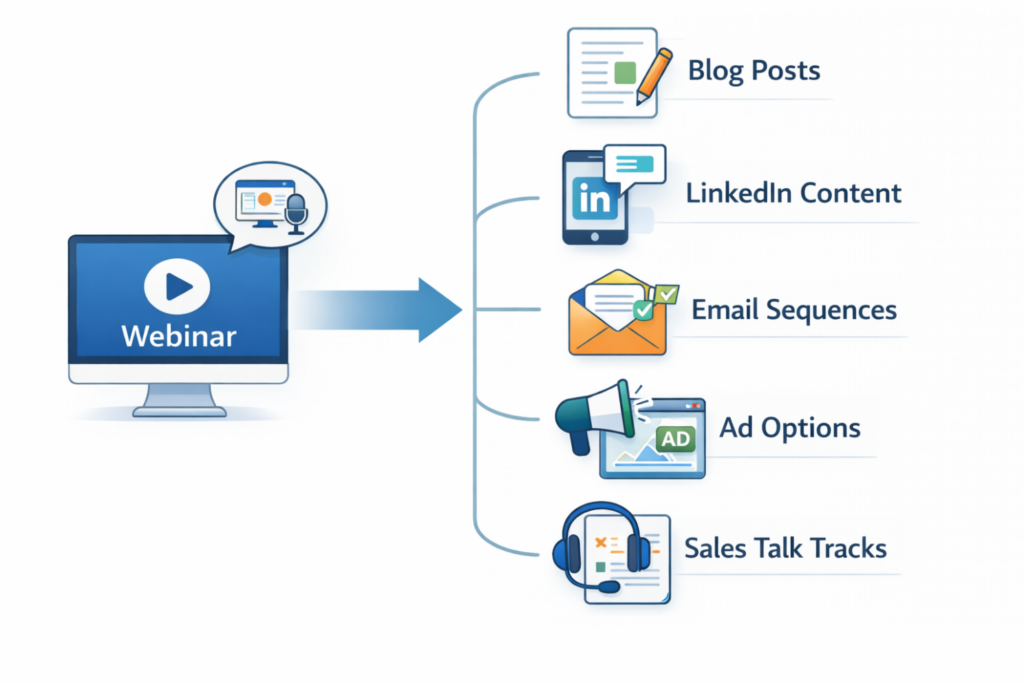
The team built a hub-and-spoke workflow in AirOps. One webinar becomes blog posts, LinkedIn content, email sequences, ad options, and sales talk tracks. A human reviews and approves the outline before full generation. Brand guidelines keep everything on voice.
The content is grounded in themes and pain points the team knows resonate because they’ve heard them in customer conversations.
What It Actually Took
This didn’t happen overnight.
- Foundation first – The first year was making sure HubSpot and Salesforce were properly integrated and data was clean. You can’t build AI systems on messy data. Nobody wants to hear that, but skipping it breaks everything that comes after.
- Content Cleanup – The AI SDR gave wrong answers in the first month. Sean traced it back to outdated help center content. The AI was doing its job. The content was the problem. They spent 30-45 days reading chat transcripts and cleaning up the knowledge base before expanding.
- Controlled testing – Every tool ran in a sandbox before going live. Sean and his team earned leadership trust by bringing results, not just ideas. He added his CRO to the Slack channel showing real-time visitor alerts. Within a week, the CRO was on board.
Enterprise teams will face longer timelines with additional compliance, security, and procurement reviews. The principles still apply. Start with foundation and controlled testing, then expand.
The Results
Year over year, the team saw 10% lower customer acquisition cost, 20% lower cost per lead, 80% meeting rates through the AI SDR versus 50% through forms, and 3x higher reply rates.
The numbers tell part of the story. Here’s what changed day to day in the reps’ work according to Sean:
“They know the prospect’s business, their pain points, what content they engaged with. Discovery calls actually discover something. The AI handles repetitive admin work and analysis so humans can have better conversations.”
Before You Build Your Version
Sean’s specific tools solved his specific problems. Yours will differ. The underlying principles hold across industries, even when the tools don’t.
What I’ve seen across the teams I advise:
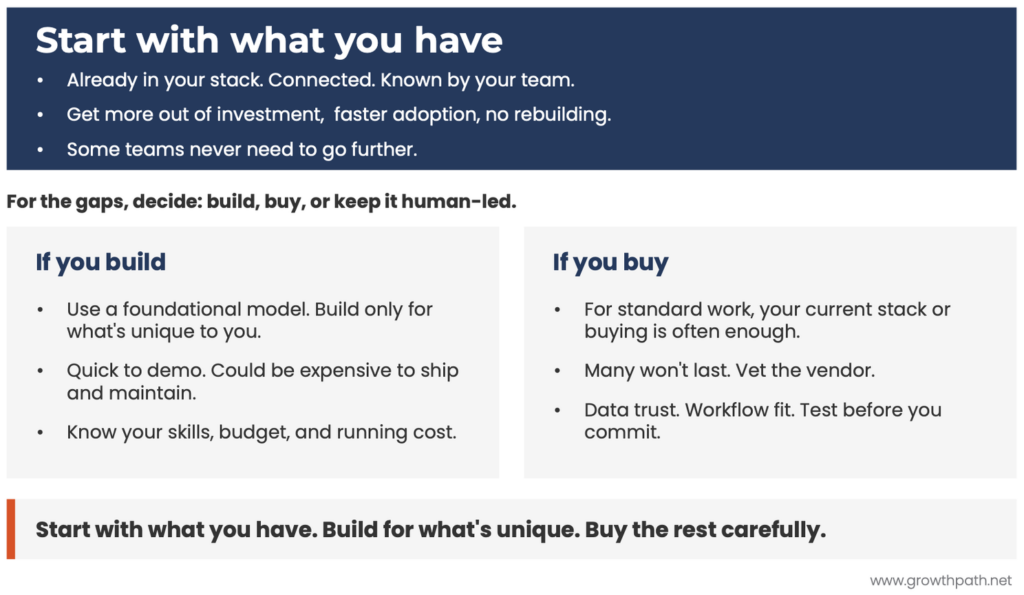
- Max out what you’re already paying for. Sean’s team uses HubSpot, Salesforce, Clearbit, and Gong as core infrastructure before reaching for anything specialized. Most CRM, marketing automation, and analytics platforms already have AI built in. Your existing platforms are already connected to your data and known by your team. Getting full value from that investment is faster to adopt and often takes teams further than expected.
- For the gaps, decide: build, buy, or keep it human-led. Sean’s system uses Qualified, Vector, Clay, and AirOps. These solved specific problems his existing stack and AI platforms alone couldn’t.
If you’re evaluating a build: start with a platform like ChatGPT, Claude, Gemini, or Copilot. Cin7 uses ChatGPT for everything from research and analytics to strategy. Build only for what’s truly unique to how you work. The demo is quick. Shipping and maintaining it is the real cost. Know what it costs to run at scale.
If you’re evaluating a buy: vet the vendor carefully. Many of these tools won’t be around in 18 months. Look at data trust, workflow fit, and whether they can keep up. Do trials. Stay flexible.
And some decisions are best kept human-led for now.
Your stack will look different. It depends on your goals, team, skills, and budget. Know which decision you’re making before you make it. Sometimes the answer is what you already have. Sometimes it’s a specialized platform. Sometimes it’s custom. Sometimes it’s a person.
Note: This isn’t a vendor recommendation. It’s a look at what becomes possible when you design AI around customer needs instead of internal workflows.
The Bigger Point
Using AI well means more than using ChatGPT, Copilot, Gemini, or Claude. AI can be wired into your entire revenue system, but only if you design it that way.
Sean and his team aren’t doing old work faster. They’re doing work that wasn’t possible before: engaging every visitor in real-time, recovering demand that would have disappeared, learning from closed deals at scale, creating content informed by what actually resonates.
If we simply train AI to do old work faster, we unintentionally create a case for automating humans out. But when we use AI to reimagine work that wasn’t possible before, work that drives growth, humans become more essential.
Customers expect you to know who they are, meet them where they are, and pick up the conversation where it left off. In the AI era, company size matters less. The advantage goes to teams that learn how to listen, respond, and improve continuously.
The money follows when you earn trust. We now have the tools to do that better than ever.
Your Next Steps
Sean’s flywheel is one version of what’s possible. You don’t have to build all five stages to start seeing value.
- Where is demand leaking? Where do high-intent visitors go when they don’t convert? If you don’t know, that’s the first problem to solve.
- Are you building for growth or productivity? Are you using AI to reimagine work around customers, or only to do old work faster? The answer determines whether humans become more essential or more optional.
I’d love to hear what you’re building. Reply to this email or share on LinkedIn. The trailblazers in this community are figuring this out together, and what you learn helps others move forward.
Want practical AI insights like this delivered every two weeks? Subscribe to the Practical AI in Go-to-Market newsletter.
For applied learning: Our applied AI workshops offer both strategic sessions (use cases and roadmaps) and hands-on building (create AI teammates during the workshop). You’ll leave with either a clear plan or working solutions.
For team transformation: See real examples, a lean GTM team’s step-by-step playbook and a global cybersecurity leader scaling to 150+ marketers with 57 AI teammates integrated into daily workflows.
For speaking: Here are virtual and in-person events where I’ve covered a variety of AI topics. I’ve also keynoted at many organization and corporate-wide events.
Whether through the newsletter, multimedia content, or in-person events, I’d love to connect.