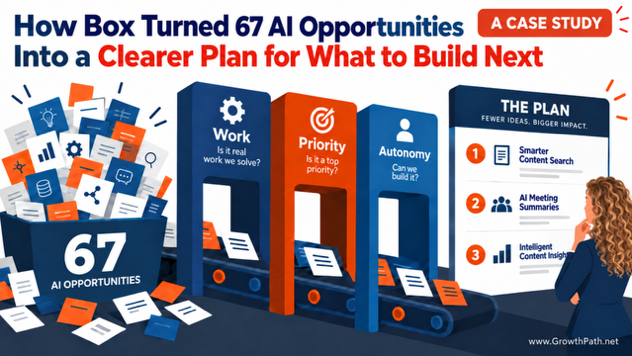
Sixty-seven AI opportunities is a good problem to have. But once the list gets that long, you need a way to decide what deserves attention first.
Box is the secure content layer supplying context to any AI agent, serving more than 120,000 paying customers. Its marketing organization already had real AI momentum. Teams were experimenting, and marketing had a growing set of agents.
Our discovery work with the marketing organization identified 67 possible AI use cases. Before we could prioritize them, we first had to understand how the work actually happened across people, processes, and systems.
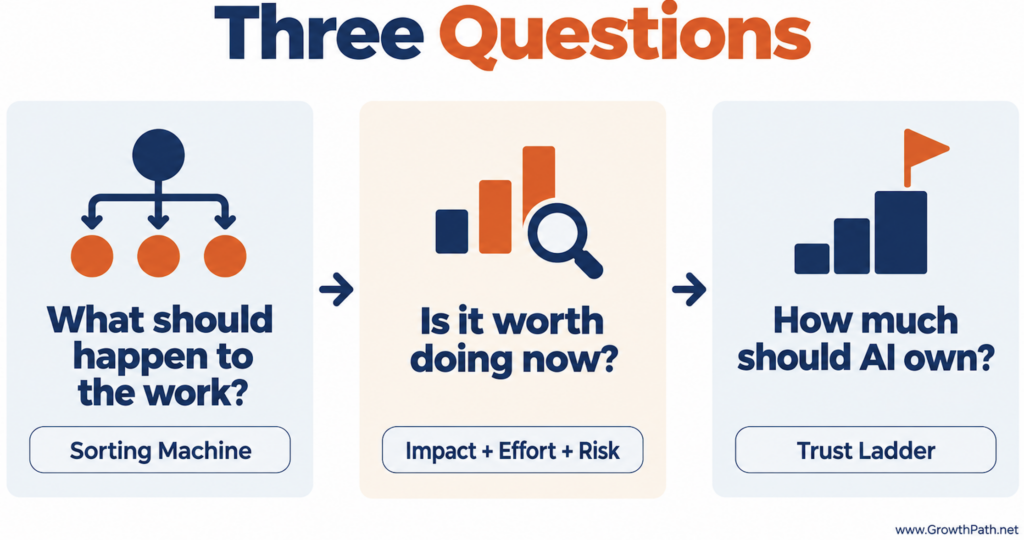
From there, we needed to make three decisions for each one: What should happen to the work? Is it worth pursuing now? And how much should AI own?
Those questions became the heart of the blueprint we built with Box.
Quick Take
The blueprint turned 67 possibilities into a sequenced plan the team could act on:
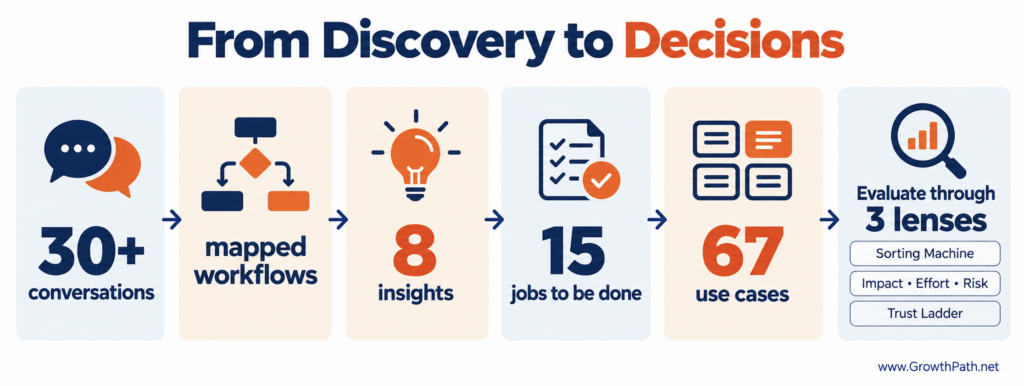
- More than 30 conversations across Marketing, SDR, Operations, and IT were translated into documented workflows, 8 core insights, 15 jobs to be done, and 67 possible AI use cases.
- The Sorting Machine process helped us decide what the work needed before choosing the technology.
- Impact, effort, and risk helped us decide what to do now and what dependencies to address first.
- The Trust Ladder helped us decide how much of each workflow AI should handle and where human judgment should stay involved.
- The resulting blueprint sequenced opportunities by maturity and dependencies. Box is now turning it into internal timelines, business cases, and project plans.
- Reimagine the work first, then the roles, then the org. Let the work tell you what needs to change before you redraw the org chart.
Watch or Listen Instead
To support different learning styles and time constraints, this newsletter will also be available as a 4-min cinematic AI video explainer and a 20-min AI podcast with two AI hosts. Both were made with Google’s Gemini Notebook and personally reviewed for accuracy and responsible AI use.
Map the Work as a System
My business partner, Megan Cabrera, led the day-to-day discovery and blueprint work with Box. She ran stakeholder interviews, mapped workflows, developed the AI blueprint, and drafted the recommendations. I provided strategic direction, developed the frameworks, guided prioritization, and reviewed the work as it evolved.
Megan spoke with more than 30 people across Marketing, SDR, Operations, and IT to understand how the work supporting marketing actually happened. How did a campaign move from idea to execution? Where were the handoffs? Which systems held the information? Who owned each step? Where did manual coordination slow things down?
The interviews were only the first step. Megan translated what we heard into documented workflows so we could see the work as a system. Marketing is creative and cross-functional, and much of that work isn’t always documented end to end. Mapping the workflows made the handoffs, dependencies, ownership, and opportunities for change visible.
From there, Megan identified 8 core insights and 15 jobs to be done, each tied to an outcome the team needed to achieve, then broke them into 67 specific AI use cases. For example, planning and launching a campaign might include AI use cases for drafting the brief, identifying audiences, or analyzing past performance.
That order was deliberate. The workflow gives you the context to decide whether the work should move faster, change, stop, or become something new before you decide where AI belongs.
For Tricia Gellman, CMO of Box, that systems view was a big part of the value:

“One of the most important parts of this work was translating what we heard in the interviews into actual workflows so we could assess the system. Once you can see how the work really happens, you can decide what to accelerate, what to change, and where AI can add value.”
That systems view gave us something concrete to take into the next step: evaluating the 67 opportunities.
Three Questions Helped Us Sort 67 Opportunities
Once the workflows were mapped and the 67 opportunities identified, we used three lenses, each answering a different question.
1. What should happen to the work?
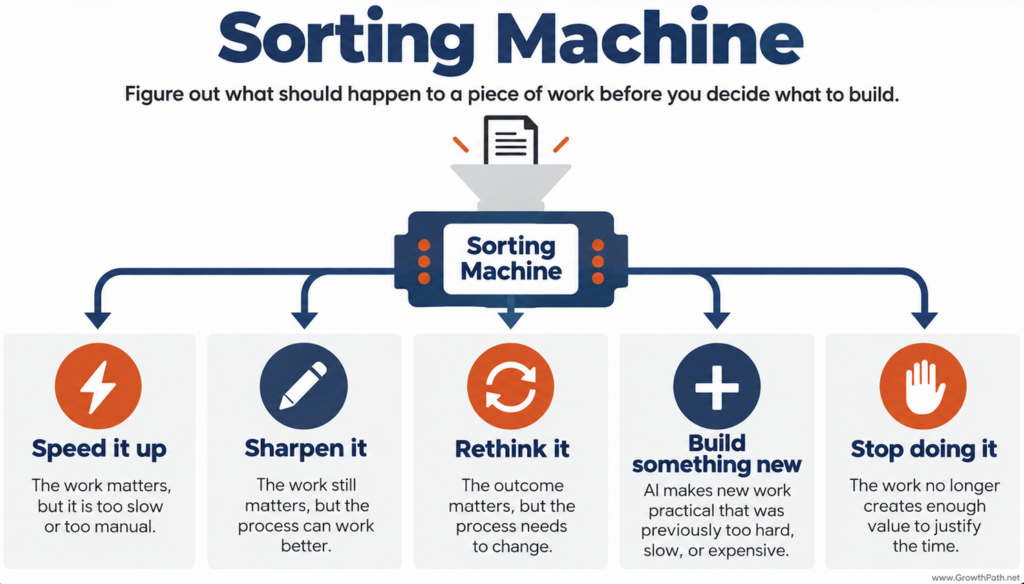
The first was the Sorting Machine, which asks what a workflow needs before deciding how AI should be used. Work can take one of five paths:
- Speed it up when the work is useful but takes too long or too much manual effort.
- Sharpen it when the outcome is right but the process can work better.
- Rethink it when the outcome is still useful but the process is not effective or not working.
- Build something new when AI makes work practical that was previously too hard, slow, or expensive with an all-human team.
- Stop doing it when the work no longer creates enough value to justify the time.
The point is to decide what the work needs before deciding what to build. I introduced the Sorting Machine and Trust Ladder in Think Before You Build: A Practical System for Human+AI Teams. That newsletter goes deeper on both frameworks. The Box engagement gave us a chance to apply them across a much broader set of work.
I’m especially interested in the concept of “Build something new” because AI removes constraints that influenced how we designed work in the first place. That can mean reading every sales call, continually refreshing competitive intelligence, tailoring insights to each account, or running scenarios before a decision. Work like this was often not done because it was too slow, difficult, or expensive with people alone.
I went deeper on those opportunities in 5 Reimagined Workflows: Work We Skipped That AI Now Does.
2. Is It Worth Doing Now?
The Sorting Machine tells you what kind of change the work needs, but not whether to pursue it now. So we evaluated each opportunity across impact, effort, and risk:
- Impact – potential business benefit, including breadth, efficiency, revenue, and quality.
- Effort – readiness of the tools, data, and process; the systems that need to connect; and the functions that need to be involved.
- Risk – sensitivity of the information and output, exposure if something goes wrong, and how much autonomy AI would have.
Megan used AI to work through the volume while making the final call:

“With 67 use cases, AI helped us get through the volume, but I never let the scoring stand on its own. I asked it to justify every rating, checked those ratings against what we heard in discovery, and changed them when they didn’t hold up. AI made the analysis faster. The context still came from the people doing the work.”
A strong AI idea can still move later in the sequence. The data may need work, ownership may need to become clearer, or the process may need to change before AI is added.
The visual below shows a representative example of an impact, effort, and risk matrix. It is not Box’s actual matrix, use cases, or scores.
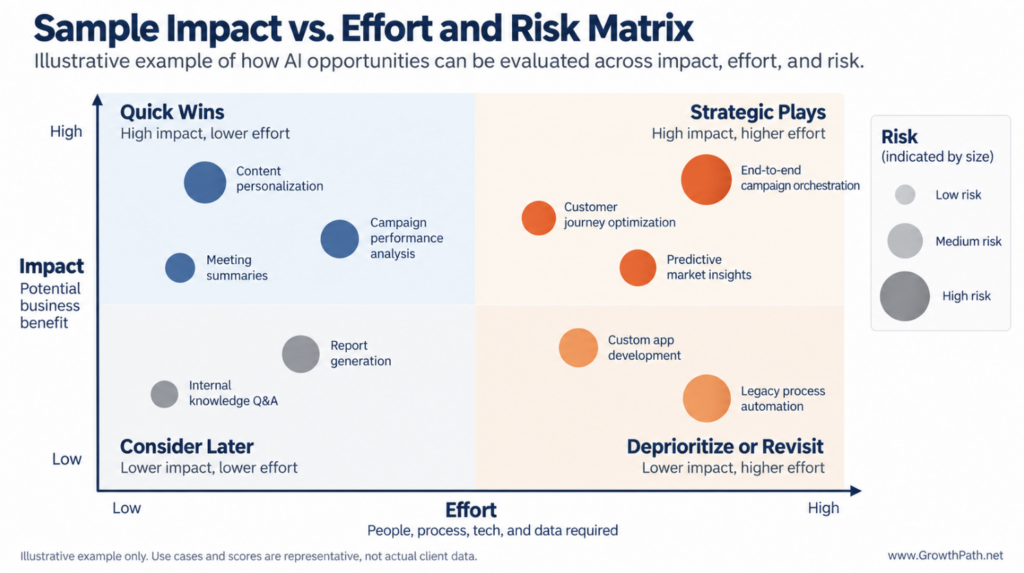
That helped us sequence 67 possibilities into a roadmap instead of treating them as 67 separate projects.
3. How Much of the Work Should AI Own?
The third lens was the Trust Ladder, which helps determine how much autonomy AI should have in a workflow. That depends on the work, the risk of a bad output, the quality of the inputs and instructions, and how easily a person can catch an error.
There are four levels:
- A person leads and AI assists. The person makes the decisions while AI helps with suggestions, drafts, or analysis.
- AI creates the first output and a person reviews it. Nothing gets used until a person has checked it.
- AI runs the workflow and a person spot-checks it. The work is proven enough that every output no longer needs review, but a person still owns quality.
- AI operates autonomously. This is reserved for well-proven, low-risk work where routine human review is no longer needed.
The Box blueprint combined the Sorting Machine, impact, effort, and risk, and the Trust Ladder into one way to evaluate each opportunity.
The same AI platform can operate at different levels depending on the job. It might help a marketer think through positioning at Level 1, create drafts for review at Level 2, and handle a proven, low-risk workflow with much more independence elsewhere.
The Trust Ladder treats autonomy as a decision about the work rather than a feature of the tool.
The Roadmap Came After Those Decisions
Once we worked through the opportunities, the harder dependencies became clearer:
- Data needed to be better connected.
- Ownership needed to be clearer.
- Some workflows needed to change.
- Teams depended on shared systems and knowledge.
Those dependencies drove the roadmap, from foundational projects to data and workflow improvements to individual agents, orchestration across agents, and new ways of working.
An agent inherits the environment you give it. Inconsistent information produces inconsistent output. Unclear ownership stays unclear. And if the workflow itself needs to change, automating it can make the wrong process faster. Some of the most useful AI work happens before anyone builds the AI.
The Human Work Changes Too
Changing a workflow can also change who does the work, who owns decisions, where expertise is needed, and which handoffs disappear. People may need new skills. Leaders may need to redraw ownership. Teams may need shared definitions and outcomes. And someone still has to decide where human judgment adds the most value and where AI can take on more responsibility.
That’s why I believe we should reimagine the work first, then the roles, then the org. I wouldn’t start by redrawing the org chart. The work tells you which roles need to change and what the organization needs to support.
Box’s roadmap included enablement, training, governance, and evolving roles alongside the technology and workflow work.
For me, this is People First. AI Forward. in practice: every AI decision gets a people lens while we keep pushing toward work that wasn’t practical before.
I wrote more about that in AI Is Making the Human Side of Work Harder to Avoid. As AI removes some of the technical constraints around work, people still have to work through trust, ownership, incentives, roles, and decision rights.
Now Box Is Putting the Blueprint Into Action
The final blueprint gave Box a sequenced set of use cases and the dependencies behind them. Box is now building internal timelines, business cases, and project plans around those choices.
The team has a clearer way to decide what to pursue, what needs to happen first, and how much AI should own.
If Your AI Opportunity List Is Getting Long
A growing list of AI ideas can be a good sign. The harder part is deciding what deserves attention now.
Before you turn that list into a roadmap, ask:
- What should happen to the work?
- Is it worth doing now?
- How much should AI own?
Those three questions helped us turn 67 possibilities into a plan Box could act on.
The Practical AI in Go-to-Market newsletter shares learnings and insights in using AI responsibly. Subscribe today and let’s learn together on this AI journey.
For applied learning: Explore our applied AI workshops, offering both strategic sessions to shift mindsets through practical AI uses and hands-on sessions to build human+AI workflows. You’ll leave with either a clear plan or working solutions. Office hours provide follow-on support to keep momentum going.
For ongoing advisory: I work with leaders as a strategic advisor through their AI transformation, providing guidance, frameworks, and a sounding board as they build. If that’s what you need, let’s talk.
For team transformation: I partner with GTM leaders to move from scattered AI adoption to an operating model where human and AI teammates work together across workflows.
For speaking: Here are virtual and in-person events where I’ve covered a variety of AI topics. I’ve also keynoted at many conferences and corporate events.
If any of this resonated, I’d love to hear from you. Reply to this email, find me on LinkedIn, or come say hi at an event.