• Skip to primary navigation
  • Skip to main content
GrowthPath Partners LLC

GrowthPath Partners LLC

Empowering Purpose-Driven Growth

  • Engagements
  • Speaking
  • Newsletters
  • About
  • Contact
  • Show Search
Hide Search

marketing operations

How Box Turned 67 AI Opportunities Into a Clearer Plan for What to Build Next

Liza Adams · October 1, 2026 ·

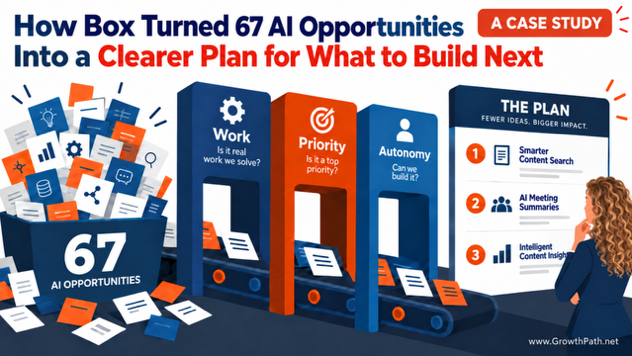
How Box turned 67 AI opportunities into a clearer plan for what to build next, case study graphic

Sixty-seven AI opportunities is a good problem to have. But once the list gets that long, you need a way to decide what deserves attention first.

Box is the secure content layer supplying context to any AI agent, serving more than 120,000 paying customers. Its marketing organization already had real AI momentum. Teams were experimenting, and marketing had a growing set of agents.

Our discovery work with the marketing organization identified 67 possible AI use cases. Before we could prioritize them, we first had to understand how the work actually happened across people, processes, and systems.

From there, we needed to make three decisions for each one: What should happen to the work? Is it worth pursuing now? And how much should AI own?

Those questions became the heart of the blueprint we built with Box.

Quick Take

The blueprint turned 67 possibilities into a sequenced plan the team could act on:

  • More than 30 conversations across Marketing, SDR, Operations, and IT were translated into documented workflows, 8 core insights, 15 jobs to be done, and 67 possible AI use cases.
  • The Sorting Machine process helped us decide what the work needed before choosing the technology.
  • Impact, effort, and risk helped us decide what to do now and what dependencies to address first.
  • The Trust Ladder helped us decide how much of each workflow AI should handle and where human judgment should stay involved.
  • The resulting blueprint sequenced opportunities by maturity and dependencies. Box is now turning it into internal timelines, business cases, and project plans.
  • Reimagine the work first, then the roles, then the org. Let the work tell you what needs to change before you redraw the org chart.
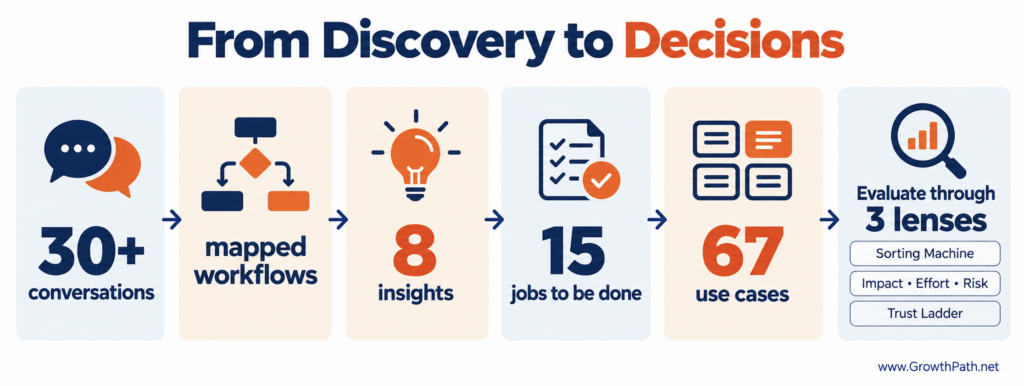
From discovery to decisions: 30+ conversations, mapped workflows, 8 insights, 15 jobs to be done, 67 use cases, 3 lenses

Watch or Listen Instead

To support different learning styles and time constraints, this newsletter will also be available as a 4-min cinematic AI video explainer and a 20-min AI podcast with two AI hosts. Both were made with Google’s Gemini Notebook and personally reviewed for accuracy and responsible AI use.

Map the Work as a System

My business partner, Megan Cabrera, led the day-to-day discovery and blueprint work with Box. She ran stakeholder interviews, mapped workflows, developed the AI blueprint, and drafted the recommendations. I provided strategic direction, developed the frameworks, guided prioritization, and reviewed the work as it evolved.

Megan spoke with more than 30 people across Marketing, SDR, Operations, and IT to understand how the work supporting marketing actually happened. How did a campaign move from idea to execution? Where were the handoffs? Which systems held the information? Who owned each step? Where did manual coordination slow things down?

The interviews were only the first step. Megan translated what we heard into documented workflows so we could see the work as a system. Marketing is creative and cross-functional, and much of that work isn’t always documented end to end. Mapping the workflows made the handoffs, dependencies, ownership, and opportunities for change visible.

From there, Megan identified 8 core insights and 15 jobs to be done, each tied to an outcome the team needed to achieve, then broke them into 67 specific AI use cases. For example, planning and launching a campaign might include AI use cases for drafting the brief, identifying audiences, or analyzing past performance.

That order was deliberate. The workflow gives you the context to decide whether the work should move faster, change, stop, or become something new before you decide where AI belongs.

For Tricia Gellman, CMO of Box, that systems view was a big part of the value:

Headshot of Tricia Gellman, CMO of Box
Tricia Gellman, CMO of Box

“One of the most important parts of this work was translating what we heard in the interviews into actual workflows so we could assess the system. Once you can see how the work really happens, you can decide what to accelerate, what to change, and where AI can add value.”

That systems view gave us something concrete to take into the next step: evaluating the 67 opportunities.

Three Questions Helped Us Sort 67 Opportunities

Once the workflows were mapped and the 67 opportunities identified, we used three lenses, each answering a different question.

1. What should happen to the work?

The first was the Sorting Machine, which asks what a workflow needs before deciding how AI should be used. Work can take one of five paths:

  • Speed it up when the work is useful but takes too long or too much manual effort.
  • Sharpen it when the outcome is right but the process can work better.
  • Rethink it when the outcome is still useful but the process is not effective or not working.
  • Build something new when AI makes work practical that was previously too hard, slow, or expensive with an all-human team.
  • Stop doing it when the work no longer creates enough value to justify the time.

The point is to decide what the work needs before deciding what to build. I introduced the Sorting Machine and Trust Ladder in Think Before You Build: A Practical System for Human+AI Teams. That newsletter goes deeper on both frameworks. The Box engagement gave us a chance to apply them across a much broader set of work.
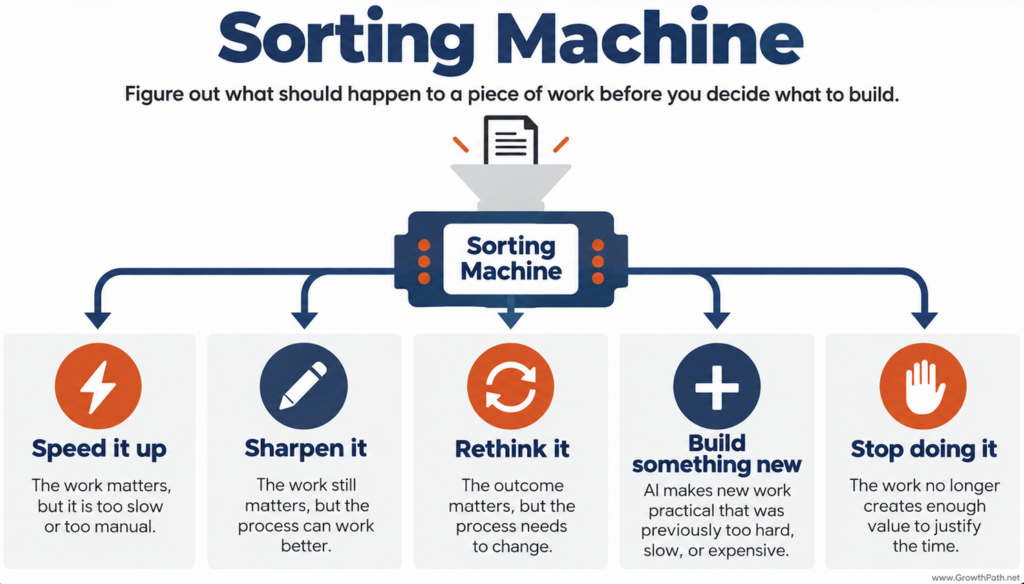
The Sorting Machine: speed it up, sharpen it, rethink it, build something new, or stop doing it

I’m especially interested in the concept of “Build something new” because AI removes constraints that influenced how we designed work in the first place. That can mean reading every sales call, continually refreshing competitive intelligence, tailoring insights to each account, or running scenarios before a decision. Work like this was often not done because it was too slow, difficult, or expensive with people alone.

I went deeper on those opportunities in 5 Reimagined Workflows: Work We Skipped That AI Now Does.

2. Is It Worth Doing Now?

The Sorting Machine tells you what kind of change the work needs, but not whether to pursue it now. So we evaluated each opportunity across impact, effort, and risk:

  • Impact – potential business benefit, including breadth, efficiency, revenue, and quality.
  • Effort – readiness of the tools, data, and process; the systems that need to connect; and the functions that need to be involved.
  • Risk – sensitivity of the information and output, exposure if something goes wrong, and how much autonomy AI would have.

Megan used AI to work through the volume while making the final call:

Headshot of Megan Cabrera, GTM Strategy and Operations Advisor
Megan Cabrera, GTM Strategy and Operations Advisor, Revenue Engine Labs

“With 67 use cases, AI helped us get through the volume, but I never let the scoring stand on its own. I asked it to justify every rating, checked those ratings against what we heard in discovery, and changed them when they didn’t hold up. AI made the analysis faster. The context still came from the people doing the work.”

A strong AI idea can still move later in the sequence. The data may need work, ownership may need to become clearer, or the process may need to change before AI is added.

The visual below shows a representative example of an impact, effort, and risk matrix. It is not Box’s actual matrix, use cases, or scores.
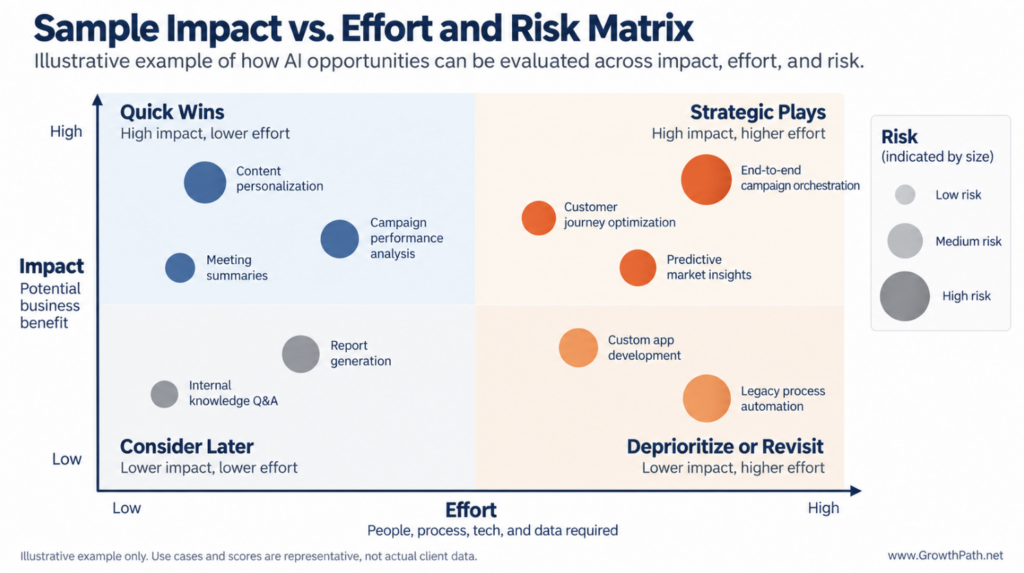
Sample impact vs. effort and risk matrix for AI opportunities

That helped us sequence 67 possibilities into a roadmap instead of treating them as 67 separate projects.

3. How Much of the Work Should AI Own?

The third lens was the Trust Ladder, which helps determine how much autonomy AI should have in a workflow. That depends on the work, the risk of a bad output, the quality of the inputs and instructions, and how easily a person can catch an error.

There are four levels:

  1. A person leads and AI assists. The person makes the decisions while AI helps with suggestions, drafts, or analysis.
  2. AI creates the first output and a person reviews it. Nothing gets used until a person has checked it.
  3. AI runs the workflow and a person spot-checks it. The work is proven enough that every output no longer needs review, but a person still owns quality.
  4. AI operates autonomously. This is reserved for well-proven, low-risk work where routine human review is no longer needed.

The Box blueprint combined the Sorting Machine, impact, effort, and risk, and the Trust Ladder into one way to evaluate each opportunity.

The same AI platform can operate at different levels depending on the job. It might help a marketer think through positioning at Level 1, create drafts for review at Level 2, and handle a proven, low-risk workflow with much more independence elsewhere.

The Trust Ladder treats autonomy as a decision about the work rather than a feature of the tool.
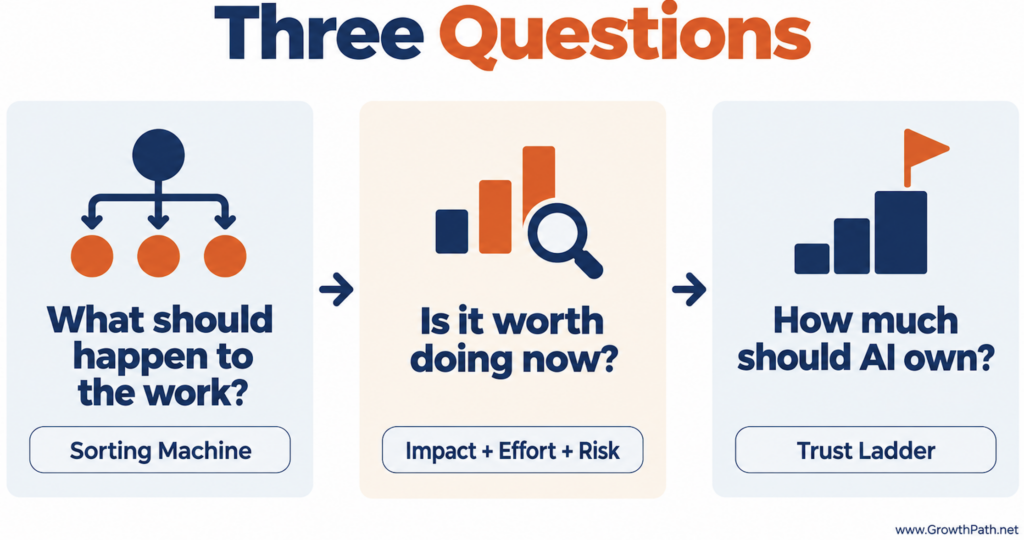
Three questions: what should happen to the work, is it worth doing now, and how much should AI own

The Roadmap Came After Those Decisions

Once we worked through the opportunities, the harder dependencies became clearer:

  • Data needed to be better connected.
  • Ownership needed to be clearer.
  • Some workflows needed to change.
  • Teams depended on shared systems and knowledge.

Those dependencies drove the roadmap, from foundational projects to data and workflow improvements to individual agents, orchestration across agents, and new ways of working.

An agent inherits the environment you give it. Inconsistent information produces inconsistent output. Unclear ownership stays unclear. And if the workflow itself needs to change, automating it can make the wrong process faster. Some of the most useful AI work happens before anyone builds the AI.

The Human Work Changes Too

Changing a workflow can also change who does the work, who owns decisions, where expertise is needed, and which handoffs disappear. People may need new skills. Leaders may need to redraw ownership. Teams may need shared definitions and outcomes. And someone still has to decide where human judgment adds the most value and where AI can take on more responsibility.

That’s why I believe we should reimagine the work first, then the roles, then the org. I wouldn’t start by redrawing the org chart. The work tells you which roles need to change and what the organization needs to support.

Box’s roadmap included enablement, training, governance, and evolving roles alongside the technology and workflow work.

For me, this is People First. AI Forward. in practice: every AI decision gets a people lens while we keep pushing toward work that wasn’t practical before.

I wrote more about that in AI Is Making the Human Side of Work Harder to Avoid. As AI removes some of the technical constraints around work, people still have to work through trust, ownership, incentives, roles, and decision rights.

Now Box Is Putting the Blueprint Into Action

The final blueprint gave Box a sequenced set of use cases and the dependencies behind them. Box is now building internal timelines, business cases, and project plans around those choices.

The team has a clearer way to decide what to pursue, what needs to happen first, and how much AI should own.

If Your AI Opportunity List Is Getting Long

A growing list of AI ideas can be a good sign. The harder part is deciding what deserves attention now.

Before you turn that list into a roadmap, ask:

  • What should happen to the work?
  • Is it worth doing now?
  • How much should AI own?

Those three questions helped us turn 67 possibilities into a plan Box could act on.


The Practical AI in Go-to-Market newsletter shares learnings and insights in using AI responsibly. Subscribe today and let’s learn together on this AI journey.

For applied learning: Explore our applied AI workshops, offering both strategic sessions to shift mindsets through practical AI uses and hands-on sessions to build human+AI workflows. You’ll leave with either a clear plan or working solutions. Office hours provide follow-on support to keep momentum going.

For ongoing advisory: I work with leaders as a strategic advisor through their AI transformation, providing guidance, frameworks, and a sounding board as they build. If that’s what you need, let’s talk.

For team transformation: I partner with GTM leaders to move from scattered AI adoption to an operating model where human and AI teammates work together across workflows.

For speaking: Here are virtual and in-person events where I’ve covered a variety of AI topics. I’ve also keynoted at many conferences and corporate events.

If any of this resonated, I’d love to hear from you. Reply to this email, find me on LinkedIn, or come say hi at an event.
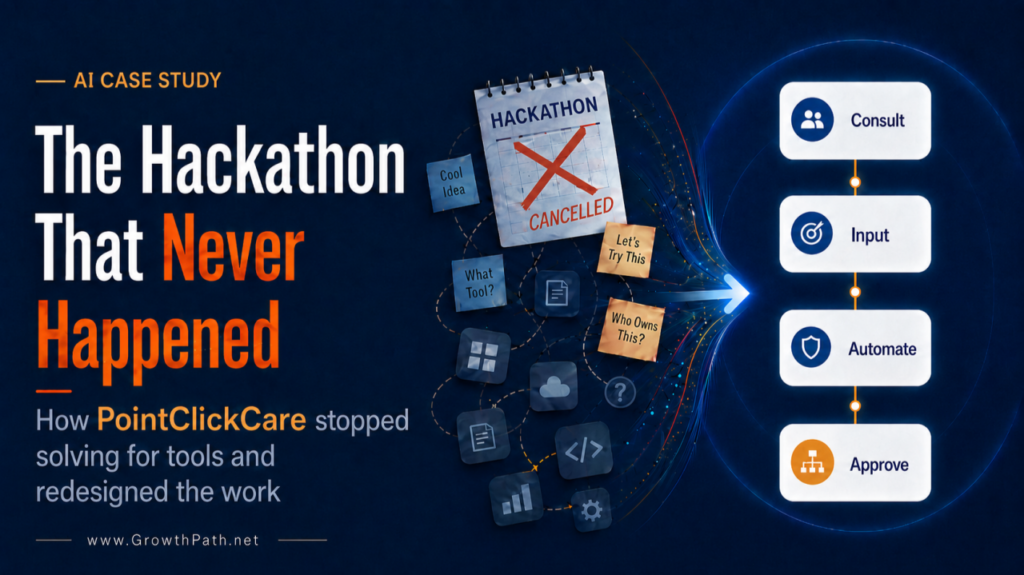
The Hackathon That Never Happened: How PointClickCare Stopped Solving for Tools and Redesigned the Work

Liza Adams · August 6, 2026 ·

The Hackathon That Never Happened: how PointClickCare stopped solving for tools and redesigned the work

The hackathon we planned with PointClickCare’s marketing team never happened.

We had the format, the workflows, and people ready to build. Then AI got more agentic, and the platform questions came up. Which tool would the company standardize on? Which connectors would security enable? What would meet legal guidelines? The hackathon slipped, then slipped again, and we let it go.

A hackathon, the way I run one, is a multi-week build window that ends in a showcase day, where the team sees what’s been built and works out what’s worth keeping. It’s the turning point, where a team stops building in pockets and starts building together.

I’m opening with the failure on purpose. You’ve read AI transformation stories that run in a straight line from kickoff to results. This one didn’t, and the zigs and zags are where the learnings are.

PointClickCare, a leading health tech company supporting over 30,000 provider organizations and every major U.S. health plan, is now running one of the most thoughtful marketing redesigns I’ve seen. They got there through stalled plans, platform changes, and governance debates, and they kept going anyway.

The context is what makes this one worth studying: healthcare data, three AI platforms in play, a skill that everyone in the company now uses with customers, and IT, security, legal, and finance involved from the start.

Renée Gapen, CMO of PointClickCare, agreed to share the good, the bad, and the messy version of the story. Her reason was simple: nobody is an expert at this yet. Her team got further because other companies were open about what worked and what didn’t, and she wants to do the same for the next team.

Quick Take

Just starting gets you further than waiting for the perfect plan. Every detour this team took taught them something they used in the next step.

  • Asset development went from months to weeks, sometimes days. Specialists no longer create every asset. They started building the systems that produce them, encoding brand rules, templates, and product context into skills, which are instructions that tell AI how the company does a specific kind of work. The business owner gets a first draft in minutes, and nothing goes out until a specialist approves it.
  • Marketing built a skill about 2,000 people across the company now use. A redesign that started in one function now changes what customers see, so PointClickCare shows up as one company rather than several.
  • A governance question answered the platform question, and it wasn’t the question the team started with. Security went from the checkpoint that slowed things down to the group that helped test and deploy the first company-wide skill.
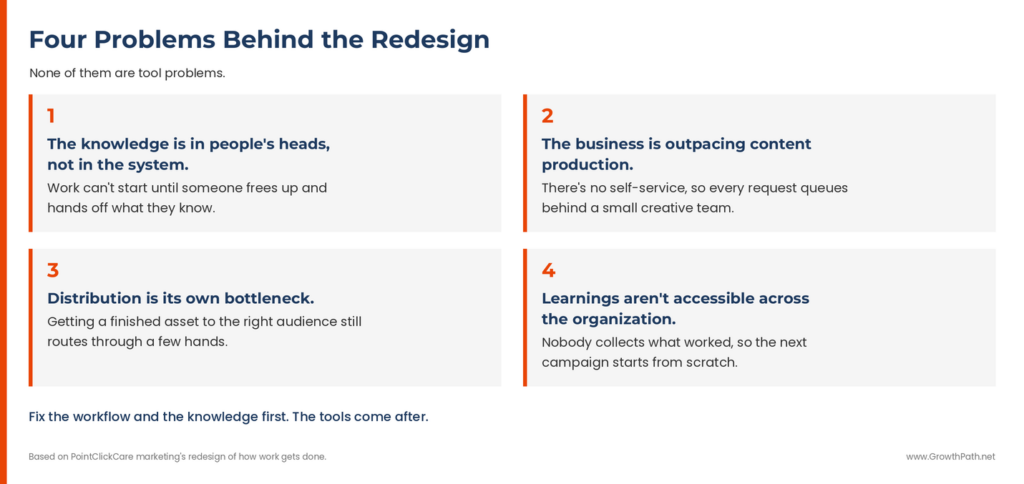
  • The four problems driving the redesign have nothing to do with tools. They are about where knowledge lives, how fast work happens, who touches it along the way, and what the team learns from what it launches.
  • Before FY27 planning, the team pulled five people out of their day jobs for 90 days to redesign the workflows first. Roles and org design follow the work, and I’d argue that’s the right order.

Watch or Listen Instead

To cater to different learning styles and time constraints, this newsletter is also available as a 4-min cinematic AI video explainer and a 16-min AI podcast with two AI hosts. Both were made with Google’s Gemini Notebook and personally reviewed for accuracy and responsible AI use.

Where They Started

When we began working together in late 2025, PointClickCare’s marketing organization of about 80 people was already using generative AI in real ways. Roughly 60% of marketing content was already being accelerated by AI-assisted first drafts. The energy was there. How work got from one person to the next was the problem.

Work ran on briefs and handoffs. A business owner who understood the product, the customer, and the market wrote a brief, handed it to a specialist, waited, reviewed, revised, and waited again. Each handoff added delay and interpretation risk. The people closest to the problem weren’t generating the output. And the business was speeding up, especially around new product launches, faster than the process could keep up.

This is the marketing model many of us grew up in, built for a world where production capacity was the constraint. That constraint changed.

Our engagement ran over several months: an in-person leadership and strategy workshop, virtual sessions for the full marketing organization, function-specific hands-on workshops, and a technical session for the ops and builder group with my automation business partner Justin Parnell. Weekly office hours and syncs with the internal program champion kept it going.

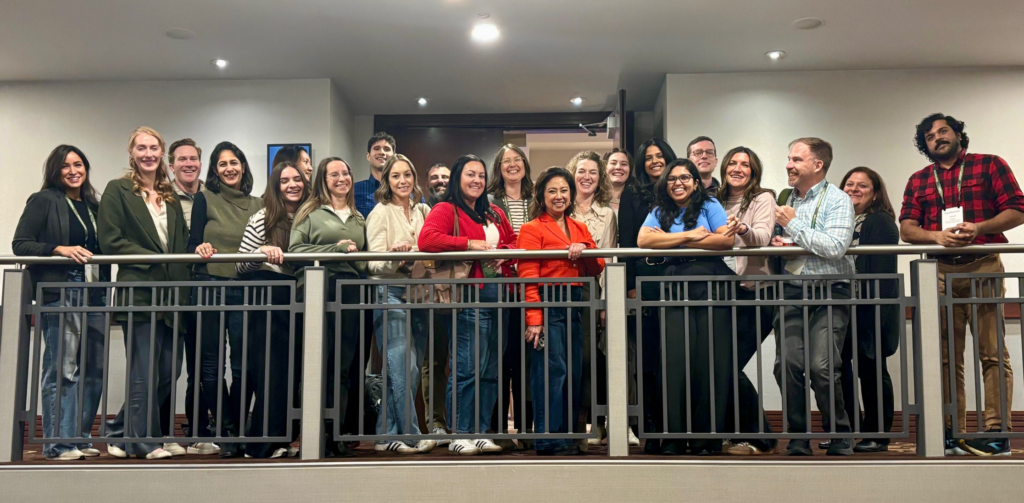
PointClickCare marketing leaders and AI trailblazers at a workshop in Niagara Falls
PointClickCare marketing leaders and AI trailblazers at our workshop in Niagara Falls. As Renée put it, ironically our first step away from decades-old waterfall processes.

The Messy Middle

This is the part that doesn’t usually get covered in case studies.

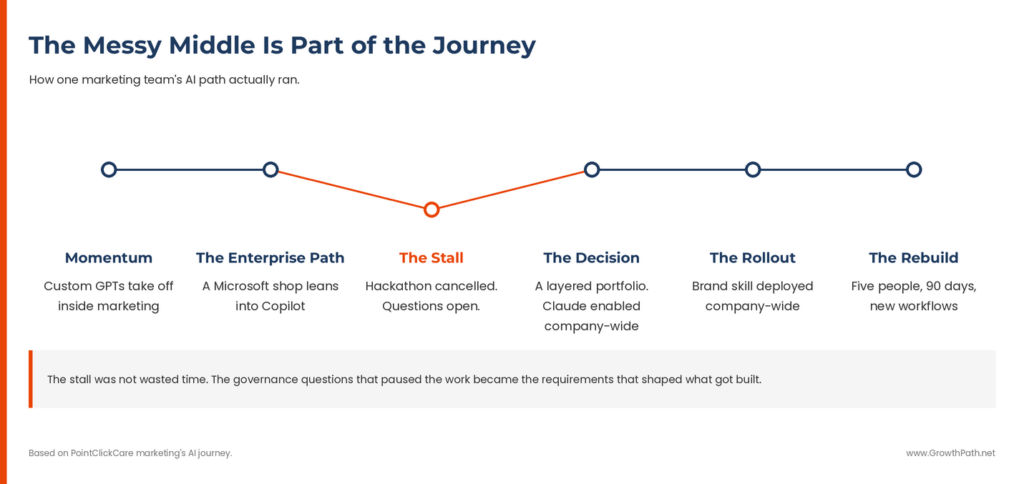
The messy middle: timeline of one marketing team's AI path from momentum to rebuild

The team’s early momentum ran on ChatGPT and custom GPTs. People liked them, built with them, and learned fast what good looked like. But that adoption stayed inside marketing.

PointClickCare runs on Microsoft. Teams, SharePoint, the tools everyone lives in all day. So Copilot was the natural enterprise path, and the company leaned in. The timing was the hard part. The agentic capabilities marketing wanted were early across the whole category in that window, and the security reviews for connectors and access were still being worked out. Those reviews were doing their job. This is healthcare, and the guardrails exist for good reasons.

That’s when the hackathon died. It wasn’t lack of interest. It was honest uncertainty about which platform to build on and what the rules would be.

The hypothesis going in was that everyone should be building, and what they found refined it. Plenty of work is self-contained, and the person closest to it should start. But workflows that need connectors, system access, and coordination with IT, legal, and finance require technical depth and alignment work that sits outside a marketer’s day job. More of their work turned out to be that second kind than the plan assumed.

Headshot of Renée Gapen, CMO of PointClickCare
Renée Gapen, CMO of PointClickCare.

“We tried to be overly efficient out of the gate. We tried to find the perfect platform first, with everyone building, and it stalled us. What moved us forward was being honest about where we were: experimenting in silos, with thin governance and rising expectations, especially as AI-enabled innovation halved product development cycle time. Once we understood that, we could design the operating model we actually needed.”

When Security Became a Partner

Here is my favorite part of this story. The same governance questions that contributed to stalling the hackathon ended up answering the platform question.

When the team looked at where their first company-wide skill should live, one they would build, test, and govern centrally, the deciding question became governance: which platform lets us push a skill to everyone, manage it centrally, and keep quality and compliance in one place. Working with their security team, they found their answer. Their IT organization then enabled Claude across the company, which gave marketing the technical orchestration that had been out of reach when the journey started.

The answer was a layered portfolio, with each tool doing the job it does best.

  • Microsoft 365 is the foundation, running the collaboration and productivity backbone the whole company works in, with Copilot woven into those tools.
  • Claude became the home for marketing’s centrally governed skills and agentic workflows, with more of their systems connected to it every couple of weeks.
  • ChatGPT gets credit too, because it’s where the team learned what they wanted AI to do in the first place.

The brand skill itself tells you how the relationship with security grew. Marketing built it with brand guidelines, sample assets, and rounds of human testing with the teams that live in presentations every day. Security helped test and deploy it, and the skill now works as a brand governance layer, so work starts on brand instead of getting fixed after the fact.

None of this is theoretical in healthcare. Every skill launched to the entire company has to hold up under the same scrutiny the product does.

Read that again. Security went from one of the reasons plans stalled to the group that helped get the first skill into everyone’s hands. When you treat governance requirements as part of the design, the people who own those requirements build with you instead of reviewing your work at the end.

Willow Terry, VP of Market, Competitor and Customer Insights, led this work, coordinating across marketing leaders and partner teams.

Headshot of Willow Terry, VP of Market, Competitor and Customer Insights at PointClickCare
Willow Terry, VP of Market, Competitor and Customer Insights at PointClickCare.

“What felt like a stall was actually a turning point. The pause gave us the opportunity to bring together marketing leaders, each with a deep understanding of their function’s workflows and pain points, alongside experts from IT, Security, Legal, and Finance.

Together, we shifted from experimenting with AI tools to designing the capabilities, governance, and ways of working needed to scale AI across the company.”

About 2,000 people across PointClickCare now use a skill that marketing built. Whatever an employee puts in front of a provider or a health plan starts on brand, so PointClickCare shows up to the market as one company rather than several.

Reimagine the Workflows First

The people closest to the work kept bringing up the same underlying problems, whatever function they sat in. So instead of starting with tools, the team stepped back and redesigned the work itself. They pulled five people out of their day jobs for 90 days to rethink how marketing operated and find the root causes limiting speed, scale, and effectiveness.

Ninety days of five people is what it took at their scale. Yours might be different. What counts is that the time is protected, because transformation doesn’t happen on the hamster wheel. That sprint is where the four-stage workflow, the skill-building playbook, and the hub-and-spoke operating model came from.

Here are the four problems they were solving.

Four problems behind the redesign, none of them tool problems

Notice that none of these are tool problems. They are workflow and knowledge problems, which is why a tool-first approach kept stalling.

Nobody at PointClickCare was collecting what worked, because an all-human team could only do so much and that work got skipped for years. Still hard, or just historically hard? For this one, the reason is gone. Check out 5 Reimagined Workflows: Work We Skipped That AI Now Does to learn more.

Dena Stewart, one of the marketing team’s 90-day orchestrators, put it this way: “The big move was about how do we move from experimenting as individuals to performing as a team.”

What They’re Building

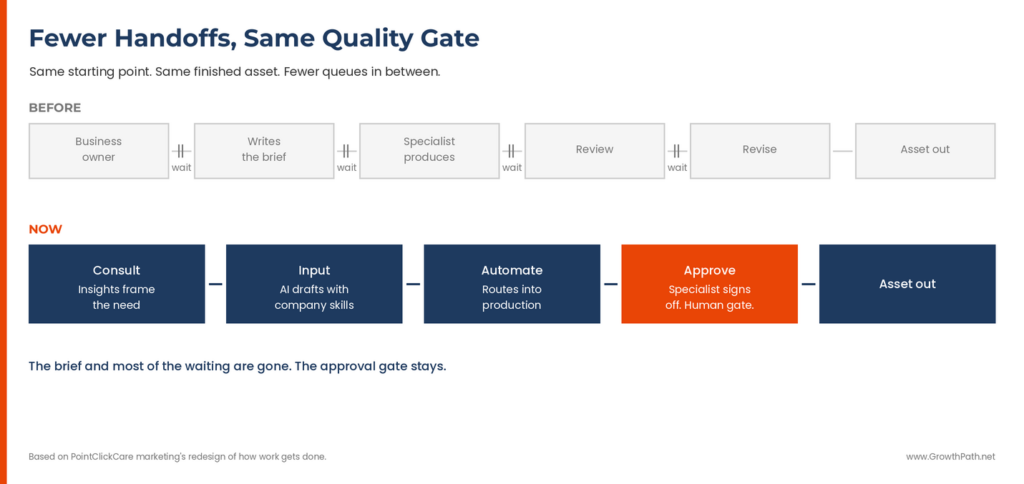
The business owner still says what they need. What changed is who answers. Specialists encoded the brand rules, the templates, and the product context into skills, so AI produces the first draft in minutes and the specialist reviews it instead of building it from nothing. The brief didn’t disappear either. It gets produced automatically, downstream, at the point the work enters production.

Fewer handoffs, same quality gate: the old asset workflow vs. the new one

The draft routes into production through Adobe Workfront’s AI briefing assistant, which fills in the project details, so the work is ready for execution. Humans still approve. Functional experts check the work instead of producing it, and quality is still their call.

The specialists’ work changed. They own the skills now, test them, and keep them current, and knowledge that used to live in their heads is written down where everyone can use it.

Cameron Ingrum, Director of Product Marketing at PointClickCare, is on the business owner side of that change.

Headshot of Cameron Ingrum, Director of Product Marketing at PointClickCare
Cameron Ingrum, Director of Product Marketing at PointClickCare.

“We used to measure asset development in months. Now it’s weeks, sometimes days. That didn’t come from the tool. It came from two things working together: the context we gave Claude about how we position and who we’re selling to, and the templates and brand rules our creative team encoded for each type of asset.

Together they get a product marketing manager to a v1 that’s 80% complete before a creative project even starts. Our designers spend their time at the top of their license now, refining instead of producing from scratch.”

What They Built to Keep It Going

Two other things came out of this work, and both are built to keep running after the 90 days end.

A playbook for building skills

Every skill goes through the same process. It takes longer than turning on a tool, and that’s the point.

  • Define the job the skill is doing.
  • Gather the source of truth: the actual brand guide, the real templates, the examples the team would point to as gold standard.
  • Encode all of it into instructions the AI can follow.
  • Run three structured QA rounds where the AI generates real artifacts and employees pick them apart, first for structure, then for edge cases, then for polish.
  • Hand it to the teams who own the work to run on their real projects. Creative and Brand stress-tested the PowerPoint skill. Content put the copy guide through its paces.
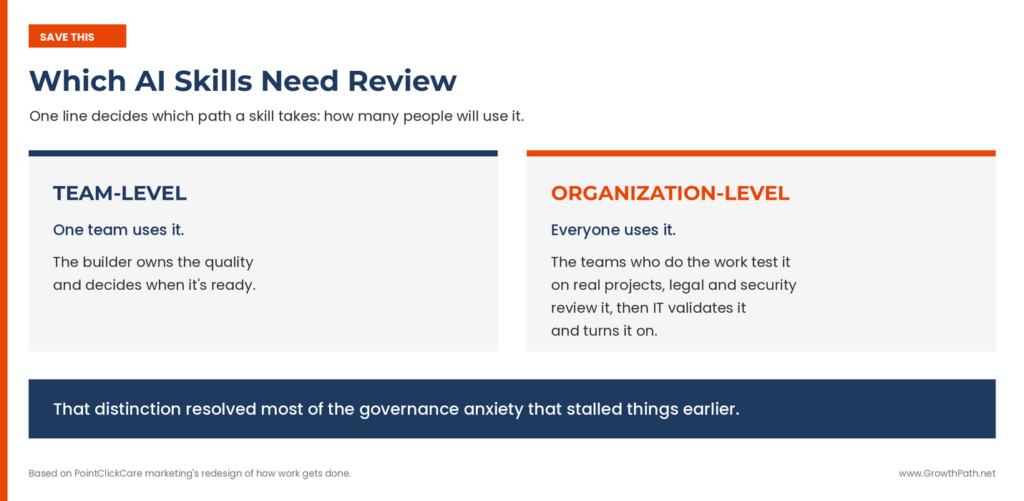
  • Only after those teams sign off, and legal and security have had their look, does IT validate the finished package and turn it on for the whole company.

Not every skill goes through all of that. One thing decides which ones do: how many people will use it.

Which AI skills need review: team-level vs. organization-level skills

An org design decision

The team looked at the three ways to organize AI in marketing: one central team that builds everything, every function building on its own, or a hub and spoke mix. They were already decentralized informally, which in healthcare is exactly the tool sprawl and compliance risk you’d worry about. They’re going to hub and spoke.

They landed on some version of democratized building with centralized enablement, which is where the lesson from the stall ended up. Their version puts the playbook, the quality gates, and the relationship with IT in the hub, while each function builds on that foundation and owns its outputs. How the pieces get divided will keep changing, and the part worth borrowing is the decision itself: the hub owns the system and the standard, and deliberately does not own every build.

Early Indications

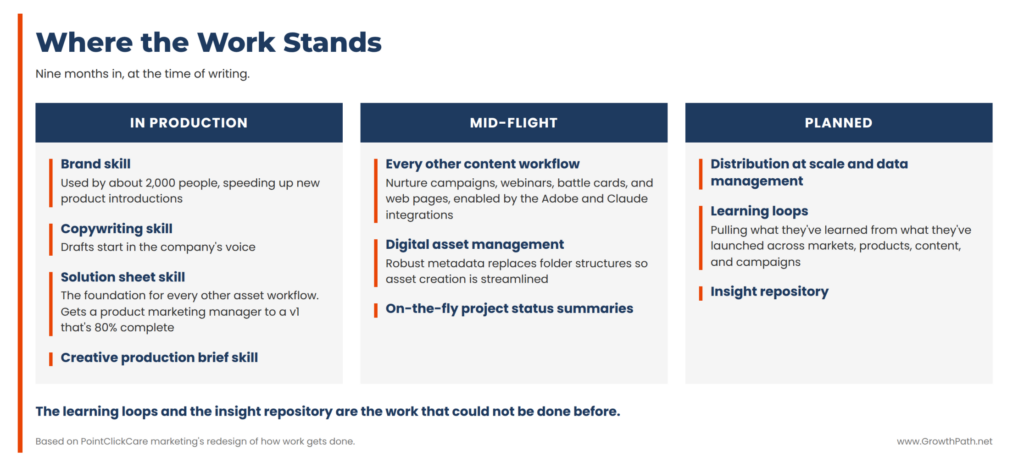
The brand skill is in production across the organization, and it’s speeding up the new product introduction workflows. That skill was about brand consistency, and it was also about proving that a governed skill could be built, reviewed, and released across the business.

They haven’t re-measured the 60%. What changed in nine months is who produces the first draft and how many hands it passes through.

Most of what’s in production today is the same work happening faster, and faster is the floor. The work that couldn’t be done before, the learning loops and the insight repository, is next. That’s an honest place to be nine months in, and it’s the part I’d watch, because innovation is where the growth comes from.

Think big, start small, move fast. Proving one skill company-wide is what makes the next set faster to build.

Where the work stands: skills in production, mid-flight and planned

As Jake Campbell, PMP, another of the marketing team’s 90-day orchestrators, says, “It’s not a build once and you’re done. We’re going to learn as we go.”

What to Take From This

Reimagine the work first, and the roles, the governance, and the org design follow. Three things from this team’s journey apply, whatever your industry.

  • When a platform decision stalls you, the platform usually isn’t the problem. Look at the workflow and knowledge problems underneath it. Bring security, IT, legal, and finance in early and treat their requirements as part of the design. The team that slows you down at the gate can become the team that builds with you.
  • Build the shared context before you scale the outputs. If the brand, audience, and product knowledge are in people’s heads, AI makes the handoff problem worse. If it sits in files your tools can reach, the handoff goes away.
  • Start before you’re sure. This team brought in new platforms, cancelled a hackathon, and rebuilt their approach more than once. Every detour informed the next decision.

Each of those three is a reframe in practice. If you want the full set, I covered the eight reframes that change how GTM teams see AI in a recent issue.

Where to Start

Pick one workflow where a brief changes hands. For PointClickCare it was the new product introduction. Map where the knowledge for that work actually resides, whether that’s in someone’s head, in scattered documents, or somewhere your AI tools can reach. That map tells you what to build first.


The Practical AI in Go-to-Market newsletter shares learnings and insights in using AI responsibly. Subscribe today and let’s learn together on this AI journey.

For applied learning: Explore our applied AI workshops, offering both strategic sessions to shift mindsets through practical AI uses and hands-on sessions to build human+AI workflows. You’ll leave with either a clear plan or working solutions. Office hours provide follow-on support to keep momentum going.

For ongoing advisory: I work with leaders as a strategic advisor through their AI transformation, providing guidance, frameworks, and a sounding board as they build. If that’s what you need, let’s talk.

For team transformation: I partner with GTM leaders to move from scattered AI adoption to an operating model where human and AI teammates work together across workflows. See real examples: a lean GTM team’s step-by-step playbook and a global cybersecurity leader scaling to 150+ marketers with 57 AI teammates integrated into daily workflows.

For speaking: Here are virtual and in-person events where I’ve covered a variety of AI topics. I’ve also keynoted at many conferences and corporate events.

If any of this resonated, I’d love to hear from you. Reply to this email, find me on LinkedIn, or come say hi at an event.
80% Meeting Rates, 3x Reply Rates: A Real-Life AI Growth Engine Built Around the Customer

Liza Adams · February 5, 2026 ·

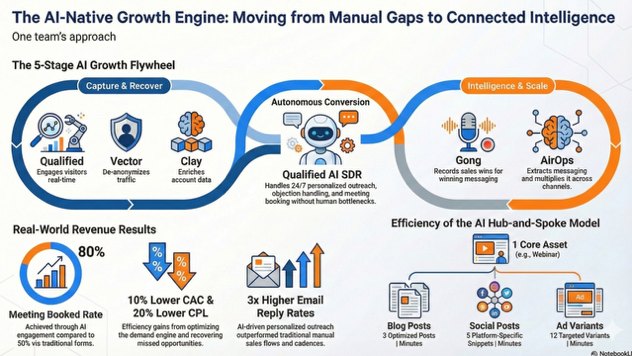
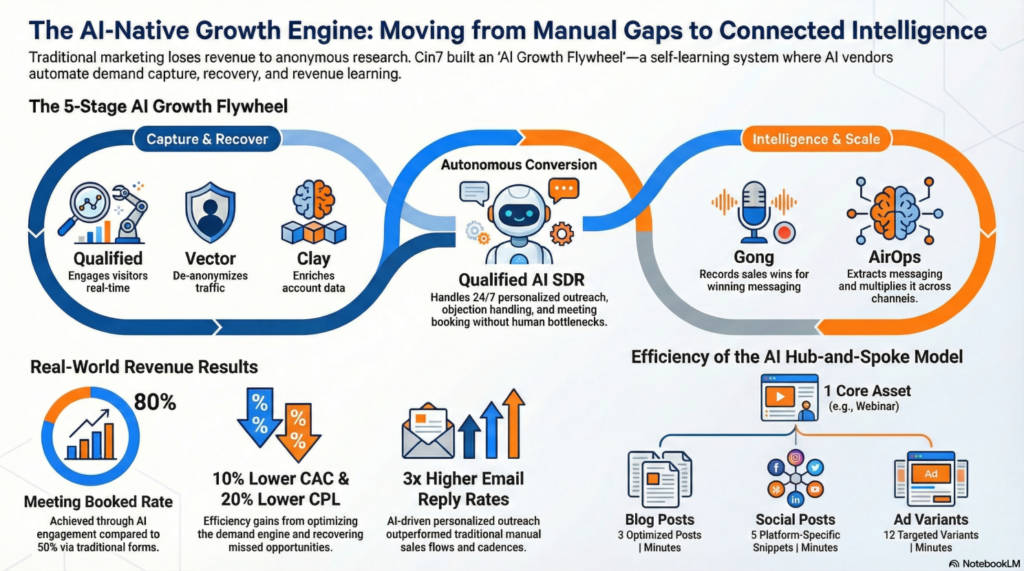
AI-native growth engine infographic: the five-stage AI growth flywheel and revenue results
Inspired by Sean McCaffrey, Sr. Dir of Strategy & Operations at Cin7

Around 98% of your website visitors leave without taking action. If that many people walked into a physical store, looked at products, checked out price tags, and walked out, you’d fix it tomorrow. Sean McCaffrey at Cin7 decided to fix it online. He built a five-stage AI growth engine designed around how customers actually buy, not around internal workflows. Today, Sean and his team are seeing 80% meeting booking rates, 3x higher email replies, 10% lower acquisition costs, and more human conversations.

Quick Take

This newsletter features how one strategic marketing operations leader built a connected AI system that captures demand in the moment, recovers interest that would otherwise disappear, learns from what closes deals, and feeds those insights back into every customer touchpoint.

Key takeaways:

  • AI creates growth when it’s wired into your revenue system around customer needs, not bolted on as isolated tools to do old work faster.
  • The right tech stack depends on your situation. This story shows what’s possible, not what to copy.
  • If we simply train AI to do old work faster, we unintentionally create a case for automating humans out. But when we use AI to reimagine work that wasn’t possible before, work that drives growth, humans become more essential. AI handles the repetitive work so humans can have better conversations.

AI Video Explainer and AI Podcast Versions of This Newsletter

To support different learning styles, this newsletter is available as an 8-min AI video explainer and a 15-min AI podcast with two AI hosts. If you haven’t seen these AIs in action, they’re worth a view. The tech is advancing in amazing ways. I used Google’s NotebookLM to create these and personally reviewed them for accuracy and responsible AI use.

The Shift

Your buyers are researching in communities, asking peers, and using ChatGPT, Gemini, Perplexity, and Google AI Mode to evaluate vendors before they ever reach your site. They avoid forms. They expect relevant responses the moment they do engage, and if you don’t deliver, they leave without telling you why.

Sean and his team decided to build around the customer instead.

One Team’s Response

Cin7 is an inventory management company serving product sellers. Sean McCaffrey, Senior Director of Marketing Strategy and Operations, joined three and a half years ago. I worked with the team early in their AI journey in 2024 and have watched them build this over time.

His starting point wasn’t “what AI tools should we buy?” It was “how do we actually meet customers where they are?”

The answer became what Sean calls an AI-native growth engine. It captures demand when buyers are paying attention, recovers the ones who leave before converting, learns from what actually closes deals, and feeds those insights back into every customer touchpoint.

The flywheel has five stages. Each one exists because of a specific customer behavior. Sean and his team didn’t build all five at once. They started with one, proved value, then expanded. You can do the same.

AI-Native Growth Engine video explainer thumbnail

Stage 1: Engage in the Moment

Buyers don’t fill out forms like they used to, but they do respond when something feels relevant.

Sean’s team uses Qualified, an AI SDR that talks to website visitors in real-time. More on the specific tools later. This story is about the approach, not a vendor recommendation. It pulls firmographic data through a Clearbit integration, knows what pages they’ve seen, and adapts the conversation based on industry.

A visitor from a food and beverage company doesn’t get a generic “How can I help you?” They get asked about expiration date tracking and inventory spoilage. The conversation starts with their likely problem, not a blank slate.

Of visitors who engage and meet their criteria, 80% book meetings compared to 50% through traditional forms.

The AI isn’t replacing human conversations. It’s making sure qualified buyers actually get to a human instead of bouncing.

Headshot of Sean McCaffrey, Senior Director of Marketing Strategy & Operations at Cin7
Sean McCaffrey, Senior Director of Marketing Strategy & Operations

“Before, reps spent 30 minutes asking ‘what do you guys do?’ Now they walk in with full context.”

Stage 2: Recover What Would Otherwise Disappear

Most of those visitors aren’t gone forever. Sean’s team built a way to find them. Vector identifies who visited from the US. Clay adds context and confirms they’re a good fit. Together, they flag the people who looked seriously but didn’t reach out.

These aren’t cold prospects. They’re people who showed interest and match the profile. They just weren’t ready yet.

Stage 3: Re-engage with Context

The follow-up isn’t generic. Those contacts flow back into Qualified, which sends emails on behalf of the human SDRs. The emails are informed by what the system knows: which pages they visited, what their company does, what problems they’re likely facing.

Sean’s team draws a clear line here: lead with helpfulness, not stalking. The email doesn’t say “I saw you on our pricing page.” It offers a point of view on a problem worth solving. That’s the line between creepy and valuable.

The AI handles the repetitive work. Humans step in for the conversations worth having.

Reply rates are 3x higher than before.

Stage 4: Learn from What Closes

Closed-won calls recorded in Gong feed into AirOps, where the team extracts what actually worked: objections that came up, language buyers used, triggers that created urgency, competitive positioning that won.

The team uses those insights to update ad copy, landing pages, email sequences, and the AI SDR’s conversation flows. When “fear of stockouts during peak season” keeps showing up in winning deals, the team puts that same language into ads and outreach. The system learns from every win.

Stage 5: Multiply Without Burnout

Producing one piece of content and moving on leaves value on the table.

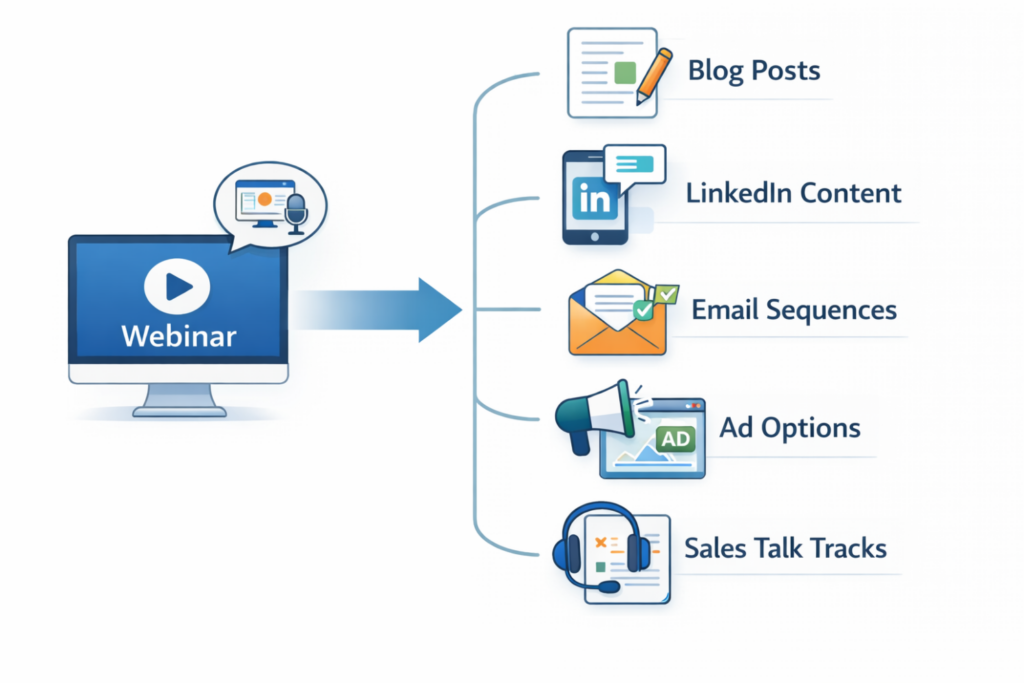
The team built a hub-and-spoke workflow in AirOps. One webinar becomes blog posts, LinkedIn content, email sequences, ad options, and sales talk tracks. A human reviews and approves the outline before full generation. Brand guidelines keep everything on voice.

The content is grounded in themes and pain points the team knows resonate because they’ve heard them in customer conversations.

Hub-and-spoke workflow turning one webinar into blog posts, LinkedIn content, emails, ads and sales talk tracks

What It Actually Took

This didn’t happen overnight.

  • Foundation first – The first year was making sure HubSpot and Salesforce were properly integrated and data was clean. You can’t build AI systems on messy data. Nobody wants to hear that, but skipping it breaks everything that comes after.
  • Content Cleanup – The AI SDR gave wrong answers in the first month. Sean traced it back to outdated help center content. The AI was doing its job. The content was the problem. They spent 30-45 days reading chat transcripts and cleaning up the knowledge base before expanding.
  • Controlled testing – Every tool ran in a sandbox before going live. Sean and his team earned leadership trust by bringing results, not just ideas. He added his CRO to the Slack channel showing real-time visitor alerts. Within a week, the CRO was on board.

Enterprise teams will face longer timelines with additional compliance, security, and procurement reviews. The principles still apply. Start with foundation and controlled testing, then expand.

The Results

Year over year, the team saw 10% lower customer acquisition cost, 20% lower cost per lead, 80% meeting rates through the AI SDR versus 50% through forms, and 3x higher reply rates.

The numbers tell part of the story. Here’s what changed day to day in the reps’ work according to Sean:

“They know the prospect’s business, their pain points, what content they engaged with. Discovery calls actually discover something. The AI handles repetitive admin work and analysis so humans can have better conversations.”

Before You Build Your Version

Sean’s specific tools solved his specific problems. Yours will differ. The underlying principles hold across industries, even when the tools don’t.

What I’ve seen across the teams I advise:

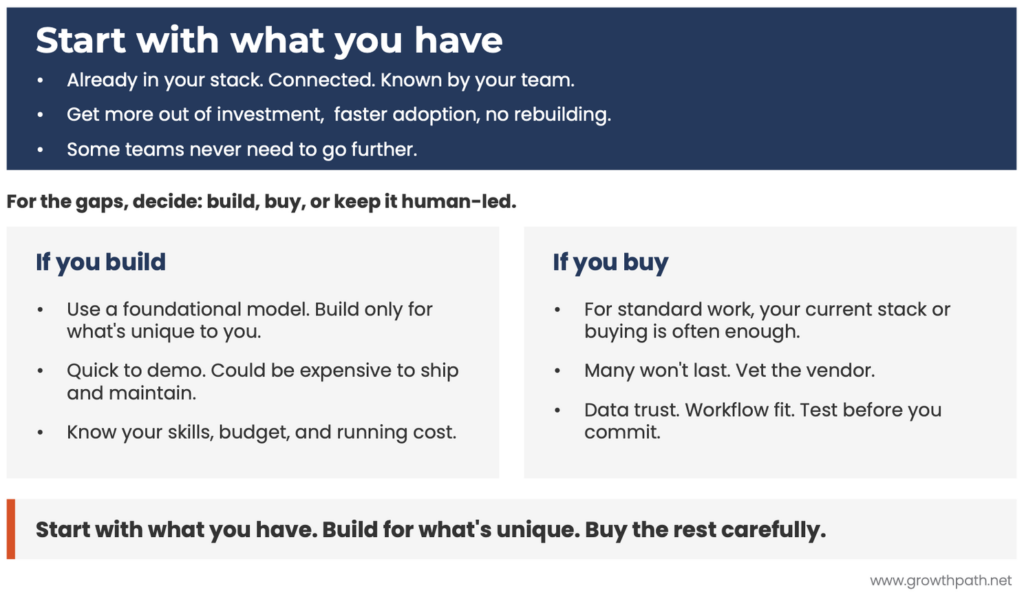
  1. Max out what you’re already paying for. Sean’s team uses HubSpot, Salesforce, Clearbit, and Gong as core infrastructure before reaching for anything specialized. Most CRM, marketing automation, and analytics platforms already have AI built in. Your existing platforms are already connected to your data and known by your team. Getting full value from that investment is faster to adopt and often takes teams further than expected.
  2. For the gaps, decide: build, buy, or keep it human-led. Sean’s system uses Qualified, Vector, Clay, and AirOps. These solved specific problems his existing stack and AI platforms alone couldn’t.

If you’re evaluating a build: start with a platform like ChatGPT, Claude, Gemini, or Copilot. Cin7 uses ChatGPT for everything from research and analytics to strategy. Build only for what’s truly unique to how you work. The demo is quick. Shipping and maintaining it is the real cost. Know what it costs to run at scale.

If you’re evaluating a buy: vet the vendor carefully. Many of these tools won’t be around in 18 months. Look at data trust, workflow fit, and whether they can keep up. Do trials. Stay flexible.

And some decisions are best kept human-led for now.

Your stack will look different. It depends on your goals, team, skills, and budget. Know which decision you’re making before you make it. Sometimes the answer is what you already have. Sometimes it’s a specialized platform. Sometimes it’s custom. Sometimes it’s a person.

Note: This isn’t a vendor recommendation. It’s a look at what becomes possible when you design AI around customer needs instead of internal workflows.

Framework: start with what you have, then decide whether to build, buy or keep it human-led for the gaps

The Bigger Point

Using AI well means more than using ChatGPT, Copilot, Gemini, or Claude. AI can be wired into your entire revenue system, but only if you design it that way.

Sean and his team aren’t doing old work faster. They’re doing work that wasn’t possible before: engaging every visitor in real-time, recovering demand that would have disappeared, learning from closed deals at scale, creating content informed by what actually resonates.

If we simply train AI to do old work faster, we unintentionally create a case for automating humans out. But when we use AI to reimagine work that wasn’t possible before, work that drives growth, humans become more essential.

Customers expect you to know who they are, meet them where they are, and pick up the conversation where it left off. In the AI era, company size matters less. The advantage goes to teams that learn how to listen, respond, and improve continuously.

The money follows when you earn trust. We now have the tools to do that better than ever.

Your Next Steps

Sean’s flywheel is one version of what’s possible. You don’t have to build all five stages to start seeing value.

  1. Where is demand leaking? Where do high-intent visitors go when they don’t convert? If you don’t know, that’s the first problem to solve.
  2. Are you building for growth or productivity? Are you using AI to reimagine work around customers, or only to do old work faster? The answer determines whether humans become more essential or more optional.

I’d love to hear what you’re building. Reply to this email or share on LinkedIn. The trailblazers in this community are figuring this out together, and what you learn helps others move forward.


Want practical AI insights like this delivered every two weeks? Subscribe to the Practical AI in Go-to-Market newsletter.

For applied learning: Our applied AI workshops offer both strategic sessions (use cases and roadmaps) and hands-on building (create AI teammates during the workshop). You’ll leave with either a clear plan or working solutions.

For team transformation: See real examples, a lean GTM team’s step-by-step playbook and a global cybersecurity leader scaling to 150+ marketers with 57 AI teammates integrated into daily workflows.

For speaking: Here are virtual and in-person events where I’ve covered a variety of AI topics. I’ve also keynoted at many organization and corporate-wide events.

Whether through the newsletter, multimedia content, or in-person events, I’d love to connect.

Copyright © 2026 · GrowthPath Partners LLC · Log in

  • LinkedIn